Two Florida cities claim the Cuban sandwich. What’s the real story?

Daftar Isi
A Sandwich With Two Florida Homes and One Cuban Beginning
Healfromzero.com – In Florida, few foods inspire hometown loyalty quite like the Cuban sandwich. Miami and Tampa share several defining traits: warm weather, beaches, large Cuban communities and long connections to Caribbean culture. Yet the sandwich remains a particularly lively point of civic pride, with each city embracing it as part of its own culinary identity.
The argument is not simply about where to find the best pressed bread, roast pork or pickle balance. It is also about migration, labor, family traditions and the ways a dish changes when it travels. Tampa and Miami offer distinct versions, while the deeper history begins in Cuba.
Tampa’s Family Tradition
For Andrew Tambuzzo, the sandwich has always belonged to everyday life in Tampa. Tambuzzo, who has Cuban and Sicilian heritage and grew up in the city, runs The Boozy Pig, a craft butcher shop and café. Its menu includes a Cuban-style sandwich called a mixto, using the name associated with the sandwich’s earlier Cuban form.
“As far back as I can remember eating, I’ve been eating Cuban sandwiches in Tampa. They were always there at birthday parties, anniversary parties, funerals,” said Andrew Tambuzzo.
Tambuzzo connects Tampa’s claim to the city’s historic cigar industry, which drew Cuban migrants and helped establish enduring food traditions. He also points to Tampa’s Cuban bread as an important part of the local case. His family’s background in the Tampa food business gives the debate a personal dimension: for many residents, the sandwich is not a museum piece but familiar party food and a regular café order.
Tampa’s version is often distinguished by the inclusion of salami. That detail has become one of the clearest markers separating its sandwich from the one commonly served farther south in Miami.
Miami’s Culinary Identity
In Miami, the Cuban sandwich carries a similarly powerful sense of belonging. Michelle Bernstein, the James Beard Award-winning chef behind Café La Trova in Little Havana, was raised in Miami despite not being Cuban herself. Her early food memories include visits to a Cuban market and butcher shop across from her childhood home.
Her mother would leave her at the counter with a Cuban sandwich and a banana milkshake while she shopped. Bernstein describes the experience as a defining memory, one that shaped the way she understood food and community.
“Miami doesn’t just eat the Cuban sandwich, we claim it as ours. It’s an identity. You grow up here and the Cuban sandwich is in your blood the same way café con leche is,” said Michelle Bernstein.
Café La Trova sits along Calle Ocho in Little Havana, an area closely tied to Miami’s Cuban cultural life. In the city’s popular version, the bread is prized for a very thin, fragile crust that can become especially crisp when pressed. The contrast in bread texture, along with the absence of Tampa-style salami, helps explain why the same sandwich can feel like two different regional traditions.
The Mixto Before the Modern Cuban Sandwich
The sandwich’s story does not start in either Florida city. Bárbara C. Cruz, Andrew T. Huse and Jeff Houck trace its roots to Cuba in their book, The Cuban Sandwich: A History in Layers. Cruz, a Cuban-American professor at the University of South Florida in Tampa, is direct about the origin.
“The Cuban sandwich absolutely has its origins in Cuba,” said Bárbara Cruz.
Early Cuban versions resembled the Spanish bocadillo: bread paired with cheese and whichever protein was available. Over time, especially by the late 19th century, the sandwich developed into the mixto, a name meaning “mixed” in Spanish and signaling that more than one meat could be included.
That was a meaningful departure from the simpler single-meat sandwiches of the period. Cruz’s research found Havana bakery advertisements for mixtos in historic Cuban newspapers, offering evidence that the idea had become a recognizable part of the island’s food culture.
“From our research, we found that this idea of the mixto really was revolutionary. Up until that time, people would have a ham sandwich, or a pork sandwich, a pan con bistec (steak sandwich),” said Cruz.
The mixture was not originally governed by the rigid ingredient rules that now fuel Florida arguments. Jeff Houck explains that island versions were shaped by what people could obtain at the time. The Cuban sandwich, in that sense, was adaptable from the beginning.
“On the island, it literally was a mixture of whatever they had. There weren’t such strict rules or perceptions of what the sandwich should or shouldn’t have,” said Jeff Houck.
People in Cuba sometimes ate these sandwiches while riding through the evening in carriages, adding another glimpse of a food that was both practical and social. Its early history is not perfectly documented, and no single moment identifies when a Cuban-style mixto first appeared in the United States. Still, Cuba is the essential starting point for every later version.
Why the Debate Endures
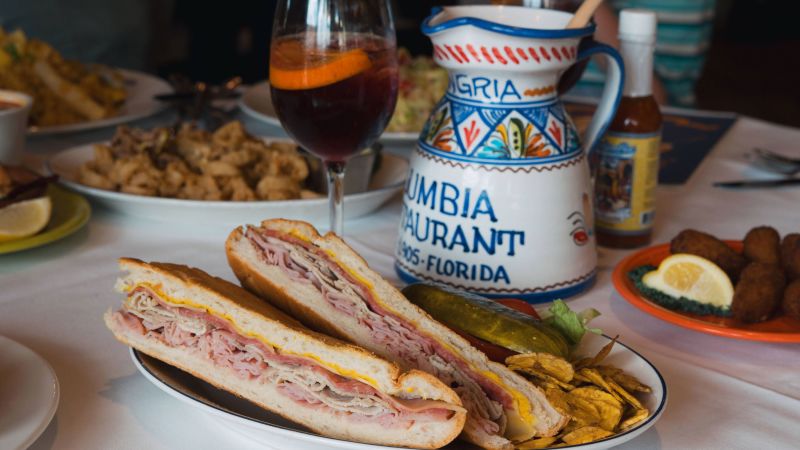
A well-made Cuban sandwich brings together toasted Cuban bread, ham, roast pork, Swiss cheese, mustard and pickles. When pressed properly, the exterior breaks with a sharp crunch while the fillings become warm and unified. The appeal lies in the combination: salty pork, sweet ham, tangy mustard, briny pickles and melted cheese contained in crisp bread.
That shared foundation leaves room for regional interpretation. Tampa’s salami and Miami’s notably delicate crust are not merely recipe variations; they reflect the different communities that adopted, protected and reshaped the sandwich after Cuban migration brought these food traditions to Florida.
So the question of ownership has no tidy one-city answer. Cuba supplied the original idea and the mixto tradition. Tampa developed a deeply rooted local style linked to its cigar-era immigrant history. Miami made the sandwich an unmistakable element of its own Cuban-American identity. The enduring rivalry is part of the dish’s appeal, because every pressed sandwich carries more than its ingredients: it carries the history of the people who made it theirs.
Related Reading
Frequently Asked Questions
What is Two Florida cities claim the Cuban?
Two Florida cities claim the Cuban is the main topic of this guide. The article explains the context, practical details, and next steps readers should understand.
Why does Two Florida cities claim the Cuban matter?
Two Florida cities claim the Cuban matters because readers are looking for a useful answer, not just a short summary. Good content should match search intent and help them decide what to do next.