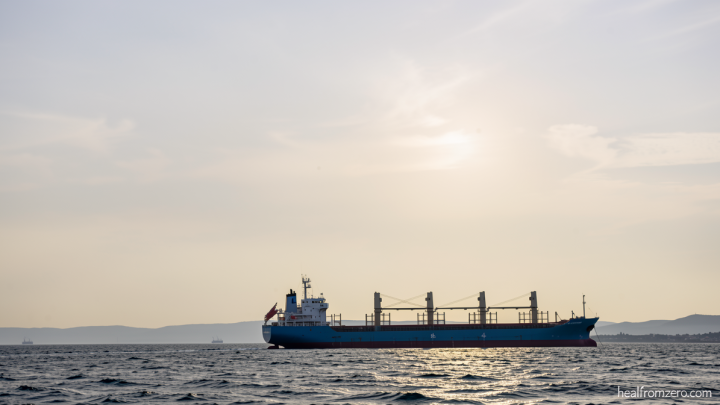
Iran reports commercial vessel struck in Strait of Hormuz

Daftar Isi
Fatal Vessel Strike Raises New Alarm in Strait of Hormuz
Healfromzero.com – A reported attack on an Iranian commercial ship near Qeshm Island has intensified concern over security in the Strait of Hormuz, where the conflict between the United States and Iran has already sharply reduced shipping through one of the world’s most important oil transit routes.
Iranian state media said the incident happened late Saturday and left one person dead and four others injured. The governor of Qeshm, cited by Iran’s state-run Islamic Republic News Agency, blamed what he called a “terrorist enemy.” No public claim of responsibility has emerged, and the United States had not commented on the incident.
The attack came shortly before planned talks involving Iran and Gulf Arab states over maritime traffic through the strait. Those discussions, scheduled for Monday in Oman, were later postponed. Omani Foreign Minister Badr Albusaidi said the delay was made “in the interests of consensus.” Bahrain had already said it would not attend.
Shipping route under severe strain
Qeshm Island sits close to Bandar Abbas, roughly 14 miles from the Iranian port city, and occupies a strategically significant position beside the waterway. The Strait of Hormuz links the Persian Gulf with the Gulf of Oman and is central to the movement of energy supplies from the region to international markets.
Before the war, roughly 20 million barrels of oil moved through Hormuz each day. Maritime traffic is now estimated to be about 90% below pre-conflict levels, underscoring how military pressure, blockades and repeated attacks have disrupted commercial navigation.
US forces have previously hit Iranian-flagged vessels while enforcing a blockade of Iranian ports. At the same time, American warships face renewed threats from Iranian ballistic missiles. Tehran has tied any meaningful reopening of the route to an end to the US blockade and what it describes as economic warfare.
“The waterway would be opened up on the condition that the US will terminate its blockade.”
Iranian President Masoud Pezeshkian made that statement in an interview with India Today TV on Saturday. Ebrahim Azizi, who leads the Iranian parliament’s national security committee, also argued that negotiations would have little value unless Washington accepted all of Tehran’s demands.
“As long as the American side does not accept all of Iran’s conditions, dialogue and negotiation are of no use.”
A senior Iranian official said the Oman discussions were intended to establish a basis for stronger regional security and safer maritime routes. But the official cautioned that an agreement would not automatically restore normal shipping through Hormuz.
“However, this agreement does not imply an automatic reopening of the Strait of Hormuz.”
“The strait will not become secure until the US fulfills its obligations and halts its naval blockade and economic warfare.”
Questions over multiple ship incidents
It remains unclear whether the Iranian vessel described near Qeshm was the same ship involved in a separate emergency involving Indian crew members off Oman’s coast.
India’s Ministry of External Affairs said Sunday that the Panamanian-flagged MT El Gaia had been attacked near Oman. Fourteen Indian nationals were among the crew. Ministry spokesperson Randhir Jaiswal said 13 had been rescued, while search-and-rescue efforts continued for one missing Indian crew member.
“Of the 14 Indian crew onboard, 13 Indians have been rescued so far.”
“Search and Rescue operations for the missing Indian national are continuing.”
Another ship was struck by an unidentified projectile in the strait late Saturday, the United Kingdom Maritime Trade Operations Centre said. A fire broke out on that vessel, and local authorities were assisting with the evacuation of crew. The center did not identify the ship’s flag state.
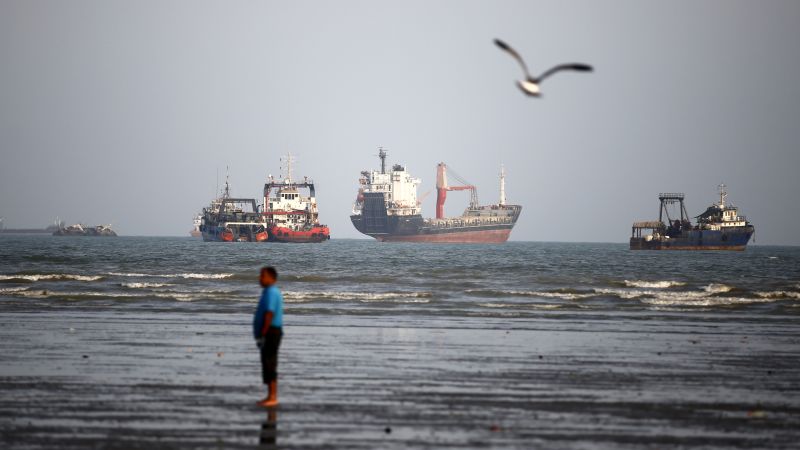
The sequence of incidents illustrates the danger confronting merchant vessels operating near Hormuz. Even when an attack does not close the passage formally, uncertainty over ship safety can discourage operators, delay cargo movements and increase the cost of transporting oil and other goods.
Regional tensions also rise near the Red Sea
The pressure on Hormuz is unfolding alongside a worsening conflict in Yemen. Iran-backed Houthi rebels have increased attacks against Yemen’s Saudi-backed government and pushed their influence toward a strategically important Red Sea route that connects Asia and Europe.
On Sunday, the Houthis claimed responsibility for an attack on a Saudi military base in the Sharurah region. Spokesperson Yahya Saree said the group used a “barrage of ballistic missiles and drones” against weapons depots and command-and-control facilities, though he did not specify when the operation occurred.
The group had said Saturday that Saudi forces carried out 129 airstrikes, reflecting the escalating confrontation on the ground. Control of territory close to major maritime corridors adds another layer of risk for commercial shipping and regional security.
The Strait of Hormuz and the Red Sea serve different routes, but disruption in either can affect global energy flows and trade. Hormuz is a principal outlet for Gulf oil exports, while Red Sea access supports shipping through the Suez Canal. Simultaneous instability around both waterways leaves cargo operators with fewer predictable options and heightens the risk of further market pressure.
For now, the proposed diplomatic track in Oman remains delayed, the circumstances of Saturday’s vessel strikes are unresolved, and ships operating in the region continue to face a rapidly changing security environment.
Related Reading
Frequently Asked Questions
What is Iran reports commercial vessel struck in Strait?
Iran reports commercial vessel struck in Strait is the main topic of this guide. The article explains the context, practical details, and next steps readers should understand.
Why does Iran reports commercial vessel struck in Strait matter?
Iran reports commercial vessel struck in Strait matters because readers are looking for a useful answer, not just a short summary. Good content should match search intent and help them decide what to do next.