Judge rules Trump administration order to fire FEMA staffers was illegal

Daftar Isi
Federal Judge Finds FEMA Staffing Reduction Order Unlawful
Healfromzero.com – A federal judge has ruled that the Trump administration acted unlawfully when it moved to sharply reduce staffing at the Federal Emergency Management Agency, delivering a major court victory to federal employee unions challenging the plan.
US District Judge Susan Illston, who sits in Northern California, said Friday that the Department of Homeland Security acted without adequate justification when it stripped FEMA of the ability to renew contracts for many of its on-call disaster workers. Those employees are part of FEMA’s Cadre of On-Call Response and Recovery program, widely known as CORE.
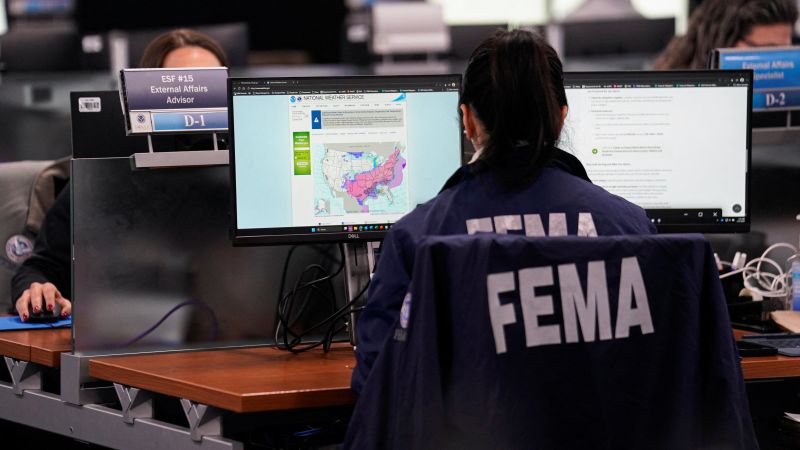
CORE personnel account for roughly 40% of FEMA’s workforce. They can be deployed after hurricanes, severe storms and other major emergencies, often becoming some of the earliest federal responders on the scene. Their work includes helping oversee disaster assistance, coordinating aid distribution and managing longer-term recovery funding for affected states and communities.
Contract restrictions became a central issue
Historically, CORE employees have held contracts lasting between two and four years, with renewals being routine. That practice changed during the Trump administration’s 2025 drive to reduce the size of the federal government.
Although DHS was excluded from President Donald Trump’s January 2025 federal hiring freeze, the department treated the renewal of FEMA CORE appointments as if it involved new hiring. FEMA was subsequently limited to extending contracts in 180-day increments while DHS considered a broader plan for the agency.
In January, DHS instructed FEMA to allow at least some CORE contracts to expire rather than renew them, effectively pushing workers out as their appointments ended. The policy formed part of a wider administration effort to reshape FEMA, reduce its workforce and place more responsibility for disaster response and recovery on state governments.
Illston concluded that DHS had not demonstrated a sound basis for reversing FEMA’s established approach to CORE renewals.
“There is no evidence in the record reflecting reasoned decision for this about-face or for the subsequent conditions DHS placed on FEMA’s renewal authority.”
The judge described the department’s conduct as arbitrary and capricious, a legal finding that means an agency failed to provide a reasoned explanation for its action.
FEMA’s role and staffing concerns
The case highlights the importance of staffing levels within an agency expected to react quickly when disasters overwhelm local and state resources. FEMA is housed within DHS, but Congress placed limits on the ability of the homeland security secretary to significantly scale back the agency. A 2006 law says the secretary may not substantially or significantly reduce FEMA’s authorities, responsibilities or functions.
The administration has argued that FEMA is ineffective, politically biased and overly large. But staffing concerns had already been documented before the current dispute. A 2023 Government Accountability Office report found that FEMA faced a shortage of more than 6,000 employees.
For communities facing a major disaster, the dispute is not simply about federal employment policy. CORE workers assist with the practical work of disaster recovery, from administering aid programs to supporting the flow of funds needed for rebuilding. A reduced pool of deployable personnel could affect the agency’s capacity during periods when several disasters require attention at once.
A FEMA spokesperson said the agency remains prepared to respond.
“We’re ensuring workforce stability and a strong, deployable force for upcoming national events and potential disasters; making the agency leaner, faster and laser-focused on supporting state, local, tribal and territorial partners before, during and after disasters.”
The spokesperson also said FEMA continues to maintain experienced leadership and support personnel at its headquarters and regional offices.
Deleted Signal messages drew a separate rebuke
Illston also issued a separate ruling involving Signal messages exchanged by former acting FEMA head Karen Evans and former DHS deputy chief of staff Joseph Guy. Signal is a messaging application that offers privacy features, including settings that can automatically delete messages after a selected period.
The judge found that the use of Signal violated federal law and DHS policy in the circumstances surrounding the lawsuit. Evans created a Signal chat that appeared likely to contain information relevant to the case, Illston wrote. The messages were initially set to disappear after four weeks.
After Evans became a defendant in the lawsuit in March, she shortened the auto-deletion period. She later created a backup of her Signal messages in April 2026, but Illston said the messages most relevant to the dispute had already been deleted by then.
“Evans should have known better.”
Illston noted that Evans had previously served as DHS chief information officer, a position that included responsibility for the department’s records-preservation policies. The court determined that her conduct was intentional.
As a consequence, the judge barred the administration from relying in future proceedings on earlier testimony denying plans to dramatically reduce FEMA staffing or denying DHS involvement in the matter. The court will also treat the missing Signal messages as unfavorable to the defendants.
“The Court will presume that the lost Signal messages would have been unfavorable to Defendants because they would have been further evidence of Defendants’ plan, DHS’s control, and Defendants’ implementing actions.”
Unions prevail, but remedies remain unresolved
The decisions favor the American Federation of Government Employees and the AFL-CIO, the unions that filed the lawsuit. The rulings establish that the staffing restrictions and related record-preservation failures cannot be treated as routine administrative decisions.
Illston did not yet decide what remedy the government must provide. Instead, she directed the parties to work toward an agreement on that question. The next phase of the case will determine what practical effect the ruling has for affected FEMA employees and for the agency’s ability to renew or restore CORE appointments.
The outcome places renewed attention on the balance between a president’s authority to reorganize the executive branch and Congress’ protections for an agency charged with coordinating federal disaster response. As the litigation continues, the staffing of FEMA’s deployable workforce will remain central to the legal and policy debate.
Related Reading
Frequently Asked Questions
What is Judge rules Trump administration order to fire?
Judge rules Trump administration order to fire is the main topic of this guide. The article explains the context, practical details, and next steps readers should understand.
Why does Judge rules Trump administration order to fire matter?
Judge rules Trump administration order to fire matters because readers are looking for a useful answer, not just a short summary. Good content should match search intent and help them decide what to do next.