Why are far-right masked men protesting at British ports?

Daftar Isi
Masked Men in Black Take to Britain’s Coast Roads as Anti-Migration Tensions Boil Over
Healfromzero.com – Two consecutive days of confrontations between masked demonstrators and police at England’s southern coastline have reignited one of the sharpest fault lines in British politics. What began on Saturday in the Kent port town of Dover escalated into a prolonged overnight standoff in Portsmouth on Sunday, leaving thousands of commuters stranded and prompting sharp criticism from government ministers, opposition lawmakers, and civil-society watchdogs alike.
The Dover Standoff
On Saturday morning, groups of men dressed in black and wearing face coverings linked arms across a main thoroughfare leading to the Dover ferry terminal, the busiest crossing point between England and France. Video circulating on social media captured the crowd chanting “stop the boats” while physically sealing off routes to the port. The National Highways agency confirmed the disruption produced a four-mile traffic jam during the morning peak. Kent Police stated that no arrests were made at the scene.
Dover’s position as the primary gateway for small-boat crossings from Calais makes it a symbolic flashpoint. Each year, thousands of asylum seekers attempt the roughly 34-mile Channel crossing in overloaded dinghies, a journey that has become shorthand in British political debate for uncontrolled migration. The Saturday action was the second major anti-migration demonstration in the UK within a single weekend, underscoring how quickly the issue has moved from parliamentary debate into street-level confrontation.
Portsmouth: Lifeboats, Buses, and a Night-Long Standoff
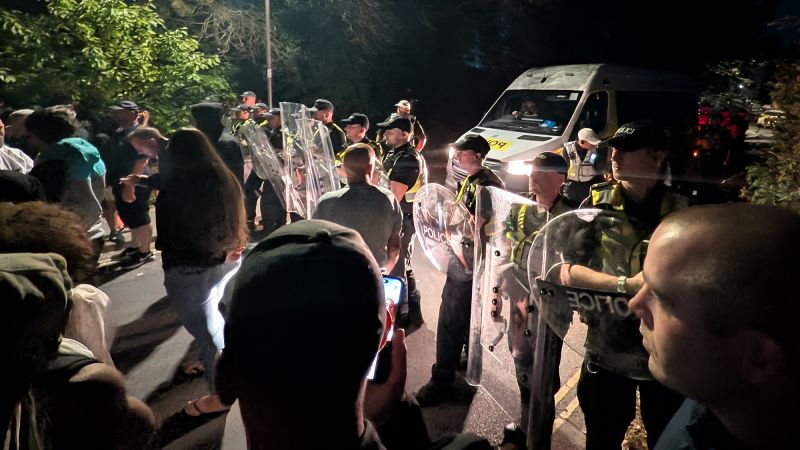
The situation intensified on Sunday when a small vessel carrying migrants made landfall on the Portsmouth coast. A larger cohort of balaclava-clad protesters, again dressed predominantly in black, first attempted to prevent lifeboats from ferrying the arrivals to shore. When that effort failed, the group shifted tactics and staged a road blockade aimed at stopping buses from transporting the asylum seekers to a nearby processing facility.
Footage from the scene showed the demonstrators shouting slogans including “stop the boats” and “I’m England ’til I die.” Police held the line until early Monday morning, and Hampshire and Isle of Wight Constabulary confirmed that no arrests were made. The force opened an investigation to identify those responsible for any assaults on officers, criminal damage to vehicles, or other offences committed during the confrontation.
Who Is Behind the Protests?
The demonstrations appear to have been coordinated by an organization calling itself the Patriot Platform, led by Daniel Thomas — better known by the alias Danny Tommo. Thomas is a former associate of Tommy Robinson, the far-right political activist and former boxer who has become a prominent voice in Britain’s anti-Islamic movement. The Platform describes itself as a Christian “army of patriots.” Thomas frames the group’s purpose in sentimental terms:
“We are protesting for a love for our children, country and most importantly the future that we are leaving for our children.”
British media have noted that Thomas served a prison sentence after pleading guilty to attempted kidnapping in 2016. The advocacy organization HOPE Not Hate, which monitors far-right extremism across the UK, has been tracking the Patriot Platform and its affiliated smaller groups. In a statement released after the weekend’s events, the group offered a pointed assessment:
“This shows the growing trend of anti-migrant vigilantism coming to a head in the public eye. Patriot Platform, and the smaller groups united by it, promote their ideology on the basis that they are providing a public service in the form of security in an ever-more dangerous Britain. In reality, Thomas has little hope of persuading others that Patriot Platform is a safety-first community group when its members march through the streets wearing balaclavas and have been exposed for their violent criminal records.”
Government and Political Reactions
The UK Home Office issued a statement condemning what it called “the intimidating and thuggish behaviour” in Portsmouth, while drawing a firm line around democratic norms:
“The right to peaceful protest is fundamental to our democracy, but it must never cross a line into disorder.”
In Westminster, the political response split along familiar lines. Nigel Farage, leader of the hard-right Reform UK party — whose support surged in England’s May local elections — had spent the preceding days framing small-boat crossings as an existential threat. In a speech on Friday he labelled the arriving asylum seekers “an invasion.” Yet on Saturday, speaking to GB News, Farage distanced himself from the masked demonstrators:
“Nobody feels more strongly about stopping the boats than me,” he said, adding that he condemned the “disgusting” tactics of the weekend. “Turning up in balaclavas is not the way to do it.”
Mike Tapp, the Labour MP representing the Dover constituency, took a more combative tone in a Facebook post on Saturday. He dismissed the demonstrators as “idiots coming to Dover to cause disruption” and pointed to official statistics showing that small-boat crossings have fallen by roughly 40 percent from their peak:
“I bet if you asked any one of those ‘protesters’ they wouldn’t know small boat crossings are down by 40% and we are working hard to fix the mess. Go home, enjoy your weekend/get a job.”
Why the Issue Keeps Resurfacing
The Home Office has confirmed that the number of migrants crossing the Channel in small boats has dropped to its lowest level since 2020, a decline driven by improved border cooperation with France and expanded processing capacity on the English side. Yet the political salience of the crossings has not faded in proportion. For Reform UK and allied commentators, even reduced numbers represent a failure of state control over borders. For Labour and other parties, the statistics demonstrate that existing measures are working and that street theatrics distract from policy.
The weekend’s events nonetheless raised practical questions about public order on Britain’s busiest transport corridors. Dover handles millions of ferry passengers annually; Portsmouth is a major naval and commercial port. When roads feeding either site are sealed by organized groups, the knock-on effects reach commuters, freight operators, and emergency services within hours. Police forces in both counties emphasized that investigations remain open, and the absence of arrests does not preclude later charges once footage and witness statements are reviewed.
For now, the image of masked men in black linking arms across a British road has become the defining visual of a political moment in which migration policy, democratic protest norms, and far-right mobilization collide in plain sight — and in plain daylight, at least until the balaclavas come out.
Related Reading
Frequently Asked Questions
What is Why are far right masked men protesting?
Why are far right masked men protesting is the main topic of this guide. The article explains the context, practical details, and next steps readers should understand.
Why does Why are far right masked men protesting matter?
Why are far right masked men protesting matters because readers are looking for a useful answer, not just a short summary. Good content should match search intent and help them decide what to do next.