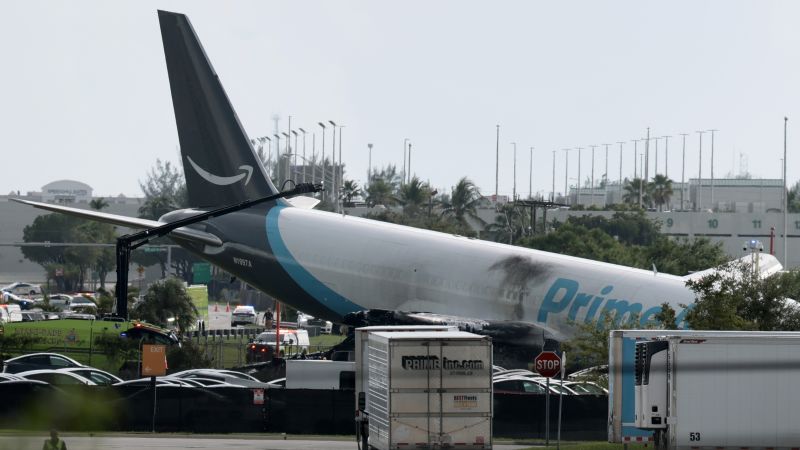
5 dead after Amazon cargo aircraft overruns runway in Miami, striking multiple vehicles

Daftar Isi
Amazon Cargo Plane Overruns Miami Runway, Kills Five and Ignites Massive Fire
Healfromzero.com – A Boeing 767 freighter contracted to haul Amazon packages slammed past the end of a runway at Miami International Airport on Sunday afternoon, plowing into parked and moving vehicles before erupting in flames. At least five people were killed in the crash, and five more sustained injuries, according to Miami-Dade Fire Rescue Chief Raied “Ray” Jadallah, who addressed reporters that evening. Three of the wounded were transported to a trauma center in critical condition; two others were taken to a nearby hospital. Multiple victims were pinned inside the vehicles the aircraft struck and required extrication by rescue crews.
Chaos on the Ground
The scene unfolded with extraordinary speed. More than sixty emergency units converged on the airport to find a burning aircraft wreathed in heavy flames and a dense column of black smoke rising above the terminal area. A fuel leak persisted well into the evening, keeping fire-rescue teams actively engaged at the crash site. Sheriff Rosie Cordero-Stutz of Miami-Dade told the press conference that no ongoing threat to public safety existed at that point, though the runway remained closed.
First-responder radio traffic captured on Broadcastify offered a raw glimpse of the confusion in those first minutes:
“Guys, the plane’s on fire. Plane’s on fire. Put your game faces on.”
Crews also confirmed that both pilots had been pulled from the aircraft and were receiving medical attention.
“Our final patients are the pilots that were removed from the aircraft, so we need to get with them and get them treated.”
What the Data Shows
Tracking information from Flightradar24 indicates the aircraft was traveling at roughly 130 miles per hour when it departed the usable paved surface of the runway. Air-traffic-control audio reviewed by journalists revealed that the flight crew never declared an emergency prior to touchdown. The cause of the overrun has not yet been determined.
The aircraft had departed San Juan, Puerto Rico, and touched down on Runway 30, a strip exceeding 9,000 feet in length. FAA records place the moment of overrun at approximately 2 p.m. local time. Inspection teams later reported that no loose aircraft components or debris were scattered across the runway surface itself, but the plane did strike and damage navigational equipment as it crossed the pavement boundary.
The Aircraft and Its Operator
The involved jet was a 32-year-old Boeing 767 operated by 21 Air, a cargo airline headquartered in Miami that flies freight missions for major shippers including Amazon and DHL. The company’s operations center sits in the same city where the crash occurred. CNN reached out to 21 Air for comment; no response had been received at the time of publication.
Amazon issued a statement through spokesperson Kelly Nantel:
“We’re heartbroken to learn that five people lost their lives in today’s incident at Miami International Airport. Our deepest sympathies go out to the families, loved ones, and all those affected by this devastating loss.”
The statement added that the aircraft was attempting a routine landing when the event unfolded, and that the company would cooperate fully with investigators.
Investigation and Airport Disruption
The National Transportation Safety Board announced it was collecting information about the crash, while the Federal Aviation Administration assumed the lead investigative role. A ground stop at Miami International was lifted around 5 p.m. Eastern Time, but a ground delay persisted into Monday because the disabled aircraft remained on the runway, blocking operations.
Runway Excursions: The Industry’s Most Persistent Hazard
The crash underscores a long-standing problem in aviation safety. Runway excursions — events in which an aircraft departs the paved surface during takeoff or landing — remain the single most frequent type of airplane incident worldwide, according to data compiled by the International Air Transport Association. Airports mitigate the risk with engineered safety areas: graded buffer zones beyond the runway end designed to slow or stop an aircraft that overshoots. Miami International, like most major U.S. airports, maintains such a designated area. In this case, however, the aircraft’s speed at the point of departure from the pavement — nearly 130 mph — appears to have exceeded what the buffer could absorb, carrying the jet into the vehicle-access zone where the fatalities occurred.
The Boeing 767, originally designed as a wide-body passenger airliner in the late 1970s, has been converted to freight service by numerous operators. Its size, weight, and momentum make runway-excursion events particularly consequential when they occur at airports with limited surrounding clearance. Investigators will need to determine whether factors such as braking performance, runway surface conditions, wind, or pilot input contributed to the aircraft’s failure to stop within the available distance.
As of Sunday evening, the crash site remained active, with fire crews continuing to manage the fuel leak and secure the wreckage. Families of the deceased were being notified, and airport authorities expected a prolonged disruption to Miami International’s schedule while the runway stayed closed for recovery operations.
Related Reading
Frequently Asked Questions
What is 5 dead after Amazon cargo aircraft?
5 dead after Amazon cargo aircraft is the main topic of this guide. The article explains the context, practical details, and next steps readers should understand.
Why does 5 dead after Amazon cargo aircraft matter?
5 dead after Amazon cargo aircraft matters because readers are looking for a useful answer, not just a short summary. Good content should match search intent and help them decide what to do next.