‘Decades in Sports’: How Colin Kaepernick taking a knee in 2016 revived athlete activism in sports

Daftar Isi
A Knee, a Silence, and a Nation Forced to Listen
Healfromzero.com – The summer of 2016 in America carried a weight that few outside the country fully grasped. Nearly half a century had elapsed since Martin Luther King Jr. addressed the nation from the steps of the Lincoln Memorial, yet the promise of that speech remained stubbornly unrealized. Police killings of Black Americans continued at a rate that defied easy explanation, and the Black Lives Matter movement—already gaining national visibility after the 2013 acquittal of George Zimmerman, who had fatally shot 17-year-old Trayvon Martin in Sanford, Florida the prior year—had become a defining political force. By July of that year, tensions reached a boiling point when Alton Sterling and Philando Castile were each killed by law enforcement officers within a single day of one another. Castile’s death in Minnesota prompted then-Governor Mark Dayton to pose a question at a press conference that echoed across the country:
“Would this have happened if the driver and passenger were white? I don’t think it would have. So I’m forced to confront, and I think all of Minnesota is forced to confront, that this kind of racism exists.”
It was into this charged atmosphere that a former San Francisco 49ers quarterback stepped—not with a megaphone, not with a march, but with a single, silent gesture that would fracture the visual landscape of American sport for years to come.
The Quiet Beginning
Colin Kaepernick’s protest did not begin with a knee. It began with a chair. On August 14, 2016, before the 49ers’ first preseason matchup against the Houston Texans, the then-28-year-old remained seated during the national anthem. He repeated the gesture the following week against the Denver Broncos. Neither instance registered with the public, largely because Kaepernick did not suit up for either contest and drew no on-field attention.
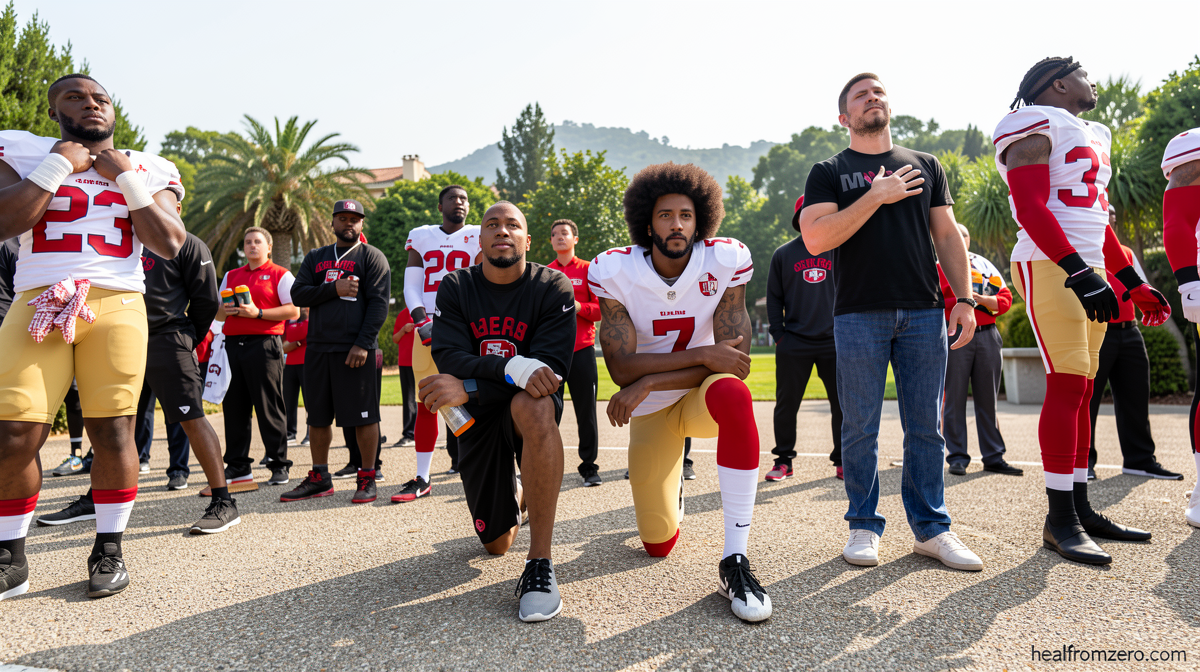
Everything shifted on August 26. Kaepernick returned to uniform for a preseason game against the Green Bay Packers and, once again, sat through the anthem. This time, millions of television viewers saw it. The following week, on September 1, 2016, before a preseason game against the San Diego Chargers, he elevated the gesture further: he took a knee, joined by teammate Eric Reid. The image—two players kneeling on a gridiron while the anthem played—became one of the most recognizable and contested visuals of 2010s sports culture.
Why He Did It
Kaepernick had been vocal about the Sterling and Castile killings on social media in the weeks before the season opened, describing Sterling’s death as a modern-day “lynching” and saying he had been “executed.” After Castile was killed less than 24 hours later, he wrote that it was “clear as day” that African Americans in the country were “under attack.”
When longtime NFL reporter Steve Wyche asked him after the Packers game what motivated the demonstration, Kaepernick answered without softening the language:
“I am not going to stand up to show pride in a flag for a country that oppresses Black people and people of color. To me, this is bigger than football and it would be selfish on my part to look the other way. There are bodies in the street and people (are) getting paid leave and getting away with murder.”
The clarity of that statement left little room for misinterpretation. Football, for Kaepernick, had become secondary. He was coming off a 2015 season marred by injuries and a loss of his starting role, yet his focus had moved beyond the scoreboard.
A Nation Divided
The reaction was immediate and polarized. As Renée Graham, Associate Editor and Columnist at The Boston Globe, later observed, “it was a quiet protest and he wasn’t being disruptive, people focused on it, (and) it just took on this sort of life of its own.” Sam Farmer, sports journalist at the Los Angeles Times, noted that “the whole country was wrapped up in this controversy.”
Kaepernick endured booing in stadiums across the league, received multiple death threats, and drew pointed criticism from then-Republican presidential candidate Donald Trump. In an interview with KIRO radio in Seattle, Trump called the protest a “terrible thing” and suggested Kaepernick should “find a country that works better for him.” The comments amplified the cultural fight to a national political level, embedding the anthem protest into the broader discourse on race, patriotism, and the role of athletes in public life.
Yet Kaepernick remained unmoved. No league sanction, no fan backlash, no political pressure derailed what he described as a moral obligation rather than a political performance. The gesture spread quickly: within weeks, players across the NFL—and soon across basketball, baseball, and soccer—were kneeling, sitting, or linking arms during the anthem. A single act of individual dissent had become a template for collective expression.
Legacy and Aftermath
Nearly a decade later, the image of that September evening in San Diego continues to shape how athletes, fans, and institutions discuss the intersection of sport and social justice. The protest catalyzed conversations about police accountability, the symbolism of national rituals, and whether silence on a field constitutes a form of speech. It also intensified scrutiny of how leagues manage player expression, how sponsors respond to controversy, and how quickly a cultural moment can outpace the institutions meant to govern it.
What began as one man choosing to sit—and then to kneel—on a football field became a mirror held up to a country still reckoning with the distance between its founding ideals and its lived realities. The anthem still plays before every game. The question it now carries, however, was written not by a composer but by a quarterback who decided that looking the other way was no longer an option.
Related Reading
Frequently Asked Questions
What is Decades in Sports?
Decades in Sports is the main topic of this guide. The article explains the context, practical details, and next steps readers should understand.
Why does Decades in Sports matter?
Decades in Sports matters because readers are looking for a useful answer, not just a short summary. Good content should match search intent and help them decide what to do next.