Spain’s ‘wolf boy of Sierra Morena’ dies aged 80

Daftar Isi
Spain’s Sierra Morena loses its most extraordinary resident
Healfromzero.com – The remote hamlet of Rante, tucked into the hills of western Galicia, has lost the man who spent more than a decade of his youth living among wolves in the Sierra Morena range. Marcos Rodríguez Pantoja, widely known across Spain as the “wolf boy of Sierra Morena,” died last week at the age of 80. The local government of San Cibrao das Viñas confirmed the passing and posted a tribute on Monday honoring a man who had called Rante home since 2001.
Those who knew him in his final years described a figure utterly unlike anyone else in the village. Arturo Arcones, a longtime acquaintance, offered a portrait that captured the strangeness of Pantoja’s existence:
“He was a person made of earth, wind, air, rain, and hunting dens. He always said that his happiest life was with the wolves, because he didn’t feel very comfortable with humans.”
A childhood shaped by war’s aftermath
Pantoja was born in 1946 in Añora, a small village in southern Spain’s province of Córdoba. The country was still stitching itself back together after two devastating conflicts: the Spanish Civil War of 1936–1939 and the global catastrophe of World War II. Poverty was the default condition of rural life, and families in the south often moved between villages in search of work. Pantoja’s early years followed that pattern until tragedy upended everything.
After his mother died, his siblings were absorbed into extended family networks, but young Marcos remained with his father. The father remarried and relocated the household into the Sierra Morena mountains, where charcoal-making provided a meager livelihood. What followed, as recounted by Professor Gabriel Janer Manila of the University of Palma de Mallorca’s philosophy department, was a descent into neglect and exploitation.
Manila, who spent five months conducting in-depth interviews with Pantoja for an academic study, documented that the boy was mistreated by his stepmother. At just seven years old, his father sold him to an elderly goat herder. The transaction was not a metaphor; it was a transfer of a child into the custody of a stranger in exchange for payment.
Into the wild
Pantoja himself recalled the moment of handover with a clarity that persisted for decades:
“They took me to the mountains, to a cave. A little old man with a beard came out wearing cork shoes. There were howling wolves, foxes, mountain goats, deer, scorpions, snakes. At night, I heard these animals and I was afraid.”
The herder, far from being a cruel custodian, became something closer to a surrogate parent in the wilderness. He kept the boy warm with animal pelts, taught him to milk goats, and showed him how to hunt rabbits using nothing more than a stick. Over the years that followed, Pantoja absorbed what Manila termed “the law of the jungle.” The boy recognized his own difference from the animals around him — “especially because he had hands,” Manila noted — yet he nonetheless felt woven into their community.
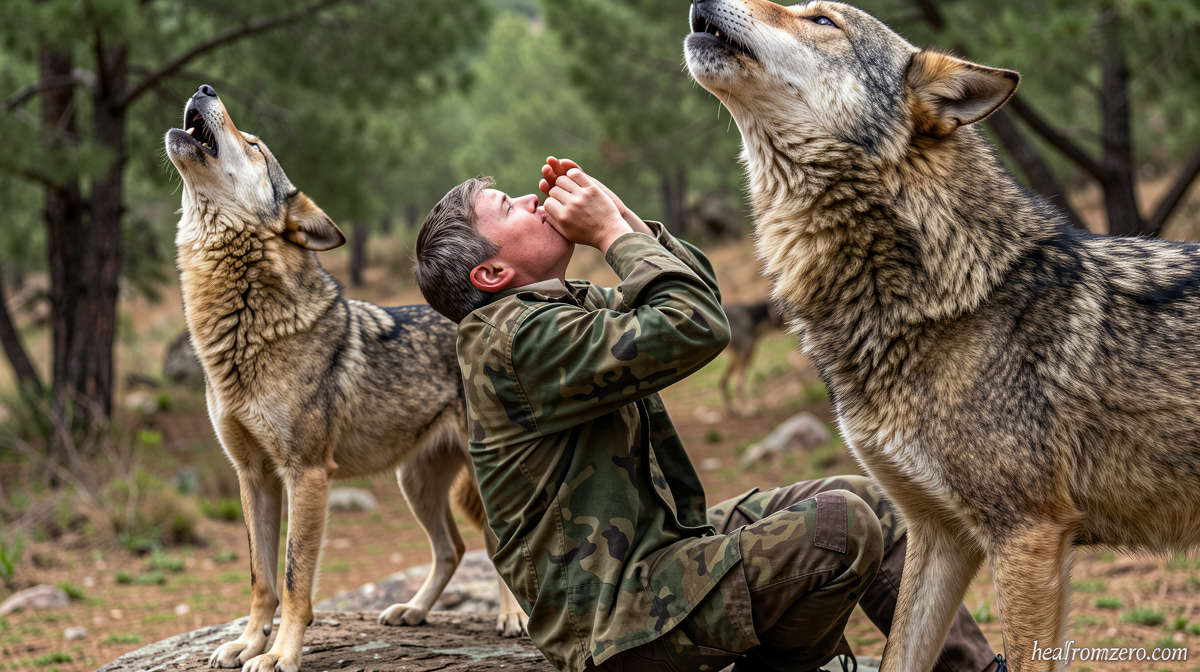
He learned to mimic birdsong, the bleat of deer, and the calls of countless other creatures. He believed, with genuine conviction, that he could communicate “effortlessly with foxes, wolves and even snakes.” When the herder vanished without explanation, Pantoja was left alone in a landscape that most adults would find unsurvivable. He drew on every skill the old man had imparted and, remarkably, earned the trust of a local wolf pack by carrying food to their cubs and raising his voice in warning whenever he sensed danger approaching.
“I was crying and they jumped up at me… then they showed me the way to their cave, the wolf’s den.”
He described the pups tumbling around him, greeting their new companion with play and curiosity. For the next stretch of years, Pantoja lived as a member of that pack, avoiding any human settlement. If voices carried down from a nearby village, he concealed himself until they passed.
Found, reintegrated, and eventually free
The Civil Guard located him in 1965, when he was 19 years old. Manila described the scene: a young man “lost and alone, among the ravines,” physically intact but socially unmoored. Pantoja later reflected on those years with a kind of bewildered pride:
“I was doing very well and I didn’t know what money was but I never lacked food. If I wanted to fish, I fished in the river. If I wanted a rabbit, I caught it. If I wanted a deer, I called to my parents who were the wolves. I let out a howl, I hid in the river and the wolves brought the cattle down to me.”
The months immediately following his rescue were, by all accounts, turbulent. Those who encountered him recalled a sharp intelligence about the natural world paired with what Manila called a “wild character.” The scholar catalogued his difficulties: a “complete lack of awareness when it came to social life, his language difficulties – especially his lack of knowledge of the names of things – his strange gait, his naiveté.” He had grown up without currency, without fixed addresses, without the vocabulary of domestic life.
He was placed first with a priest in Jaén, then with nuns in Madrid. After completing his compulsory military service, he ended up on the island of Mallorca, taking work in hotels and restaurants. It was there that he had a chance meeting with anthropologist Manila, who became the first outsider to take his story seriously and to document it in academic form.
A life of telling
In his later decades, Pantoja turned his extraordinary biography into a public narrative. Arcones explained that the motivation was conservation-oriented: Pantoja wanted to share his experience “with the intention of protecting nature and fostering a better understanding of it.” Manila’s doctoral thesis was published as a book titled I Played with Wolves, and a film adaptation, Among Wolves, carried the story to wider audiences.
By 2001, Pantoja had settled permanently in Rante, sharing a modest home with a retired police officer. The hamlet, part of the municipality of San Cibrao das Viñas in Galicia, became his final address. He remained there until his death last week.
The Sierra Morena range, stretching across the provinces of Córdoba, Jaén, and Ciudad Real, has long been associated with isolation, charcoal production, and the slow retreat of large predators from European landscapes. Pantoja’s story, whether read as memoir, anthropological case study, or simply as one man’s improbable life, belongs to that landscape. His passing closes a chapter that no other living person can speak from firsthand experience.
Related Reading
Frequently Asked Questions
What is Spain s wolf boy of Sierra?
Spain s wolf boy of Sierra is the main topic of this guide. The article explains the context, practical details, and next steps readers should understand.
Why does Spain s wolf boy of Sierra matter?
Spain s wolf boy of Sierra matters because readers are looking for a useful answer, not just a short summary. Good content should match search intent and help them decide what to do next.