Gangbangers, rap feuds and old tapes: What we learned in the first week of the Tupac murder trial

Daftar Isi
Thirty Years After the Shooting, a Jury in Las Vegas Weighs Whether One Man’s Story Is Truth or Fabrication
Healfromzero.com – The desert heat outside the Regional Justice Center in downtown Las Vegas pushes toward 110 degrees, sending tourists scrambling for shade beneath the Fremont Street canopy where zip lines still swing overhead. Three blocks from that spectacle, a jury sat down for the first week of what prosecutors expect will be a month-long proceeding over the most famous unsolved killing in hip-hop history. At the center of the case stands Duane Davis — known to fans of 1990s rap as “Keffe D” — the sole individual ever formally charged in connection with the September 7, 1996, shooting that killed Tupac Shakur.
For jurors, the central question distilled into a binary: Is Davis a compulsive storyteller who spent nearly two decades embellishing his role in the crime, or is he the cold-blooded architect of a drive-by revenge killing? The answer, the jury will ultimately decide, hangs on whether his words — scattered across a secret 1998 LAPD interview, public interviews, podcasts, a memoir, and a 2018 documentary — constitute a coherent confession or a long-running performance.
A Trial Hidden in Plain Sight
Despite the international media attention the case has attracted, the proceedings blend almost invisibly into the daily churn of a busy municipal courthouse. Before sessions began on Monday, August 17, a queue of motorists snaked through the lobby paying traffic citations. The trial’s only visible marker was a single entry — “DAVIS, DUANE KEITH” — buried in tiny type at the middle of the second screen in a bank of 14 monitors listing every case scheduled that day, alphabetized among hundreds of routine matters.
That anonymity, of course, is a far cry from the spectacle the case has become outside the courtroom walls. Shakur’s murder, which occurred in the parking lot of the MGM Grand hotel after he and his entourage assaulted Orlando “Baby Lane” Anderson, nephew of Davis, has haunted popular culture for three decades. The trial has reopened a chapter in music history defined by gang rivalries, label feuds, and a culture where silence was treated as the only reliable survival strategy.
The Weight of Three Decades
Every day of testimony has required the jury to mentally transport itself back to 1996. Cellphones capable of voice calls were not yet universal accessories; the technology that now saturates courtrooms was, at the time, a novelty carried by a handful of personalities. A paper hotel folio itemizing a string of 75-cent local phone charges now reads like a relic from another century. Surveillance footage capturing Shakur’s group exiting the MGM Grand after the Anderson assault — the incident prosecutors say triggered Davis’s plan for retaliatory violence — carries the wavy distortion of analog videotape.
“We had to maintain a VHS player in homicide to be able to view those things,” former Las Vegas police officer Dean O’Kelley told the jury from the witness stand.
The erosion of time is visible not only in the evidence but in the witnesses themselves. Investigators who have not already died are nearly all retired; several testified remotely via Zoom, occasionally interrupted by connection glitches from homes far from Nevada. A young partygoer who watched the shooting from a passing vehicle in 1996 now appears as a quietly dressed middle-aged woman. Reggie Wright Jr., once the feared security chief at Death Row Records, is too debilitated by Long Covid to walk to the stand and instead testifies from an electric scooter.
Two Competing Narratives
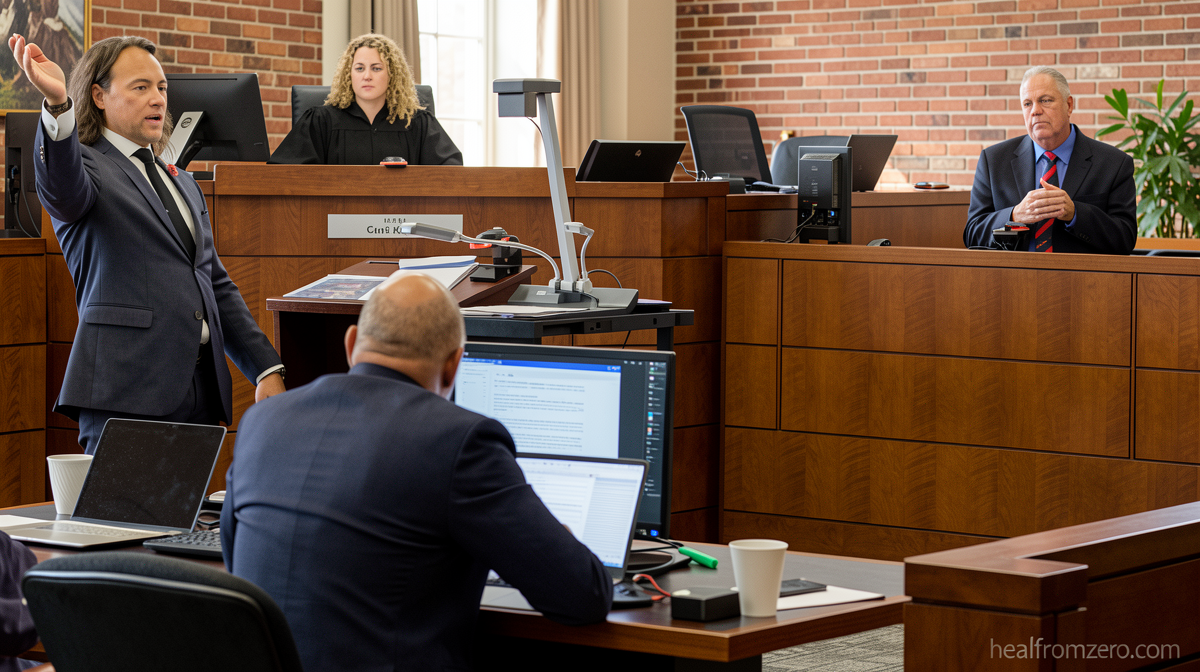
Defense attorney Michael Sanft built his opening statement around the argument that Davis’s repeated public accounts of his involvement are a sustained fiction. On a slide displayed during his Monday remarks, Sanft rendered his verdict on those accounts in all-caps: “BULLSH*T.” He urged the jury to treat every podcast appearance, every interview, every chapter of the memoir as performance rather than confession.
Sanft also leaned heavily on the absence of formal police documentation for many events in the prosecution’s timeline, including the Anderson assault itself. He told reporters outside the courthouse that the passage of time is his client’s greatest ally.
“The length of time is going to be a huge problem for anybody to try to recall things. That’s why police reports are important.”
Prosecutor Binu Palal countered that Davis’s own words render such documentation superfluous. In his framing, the defendant has confessed repeatedly and voluntarily, in settings both private and public, right up to the eve of trial.
“Even in private calls, Duane Davis has repeatedly told us over and over again about the anger he felt and his own role in the revenge drive-by shooting of Tupac Shakur,” Palal told the jury.
Palal also invoked the culture of the era to explain why others stayed quiet while Davis spoke.
“In this world, silence means survival. The one person who has a hard time being silent is Duane Davis.”
Why This Trial Matters Beyond the Courtroom
The Shakur killing has functioned for nearly thirty years as a cultural wound that never fully closed. Fans, scholars, and fellow artists have circulated competing theories — pointing at rival gangs, label executives, and police corruption — while no single defendant faced a jury until now. The trial’s outcome will either close that chapter with a verdict or leave it open again, depending on whether the jury finds the evidence sufficient to convict or to acquit the only person ever charged.
For the jurors, the task is to sort through aging testimony, degraded video, and a defendant’s own sprawling self-narrative to determine what actually happened in a Las Vegas parking lot on a September night in 1996. The desert sun outside will keep burning at nearly 110 degrees. Inside, the jury will spend the next several weeks deciding whether one man’s story is the truth or a two-decade-long work of fiction.
Related Reading
Frequently Asked Questions
What is Gangbangers rap feuds and old tapes?
Gangbangers rap feuds and old tapes is the main topic of this guide. The article explains the context, practical details, and next steps readers should understand.
Why does Gangbangers rap feuds and old tapes matter?
Gangbangers rap feuds and old tapes matters because readers are looking for a useful answer, not just a short summary. Good content should match search intent and help them decide what to do next.