When Lake Mead hits new lows, its waters unveil mysteries. Last time, it revealed a murder case that is still unsolved

Daftar Isi
Lake Mead’s Record-Low Waters Surface New Human Remains as an Old Murder Mystery Remains Unsolved
Healfromzero.com – A jagged jawbone, its teeth stained yellow with decades of submersion, was pulled from the rocky shoreline of Lake Mead on August 16. The man who found it had been sifting through stones at the water’s edge when the fragment came free. Within hours, several additional curved and slender bones were located nearby, photographed and logged. The Clark County Coroner’s Office has taken custody of the material and is working to establish both identity and cause of death. Park authorities are examining the circumstances but have indicated they do not believe the individual was killed by another person.
The find arrives at a moment of particular significance. Just days before the jawbone surfaced, the reservoir registered a record-low elevation of 1,040.5 feet above sea level, pulling back hundreds of miles of shoreline along the Nevada-Arizona border. What the receding waters expose is not merely sand and sediment; it is a growing archive of objects and, occasionally, people that the lake swallowed during wetter decades.
The 2022 Precedent: A Barrel, a Body, and a Cold Case
The most consequential revelation from the previous record-low episode came on a bright May morning in 2022. At Hemenway Harbor, one of the reservoir’s most frequented beach areas, a visitor’s scream carried across the water. She had encountered a metal barrel so corroded by years of submersion that its interior was visible: the decomposed remains of a man, his skeletal structure still encased in battered jeans, Velcro sneakers, and a silver Timex wristwatch.
Las Vegas police officers descended to the steel drum at the lapping waterline on May 1, 2022, and found a gaping hole in the deteriorated metal. What lay inside left no ambiguity. Lt. Jason Johansson of the Las Vegas police homicide unit confirmed at the time that the victim had sustained a gunshot wound.
“The person (who disposed of the body) took a lot of steps to make sure that the victim had not been recovered,” former Las Vegas homicide lieutenant Ray Spencer said.
Spencer, who oversaw the homicide unit when the body was discovered, explained that the barrel had been punctured multiple times and dumped well offshore. Whoever discarded the remains almost certainly never anticipated that the reservoir’s shoreline would retreat hundreds of feet over the following years, returning the barrel to dry land.
The victim, designated the Hemenway Harbor Doe, was still wearing a 2X-sized striped short-sleeved button-down shirt, jeans, and Trax-brand Velcro sneakers when sealed inside the container. The cool freshwater environment preserved the clothing well enough for investigators to date his death to somewhere between the mid-1970s and early 1980s — an era when organized crime still held a firm grip on Las Vegas and the city was cementing its reputation as a glittering destination for human desire.
Three More Sets of Remains, One Still Unknown
In the months following the barrel discovery, three additional sets of human remains were located along the exposed shoreline. Investigators employed DNA analysis alongside conventional investigative methods and successfully identified all three individuals. The Hemenway Harbor homicide victim, however, has resisted identification for years. Locals and true-crime enthusiasts continue to generate theories about the fate of a man whose killer went to considerable lengths to ensure he would never be found.
The Broader Exposure: Wrecks, Boats, and a Receding Coastline
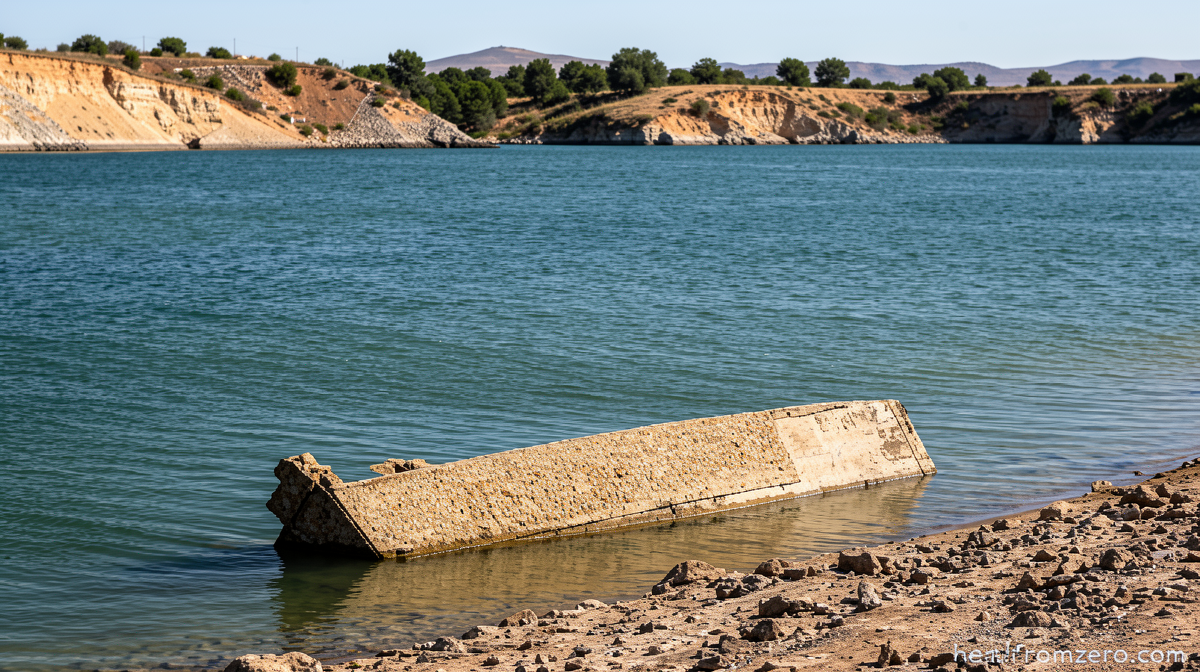
The 2022 drawdown also brought to light a World War II-era vessel whose gutted frame had not seen sunlight in years, the abandoned wreck of a houseboat, and dozens of sunken skiffs and speedboats long written off by their owners. Each exposed object told a small story of abandonment. The barrel told a larger one.
A Climate-Driven Retreat
The mechanism behind the shrinking shoreline is not seasonal fluctuation. At its peak in 1983, Lake Mead sat at 1,225 feet above sea level. Since then, the waters have fallen nearly 200 feet. The decline is attributed to a climate-crisis-fueled mega-drought compounded by persistent overuse of the Colorado River system, which feeds the massive reservoirs along its course. The river basin is now in a state of sustained hydrological crisis.
“If you were to go back 40 years ago, where the victim was found was probably about half a mile to a mile offshore,” Spencer said.
That distance — the gap between where a body was discarded and where it eventually reappeared — is itself a measure of how dramatically the landscape has changed. What was once open water, a mile from shore, is now dry sand and exposed rock where a man can walk and pick up a jawbone.
As the reservoir continues its historic descent, each new low-water mark carries the implicit possibility of further revelations. The Clark County Coroner’s Office will determine whether the August 16 find represents a natural death or something more troubling. Meanwhile, the Hemenway Harbor case remains open, a decades-old question sealed in a corroded drum that the lake returned to the world only because the waters finally withdrew far enough to let it surface.
Related Reading
Frequently Asked Questions
What is When Lake Mead hits new lows?
When Lake Mead hits new lows is the main topic of this guide. The article explains the context, practical details, and next steps readers should understand.
Why does When Lake Mead hits new lows matter?
When Lake Mead hits new lows matters because readers are looking for a useful answer, not just a short summary. Good content should match search intent and help them decide what to do next.