
Venezuelans search for a future as well as survivors after twin quakes pile disaster on years of crisis
Venezuela’s Earthquake Crisis: Survivors Seek a Future Amid Years of Hardship
Venezuelans search for a future as well as survivors after twin quakes compounded the nation’s existing crises. The recent earthquakes, registering 7.2 and 7.5 on the Richter scale, struck with alarming speed, leaving thousands displaced and hundreds of lives lost. As the damage unfolds, Venezuelans face not only the immediate challenge of rebuilding but also the broader question of whether their country can recover from a relentless sequence of economic and political turmoil.
Immediate Impact on Communities
“Some very tough days are coming,” said Caracas resident Neida Pernilla. Her apartment in the capital was reduced to rubble, yet she and her relatives managed to survive. “I think we have to learn from everything we’re going through. That life is fleeting — just a moment. We have to thank God, the Virgin Mary, whatever we have faith in, for the fact that we’re alive, and we need to be more human, more cooperative, more humble.”
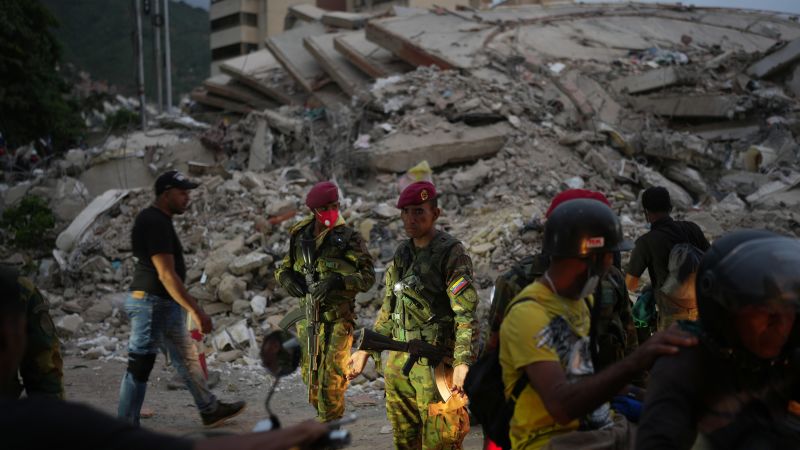
The twin tremors struck across all social levels, from affluent districts to struggling neighborhoods. In La Guaira, a port city 20 miles from Caracas, the aftermath has been particularly severe. Collapsed roadways and damaged infrastructure have isolated the region, forcing residents to rely on scavenging for essentials like food and clean water. The destruction mirrors the nation’s broader vulnerabilities, where decades of mismanagement have left public services strained and the population desperate.
Government Response and Local Efforts
Acting President Delcy Rodríguez promised support, but the reality on the ground shows a different picture. With the economy in freefall and public services overwhelmed, the response to the disaster has been slow. Many Venezuelans, like Mileidy Duque, 43, have turned to family efforts to locate missing loved ones. “It’s been us, the families, trying to dig through debris to find our relatives,” Duque said, her voice steady despite the chaos. Her mother, brother, daughter, and her partner-in-law remain unaccounted for after their home in the Luisa Caceres de Arismendi building — government housing inaugurated by former president Nicolás Maduro in 2015 — crumbled beneath them.
The destruction in La Guaira has reminded residents of another tragedy that shook the city a quarter-century earlier. In December 1999, torrential rains triggered massive landslides, claiming an estimated 15,000 lives. Though an official death toll was never released, researchers at the Central University of Venezuela documented the scale of the disaster. Lindomar Milla, whose sister and brother-in-law perished in the Playa Los Cocos neighborhood, described the current crisis as “much worse than the mudslides.” “So many people are still looking for their loved ones. There are people who traveled to La Guaira and found buildings that no longer exist,” he told CNN, his words echoing the deepening sense of loss.
Survival Challenges and Emotional Toll
As days pass, the challenges of survival intensify. The tropical heat lingers over damaged areas, and the stench of decay becomes an ever-present companion. Survivors have resorted to wearing face masks to shield themselves from the pervasive smell, a stark reminder of the human toll. In the Petunia residential complex, which once stood as a symbol of middle-class stability in the Palos Grandes neighborhood, Susana Henríquez watches the remnants of her home from behind yellow tape. “I have been feeling so much pain and uncertainty,” she said, her tears mingling with the dust of the ruins.
Henríquez’s story is emblematic of the countless families whose lives have been upended. The twin towers of Petunia, built behind secure gates, now lie in splinters. She escaped from her unit in Petunia II, while the other tower collapsed, trapping residents inside. “We want to trust that our neighbors in the Petunia I will be rescued alive,” she added, her hope tempered by the weight of the unknown. Her words highlight the emotional resilience of a people who have grown accustomed to hardship, yet still cling to the possibility of recovery.
The 72-hour golden window for rescue operations has passed, but the search for survivors continues. Hundreds of aftershocks have shaken the remaining structures, some of which still stand precariously. These tremors have not only destabilized buildings but also the fragile hopes of those still in the rubble. Each moment of relief — such as when a survivor is pulled from the debris — is a fleeting triumph against the backdrop of sorrow.