
Venezuelans scour collapsed buildings by hand while government machinery stands unused
Venezuela Earthquake Crisis: Search and Rescue Lags as Government Faces Backlash
Survivors Dig Through Rubble Without Heavy Machinery
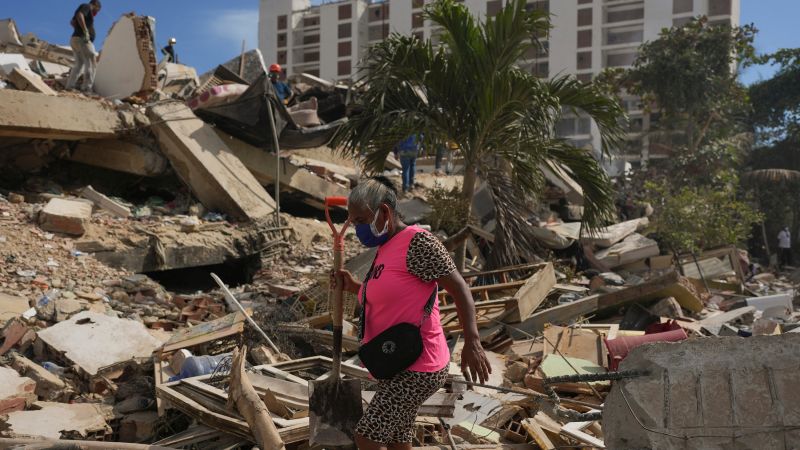
Venezuelans scour collapsed buildings by hand – More than a week after a devastating earthquake struck La Guaira, a coastal city in Venezuela, residents continue to sift through the wreckage of collapsed structures by hand. Despite the urgent need for efficiency, government equipment such as excavators remains stationary, idle due to a shortage of fuel. This situation has sparked frustration among locals, who are left to rely on basic tools like shovels and pickaxes, or even their bare hands, to navigate the rubble. The disaster has exposed the country’s infrastructure vulnerabilities and the government’s inability to mobilize resources swiftly.
While heavy machinery is essential in rescue operations, its absence has forced families to endure grueling conditions. CNN observed volunteers struggling to break apart the remnants of high-rise buildings, their efforts hampered by a lack of specialized tools. One survivor, Hassel Mendoza, described the difficulty of the task. “We lost a lot of time trying to figure out new tools to use for a specific activity, like to cut steel,” she told CNN. Mendoza, an engineer who flew in from Tampa, has been searching for her mother, sister, brother-in-law, and nephew in the ruins of their nine-story apartment building. She and others have been sleeping on the ground, with little hope for progress without proper equipment.
Government Criticized for Slow Response
The delayed response has drawn sharp criticism from both citizens and analysts. Political commentator Carmen Beatriz Fernández, director of DataStrategia, highlighted the government’s broader failures. “What we are seeing is this tragedy as a reflection of another tragedy, which was dedicating the state’s capabilities solely to repression and propaganda. You dismantled a state’s capacity to provide basic needs,” she said in a statement. The analyst’s words underscore the growing sentiment that the earthquake is not just a natural disaster but a symbol of systemic neglect.
Meanwhile, the government has attempted to justify its actions. Interior Minister Diosdado Cabello urged Venezuelans to trust their leadership, emphasizing the need for organized efforts in communes and local structures. “We have to know who is missing, where they were, and so that we can do the rescue work more precisely,” he stated last Thursday. However, these efforts have been overshadowed by reports of mismanagement. Four officials were arrested for allegedly taking valuables from the rubble, a move that further damaged public confidence. The Scientific, Penal and Criminal Investigations Corps (CICPC) confirmed the arrests, stating the men had been removed from their posts and their cases referred to the judiciary.
Human Toll and Unmet Needs
The tragedy has left a profound human impact, with overwhelmed hospitals working tirelessly to save lives. The air in La Guaira is thick with the scent of decay, a grim reminder of the devastation. At a makeshift morgue near the port, rows of caskets were stacked high, each representing a life lost in the chaos. For many, the sight is a painful reality, with families refusing to accept the worst until every possible moment has passed.
The official death toll, announced by National Assembly President Rodríguez—the brother of the acting president—has climbed to 2,295, a rise of approximately 350 from the previous day. Yet this figure is widely believed to be an undercount. The US Geological Survey estimates that tens of thousands may have perished, prompting the United Nations to prepare for an even larger scale of loss. Gianluca Rampolla, the UN’s Resident and Humanitarian Coordinator in Venezuela, revealed that 10,000 body bags are being procured to handle the expected increase in casualties.
Opposition Calls for Unity
Amid the crisis, opposition leader María Corina Machado has returned to Venezuela from her exile in the United States, vowing to stand with her people. Speaking to Fox News, she emphasized the importance of unity in the face of adversity. “We need to be together,” she said, expressing hope that collective efforts could turn the tide. Her return has been seen as a sign of resilience, though it also highlights the deepening divide between the government and its critics.
Government officials, including top lawmaker Jorge Rodríguez, have defended their response, citing the distribution of volunteers based on priorities. However, these efforts have been criticized as inadequate. Mendoza pointed out that neighboring states, like Aragua, lacked the necessary equipment to expedite the search. “No drills, no sensors,” she said, underscoring the gaps in preparedness. Even with donations of water, the challenges remain immense, as the focus shifts from prevention to salvage.
The earthquake has become a focal point for Venezuelans to question their leadership. As the government struggles to address the immediate aftermath, the crisis serves as a stark reminder of the country’s broader struggles with economic collapse and political instability. For those still trapped in the rubble, the hope of survival is intertwined with the promise of better coordination and more resources. Yet, with each passing day, the urgency grows, and the need for a more effective response becomes increasingly critical.
While the search for survivors continues, the emotional and physical toll on the community is undeniable. Families gather in makeshift camps, sharing stories and resources, as they wait for news of their loved ones. The absence of heavy machinery and the delays in government action have turned a natural disaster into a test of endurance. As the official death toll rises, the international community watches closely, aware that the crisis could deepen the already fragile situation in Venezuela. The road to recovery, however, seems long, with challenges both natural and man-made shaping the path ahead.
“People are outraged,” said Carmen Beatriz Fernández, a political analyst. “What we are seeing is this tragedy as a reflection of another tragedy, which was dedicating the state’s capabilities solely to repression and propaganda. You dismantled a state’s capacity to provide basic needs.”
The government’s ability to respond to the earthquake will be a litmus test for its credibility. With the official death toll rising and the UN preparing for a larger scale of casualties, the need for efficient rescue operations is urgent. For now, Venezuelans remain steadfast, driven by hope and the determination to rebuild, even as they face the harsh realities of the disaster.