Rescuers hopeful they can pull 5 villagers from flooded Laos cave soon

Rescuers Hopeful They Can Pull 5 Villagers from Flooded Laos Cave Soon
Rescuers hopeful they can pull 5 villagers – Seven residents of Laos found themselves stranded in a submerged cave system after torrential rains triggered flash floods that sealed the exit. A team of specialized cave divers is racing against time to save the group, with cautious optimism growing as five of the men were recently located deep within the underground chamber of Xaisomboun, a central province of the landlocked Southeast Asian nation. The breakthrough came a week after the initial incident, as rescuers prepared for the arduous task of extracting the survivors from the labyrinthine cave. For now, the focus remains on stabilizing the situation and ensuring the safety of those who have been found.
Discovery of Survivors
According to Rescue Volunteer for People, the Laotian rescue group spearheading the operation, the five individuals discovered were “alive and all safe.” Their location was confirmed via video footage released by the team, showing divers navigating the waterlogged tunnels before reaching the trapped men. The survivors were seen perched on a rocky outcrop, their headlamps casting soft beams through the murky water, as they clung to the hope of being rescued. The video captured the emotional relief of rescuers on the surface, who celebrated the finding with hugs and tears, their joy evident in social media posts shared by the team.
“Five people have been found alive and are safe. They have already received basic medical checks and soft food following doctors’ advice,” wrote Thai rescue diver Kengkad Bongkawong on Facebook at 11:30 p.m. local time. The quote underscores the urgency of the mission, as the survivors’ condition remains a priority for the team. Despite the positive news, the rescue effort is far from over, with two individuals still missing in the depths of the cave complex.
Challenges in the Rescue Operation
The rescue operation has faced numerous obstacles, from the cave’s pitch-black environment to its partially flooded passages. Some sections of the tunnel are no wider than 23 inches, forcing rescuers to contort through tight spaces. One diver recounted how he had to remove his equipment to squeeze through a narrow corridor, highlighting the physical demands of the task. The survival of the five found individuals is a critical milestone, but it also reveals the precariousness of the situation for the remaining two.
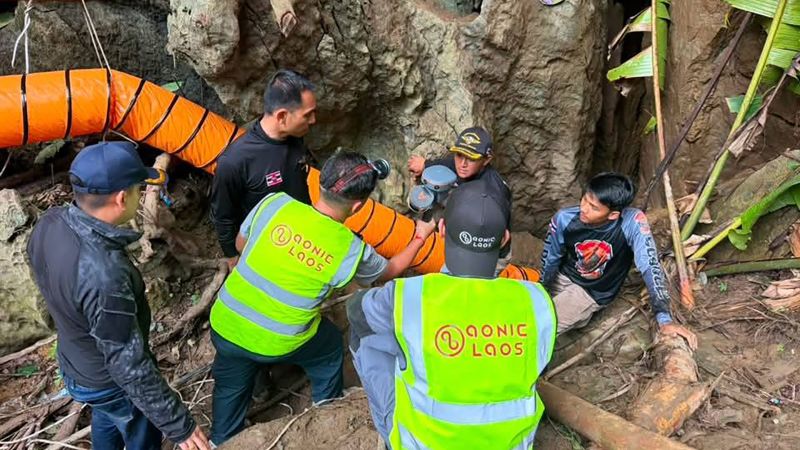
Environmental factors have compounded the challenges. Toxic hydrogen sulfide gas, a byproduct of decomposing organic matter, was detected in the cave, adding a layer of danger to the divers’ work. Additionally, deploying a pump to supply fresh air to the cavern proved difficult, leading to delays in the operation. The cave’s complex layout, with its bends and multiple chambers, further complicates the path forward. Rescuers must navigate these obstacles while maintaining constant communication to avoid collisions in the confined space.
A Tale of Resilience and Experience
The current rescue mission has drawn parallels to the 2018 dramatic operation in neighboring Thailand, where a group of teenage soccer players was saved from a flooded cave system. Some of the international divers involved in Laos’ mission are veterans of that event, bringing expertise and familiarity with similar challenges. Finnish diver Mikko Paasi, part of the team, emphasized the significance of the discovery while noting the ongoing difficulties.
“The task so far has been far from easy and everybody involved has done amazing work,” Paasi wrote on Instagram. However, he added, “it was only a brief relief, as the survivors are still stuck in the cavern for now.” The villagers, all male, were identified as the primary focus of the rescue, with their condition described as “all healthy and in good spirits” by Kengkad. Yet, the extraction process remains uncertain, requiring further planning and resources.
Despite their strength, the survivors are still vulnerable to the cave’s conditions. Paasi’s footage shows the men being asked for their names and whether they had any illnesses, with responses indicating they felt weak and extremely hungry. This highlights the need for immediate relief, as the extraction process will likely demand both physical endurance and technical precision. Kengkad explained that the group is approximately 200 meters inside the cave system, where elevation changes and narrow passages create additional hurdles.
Strategies for Extraction
Rescuers are now prioritizing strategies to lower water levels and facilitate the movement of survivors. Pumping operations are underway at multiple downstream points, aiming to reduce the flood’s impact and create a clearer path for the team. Kengkad noted that the optimal approach is to maintain a steady flow of water removal while preparing the survivors for a self-assisted exit. “If access can be opened further, rescuers believe the survivors are physically strong enough to help move themselves out with support from the teams,” he stated.
The process, however, requires specialized equipment. Divers are seeking stretchers designed for the cramped, narrow tunnels, as well as additional oxygen tanks—specifically 40-liter models—to sustain the operation. Kengkad stressed that the air supply inside the cave is insufficient, and the current oxygen levels limit each trip in and out to about an hour. This constraint means every movement must be meticulously planned to conserve resources and ensure the safety of both rescuers and survivors.
One of the cave’s most pressing challenges is the one-way nature of the route. Once inside, divers cannot easily backtrack, necessitating precise coordination to avoid missteps. The team has also been searching for vertical shafts that could provide alternative access points, potentially shortening the extraction process. These efforts reflect the adaptability of the rescuers, who are leveraging every available strategy to increase their chances of success.
The Journey into the Unknown
The villagers’ decision to enter the cave last Wednesday was driven by the pursuit of gold, a common activity in the region. However, the sudden onset of heavy rains transformed the cave into a perilous trap, blocking the exit and leaving the group stranded. Kengkad, who has been vocal about the mission, described the operation as “a race against time” and “a test of human resilience.” The emotional toll on the team is evident, as they balance the urgency of the situation with the need for careful execution.
While the five survivors have been stabilized, the remaining two continue to be a focus of concern. The cave’s labyrinthine structure makes it difficult to pinpoint their exact location, and the ever-present risk of low oxygen levels adds to the pressure. Kengkad acknowledged that the recovery of all seven individuals is a complex endeavor, requiring both technological ingenuity and unwavering determination. “Finding them was never enough. I immediately started planning how to transport them out afterward,” he said, underscoring the team’s commitment to completing the mission.
As the operation progresses, the international collaboration has become a cornerstone of the rescue. The expertise of the Thai and Finnish divers, alongside the local team, exemplifies the global effort to save lives in extreme conditions. With each new development, the hope grows that the remaining two villagers will soon join their counterparts above ground. The success of this mission could set a precedent for future cave rescues, demonstrating the power of teamwork and perseverance in the face of adversity.
For now, the survivors remain in their temporary refuge, a place of both danger and hope. The extraction process is poised to begin, but it will require sustained effort and ingenuity to overcome the cave’s challenges. As the divers continue their work, the world watches with anticipation, eager to see how this unprecedented rescue will unfold in the heart of a submerged labyrinth.