
Planet found orbiting a dead star could preview what will happen to our solar system
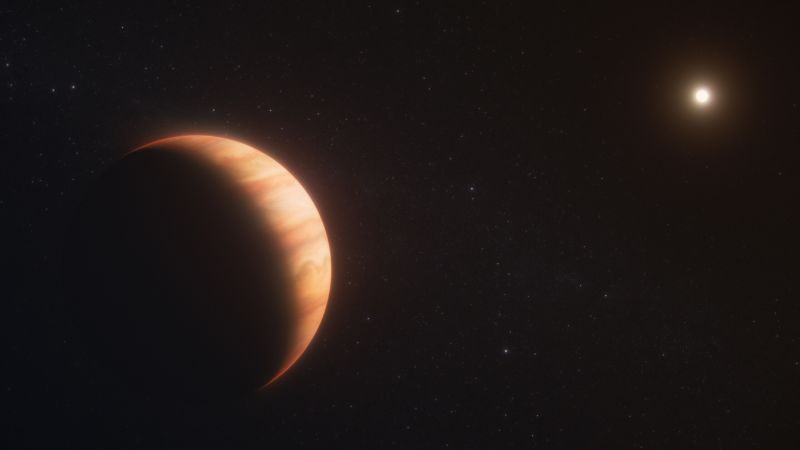
Planet Orbiting Dead Star Offers Solar System’s Future Preview
Planet found orbiting a dead star – A planet found orbiting a dead star has revealed a cosmic mystery that could offer insights into our solar system’s future. This newly discovered world, which is roughly seven times the size of Earth, now circles a white dwarf star at a distance of just 2 million miles. Such an unusual configuration challenges existing models of planetary survival, as the star it once orbited has long since collapsed into a dense, compact remnant. The findings, published in the Journal of Nature, provide a rare opportunity to observe what might happen to planets like ours as the sun ages and eventually dies.
Survival of WD 1856 b: A Cosmic Enigma
WD 1856 b, the planet in question, defies expectations. When a star like our sun exhausts its fuel, it expands into a red giant, engulfing inner planets and leaving behind a white dwarf. Yet, WD 1856 b remains in its orbit, suggesting it endured the star’s violent transformation. Researchers are still puzzled by how it survived, with theories pointing to gravitational interactions or tidal forces as possible explanations. Its existence raises questions about the resilience of planetary systems in the face of stellar evolution.
“The system around WD 1856 b is unlike anything we’ve seen before,” said Dr. Christopher O’Connor, a coauthor of the study. “It’s a glimpse into a possible future for our own planets.”
Dr. O’Connor, affiliated with Northwestern University’s Center for Interdisciplinary Exploration and Research in Astrophysics, highlighted the planet’s unique orbit. While the white dwarf is about the size of Earth, WD 1856 b is nearly seven times larger, creating an extreme gravitational relationship. This suggests the planet either migrated inward after the star’s expansion or was somehow protected during the engulfment phase. The data gathered by the James Webb Space Telescope has been instrumental in analyzing its atmospheric properties and orbital behavior.
Observational Challenges and Breakthroughs
Studying WD 1856 b required overcoming significant technical obstacles. White dwarfs emit far less light than their former selves, making it difficult to detect nearby planets. The planet’s transit—when it passes in front of the star—lasts only 8 minutes, akin to observing a fleeting shadow in a dark room. Researchers at Cornell University, including graduate student Victoria Boehm, noted that these conditions tested the limits of current observational tools.
Despite the challenges, the Webb telescope’s advanced instruments enabled precise measurements of the planet’s spectrum. This breakthrough allowed scientists to determine its composition and temperature, which exceeded predictions based on its proximity to the white dwarf. The findings indicate that WD 1856 b may have absorbed additional energy during its migration, potentially from interactions with stellar debris or tidal forces. These insights refine our understanding of how planets adapt to their host stars’ demise.
Unraveling the Planet’s Origin and Fate
Two primary theories attempt to explain WD 1856 b’s survival. The first posits that the planet was partially consumed by the star during its red giant phase but retained enough mass to persist as a gas giant. The second suggests gravitational tugs from other celestial bodies, such as a companion star or planetesimals, nudged it into its current orbit. Both scenarios imply that the planet experienced extreme conditions, reshaping its thermal and structural properties over time.
Regardless of the mechanism, the planet’s existence challenges the notion that all planets are doomed when their stars die. Instead, it demonstrates that some may endure, evolving in ways that were previously unimagined. The research team’s analysis of the planet’s atmosphere also revealed traces of heavy elements, hinting at its history of interactions with the star’s remnants. These findings could reshape future models of planetary survival and the long-term fate of stellar systems.
As the sun progresses through its life cycle, it will eventually expand into a red giant, potentially engulfing Mercury, Venus, and Earth. The WD 1856 b system serves as a prototype for what might happen to planets in our solar system. By studying how this planet has adapted to its dead star, scientists can better predict the future of worlds like ours, even as they face the inevitable heat and gravitational shifts of stellar aging.