Illegal excavation reveals grand Roman villa with elaborate mosaics

Daftar Isi
- Unexpected Discovery on Government Land
- The Excavation Process The illegal dig involved the use of heavy machinery, specifically a backhoe, to uncover a vast underground chamber concealed behind a series of protective fences. These barriers, which had been deliberately cut through by the perpetrators, masked the site’s significance from public view. While the operation disrupted parts of the villa’s structure, the damage was not severe, allowing for the recovery of key artifacts. Among the finds were intricate mosaics, meticulously crafted marble elements, and remnants of a statue believed to depict Silvanus, the Roman deity associated with rural landscapes. The statue, holding a small animal in one hand and a basket adorned with birds in the other, has sparked speculation about its symbolic and functional role in the villa’s design. Forensic archaeologists, working in tandem with the Carabinieri Art Police, have since taken over the site to ensure its preservation. This specialized unit, dedicated to combating the theft of Italy’s cultural heritage, played a pivotal role in halting the excavation. “In just a few days, officials from the Ministry of Culture, in collaboration with the Carabinieri, stopped a clandestine operation,” stated Italian Minister of Culture Alessandro Giuli in a statement released on Monday. “They secured an archaeological area and brought to light the remains of a splendid Imperial-era villa in the Roman countryside where the imperial residences of the Antonine dynasty were located.” The joint effort highlights the critical role of law enforcement in safeguarding historical treasures from the black market. Impact of Illegal Excavations For years, tomb raiders have systematically looted archaeological sites across Italy, often selling their finds to collectors or museums abroad. This practice has resulted in the loss of countless artifacts, many of which were later recovered through international cooperation. The current case underscores the ongoing challenges of preserving ancient sites, as the thieves targeted a location that was not only hidden but also protected by physical barriers. “The exceptional quality of the decorations testifies that the villa belonged to prominent members of the Roman aristocracy, closely linked to the Imperial court,” said Alessia Contino, an archaeologist with the Special Superintendency of Rome, during the unveiling of the discovery this week. Her words emphasize the villa’s status as a symbol of Roman opulence and political power. Authorities are now examining the extent of the damage caused by the unauthorized excavation. While some structural elements were mildly disturbed, the core of the villa remains intact, offering a rare glimpse into the architectural sophistication of the Imperial period. The presence of well-preserved mosaics, featuring black and white botanical and geometric motifs, has been particularly notable. These designs, which once adorned the entrance hall and atrium, suggest a blend of artistic creativity and practical functionality, with the sunken basin, or impluvium, serving as a central feature of the space. Preservation and Public Access
Unexpected Discovery on Government Land
Illegal excavation reveals grand Roman villa – In a surprising turn of events, a grand Roman villa with elaborate mosaics has been uncovered near the outskirts of Rome, thanks to a tip-off from concerned neighbors. The excavation, which took place on private property in Castel di Guido—approximately 12 miles from the Italian capital—was initially flagged as an unauthorized activity when authorities were called in February. Police reports indicate that the operation, conducted in secrecy, was halted after officials identified signs of illegal digging, including small dirt piles, nighttime activity, and the absence of authorization markers. This led to the revelation of a hidden treasure beneath the surface, one that could reshape historical understanding of Roman architecture and art.
Historical Significance of Lorium
The site, known as Lorium during the Imperial era, spanning from 27 BC to the fifth century AD, was once a thriving settlement of elite residences. According to the Ministry of Culture, this area was frequented by prominent figures such as Emperor Hadrian, Antoninus Pius, and Marcus Aurelius, suggesting its importance as a hub for imperial influence. The recently exposed villa, though still under investigation, appears to have been a part of this network of palatial structures. Its discovery has reignited interest in Lorium’s role in Roman society, with archaeologists eager to explore its connection to the Antonine dynasty.
The Excavation Process
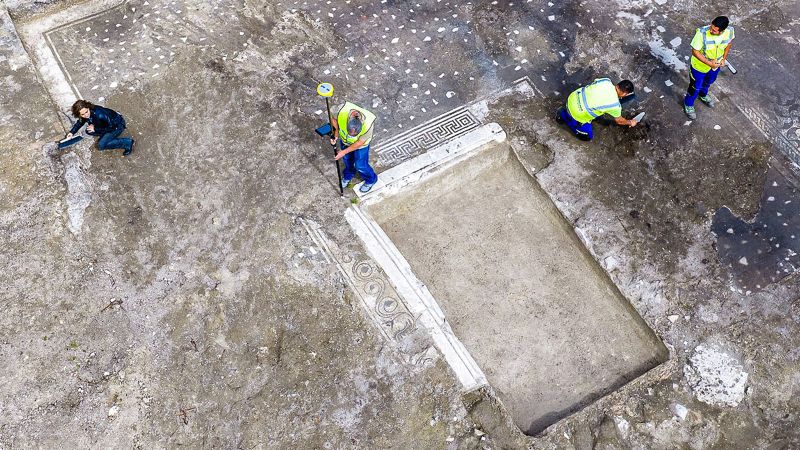
The illegal dig involved the use of heavy machinery, specifically a backhoe, to uncover a vast underground chamber concealed behind a series of protective fences. These barriers, which had been deliberately cut through by the perpetrators, masked the site’s significance from public view. While the operation disrupted parts of the villa’s structure, the damage was not severe, allowing for the recovery of key artifacts. Among the finds were intricate mosaics, meticulously crafted marble elements, and remnants of a statue believed to depict Silvanus, the Roman deity associated with rural landscapes. The statue, holding a small animal in one hand and a basket adorned with birds in the other, has sparked speculation about its symbolic and functional role in the villa’s design.
Forensic archaeologists, working in tandem with the Carabinieri Art Police, have since taken over the site to ensure its preservation. This specialized unit, dedicated to combating the theft of Italy’s cultural heritage, played a pivotal role in halting the excavation. “In just a few days, officials from the Ministry of Culture, in collaboration with the Carabinieri, stopped a clandestine operation,” stated Italian Minister of Culture Alessandro Giuli in a statement released on Monday. “They secured an archaeological area and brought to light the remains of a splendid Imperial-era villa in the Roman countryside where the imperial residences of the Antonine dynasty were located.” The joint effort highlights the critical role of law enforcement in safeguarding historical treasures from the black market.
Impact of Illegal Excavations
For years, tomb raiders have systematically looted archaeological sites across Italy, often selling their finds to collectors or museums abroad. This practice has resulted in the loss of countless artifacts, many of which were later recovered through international cooperation. The current case underscores the ongoing challenges of preserving ancient sites, as the thieves targeted a location that was not only hidden but also protected by physical barriers. “The exceptional quality of the decorations testifies that the villa belonged to prominent members of the Roman aristocracy, closely linked to the Imperial court,” said Alessia Contino, an archaeologist with the Special Superintendency of Rome, during the unveiling of the discovery this week. Her words emphasize the villa’s status as a symbol of Roman opulence and political power.
Authorities are now examining the extent of the damage caused by the unauthorized excavation. While some structural elements were mildly disturbed, the core of the villa remains intact, offering a rare glimpse into the architectural sophistication of the Imperial period. The presence of well-preserved mosaics, featuring black and white botanical and geometric motifs, has been particularly notable. These designs, which once adorned the entrance hall and atrium, suggest a blend of artistic creativity and practical functionality, with the sunken basin, or impluvium, serving as a central feature of the space.
Preservation and Public Access
The Ministry of Culture has announced plans to continue excavations while ensuring the site’s long-term protection. Although the culprits of the illegal dig remain at large, the artifacts recovered so far have already provided valuable insights into Roman domestic life. The discovery has also prompted discussions about the broader implications of such thefts, which have deprived the country of thousands of priceless items over the decades. Many of these lost treasures eventually found their way to museums worldwide, often through forged documentation or covert smuggling operations.
Some of the artifacts have since been repatriated, with notable examples including pieces returned to American institutions. This trend reflects a growing global effort to restore stolen cultural heritage to its rightful place. However, the current find in Castel di Guido may offer a new opportunity for public engagement, as the site is set to open for visits on Saturday. Invitations will be extended to visitors by appointment, marking the first time the villa’s grandeur is accessible to the general public. “The exceptional quality of the decorations testifies that the villa belonged to prominent members of the Roman aristocracy, closely linked to the Imperial court,” Contino reiterated in a statement, underscoring the site’s historical value and the need for careful preservation.
The discovery has also raised questions about the methods used by tomb raiders. Unlike traditional excavations, which follow meticulous documentation protocols, these illicit operations often prioritize speed and secrecy. The use of heavy machinery to create a cavernous space beneath the surface highlights the technological advancements employed by modern looters. Despite this, the villa’s intact mosaics and structural elements suggest that the site’s location and design offered a degree of protection against complete destruction. The Carabinieri Art Police, which has been instrumental in combating such thefts, continues to monitor the area to prevent further damage.
As the excavation progresses, archaeologists anticipate uncovering more details about the villa’s layout and its connection to the Imperial court. The site’s proximity to Rome’s historical heart adds to its significance, as it may represent a lesser-known extension of the capital’s ancient infrastructure. This find serves as a reminder of the delicate balance between human curiosity and the need for responsible stewardship of cultural heritage. With further excavations scheduled, the villa’s secrets are expected to unfold, offering a deeper understanding of Roman life and the enduring legacy of its artistic achievements.
The incident in Castel di Guido has also prompted a reevaluation of how government land is managed for archaeological purposes. While the site was initially overlooked due to its remote location, the unauthorized excavation has highlighted vulnerabilities in current oversight. As the Ministry of Culture works to secure the area, they are also considering measures to prevent future thefts. The public unveiling of the villa’s findings is a step toward fostering appreciation for Roman history, ensuring that these ancient wonders are not only preserved but also shared with a wider audience. The upcoming access to the site represents a turning point, where the past and present intersect in a celebration of cultural heritage.
In conclusion, the illegal excavation has revealed a remarkable glimpse into the Roman world, with the villa’s mosaics and architecture standing as testaments to the empire’s artistic and political sophistication. The collaboration between law enforcement and archaeologists demonstrates the importance of interdisciplinary efforts in protecting historical sites. As the story of this discovery continues to unfold, it serves as both a warning and a triumph, showcasing the resilience of Rome’s legacy in the face of modern challenges.