
Egypt uncovers lost Byzantine-era city in the western desert
Egypt uncovers lost Byzantine-era city in the western desert
Egypt uncovers lost Byzantine era city – On Saturday, the Egyptian government revealed two significant archaeological discoveries, one of which is a remarkably intact residential city from the Byzantine era hidden in the western desert. The find, located in the Dakhla Oasis, has sparked excitement among historians and cultural enthusiasts, as it offers a rare glimpse into the daily lives and urban landscapes of ancient Egyptians during the fourth century. These revelations, alongside another site in Alexandria, are expected to play a crucial role in revitalizing Egypt’s tourism industry, which has long relied on its rich historical heritage.
Unearthing a Window into the Past
The Dakhla Oasis, situated in the New Valley province, is a remote region that has remained largely unexplored until now. Archaeologists have uncovered a network of streets and buildings that suggest a thriving community, with north-south pathways intersecting east-west roads to create open squares and communal areas. Hisham el-Leithy, secretary general of the supreme council of antiquities, emphasized that these structures provide invaluable insights into how people lived and interacted in the region during the Byzantine period. The discovery is particularly notable because it highlights the continued relevance of Egypt’s ancient history in shaping modern cultural identity.
“The first discovery reveals details of daily life, urban development and economic activities in the Dakhla Oasis in the fourth century,” el-Leithy stated, underscoring the significance of the findings. “This was a time when Egypt was part of the Byzantine empire, and the settlement offers a unique snapshot of that era.”
Among the most striking elements of the site is a basilica church, dating back to the mid-fourth century, which stands at the heart of the settlement. The church overlooks the city’s main thoroughfares, suggesting it was a central hub for religious and social gatherings. Additionally, remnants of two watchtowers were found, which archaeologists believe were designed to protect the city’s outer boundaries. Mahmoud Massoud, who leads the archaeological mission, noted that these structures indicate a strategic focus on security and community organization.
Artifacts of Faith and Commerce
Further excavations have yielded a wealth of artifacts, including a heavily fortified building with thick defensive walls and residential quarters composed of reception halls and vaulted roofs. One particularly intriguing find is the “house of Tisous,” a structure associated with a church deacon from the second half of the fourth century. Experts suspect it functioned as a domestic church before the construction of the central basilica. The site also features bread ovens, kitchens, and stone grinding tools, suggesting a complex system of food production and trade.
“We found a collection of about 200 pottery fragments which would have been used as writing material,” Diaa Zahran, head of the Islamic, Coptic and Jewish Antiquities department, explained. “These octraca have inscriptions detailing commercial transactions, correspondence, and other aspects of daily life, offering a tangible link to the past.”
Another remarkable discovery is a group of bronze coins bearing the portraits of Byzantine emperors, Latin inscriptions, and Christian symbols. These coins, alongside gold pieces from the reign of Roman emperor Constantius II (337–361), provide evidence of the region’s economic and religious ties during the fourth century. The presence of such artifacts underscores the cultural fusion that characterized the area at the time.
Marina el-Alamein: A New Chapter in History
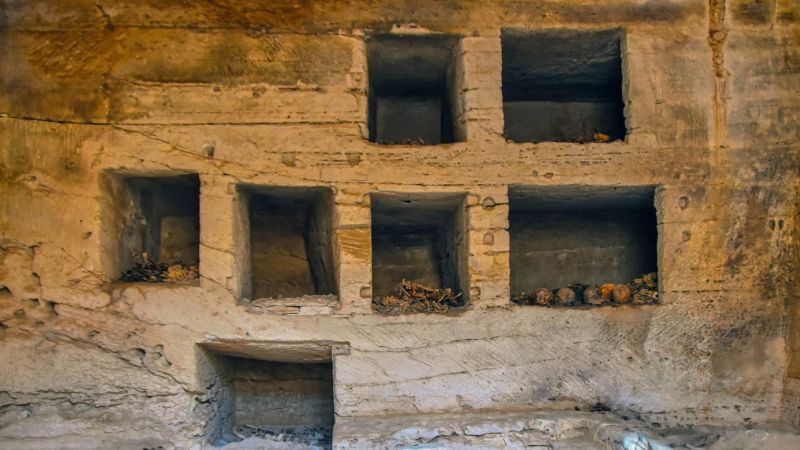
Separately, archaeologists have made breakthroughs at the Marina el-Alamein site, located approximately 100 kilometers west of Alexandria. This site has yielded 18 ancient tombs, bringing the total to 48. The tombs include 11 rock-cut structures, averaging 8 meters in depth, and seven surface limestone-built ones. These findings have deepened understanding of burial practices and the site’s historical significance.
“Close to the sarcophagus, they found the remains of a plaster sphinx statue,” said Eman Abdel-Khaliq, the mission chief. “Additionally, four gold pieces were placed inside the mouths of some deceased individuals, a practice known as ‘the golden tongue,’ which was believed to aid in the afterlife.”
The Marina el-Alamein site is believed to be the ancient Greco-Roman port city of Leukaspis, which was established in the second century and thrived until the fourth century. This connection to a bygone era highlights the region’s historical role in trade and cultural exchange. The newly discovered tombs, along with pottery vessels, amphorae, lamps, and limestone basins, paint a vivid picture of the site’s past.
Revitalizing Tourism After Years of Challenges
Egypt’s tourism sector has been making a comeback following years of political instability and violence after the 2011 uprising, as well as the disruptions caused by the coronavirus pandemic. The country’s ability to attract visitors has improved significantly, with record numbers of tourists visiting in 2025. According to official statistics, 19 million tourists traveled to Egypt last year, marking a 21% increase from 2024. In the first four months of 2026 alone, 6.1 million tourists arrived, compared to 5.7 million during the same period in 2025.
The recent discoveries are part of a broader strategy to enhance Egypt’s appeal as a destination for cultural and historical tourism. These finds, along with others, are seen as key to drawing more international visitors to the country. The Dakhla Oasis, which is on UNESCO’s Tentative List, has the potential to be added to the World Heritage List, further elevating its status as a site of global importance.
As the Egyptian government continues to invest in archaeological projects, these unveilings serve as a testament to the country’s enduring historical legacy. The combination of ancient architecture, religious artifacts, and evidence of daily life not only enriches Egypt’s cultural narrative but also reinforces its position as a crucial player in the world of archaeology and tourism. With each new discovery, the story of Egypt’s past becomes more intricate, offering generations of visitors and scholars a deeper connection to the land’s storied history.