East Asia’s tallest tree is the ‘Heaven Sword,’ an environmental guardian

East Asia’s Tallest Tree Unveiled: A Guardian of Nature’s Majesty
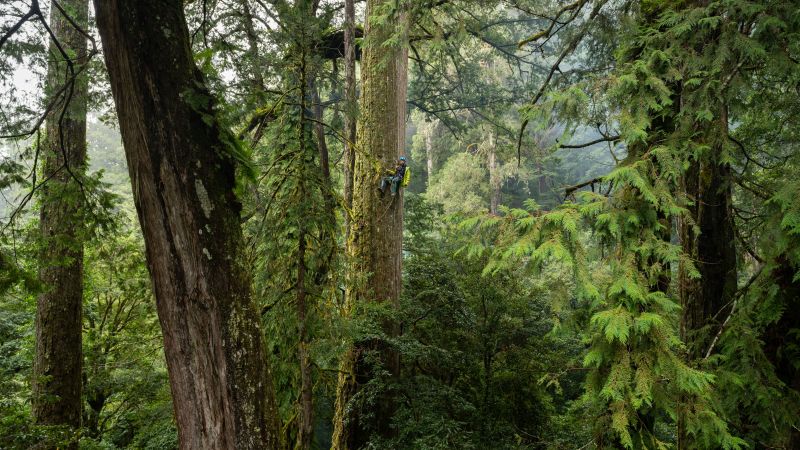
East Asia s tallest tree is – After a decade-long investigation, a team of researchers has pinpointed the tallest tree in East Asia, a towering Taiwania cryptomerioides named “Heaven Sword of the Da’an River.” This moniker, borrowed from Jin Yong’s legendary martial arts tales, reflects the tree’s mythical stature and its location near the island’s longest river. The discovery, made in a secluded valley, highlights the persistence of scientists and the intricate interplay between nature and human effort to uncover Earth’s hidden wonders.
A Fusion of Tradition and Technology
The journey to locate the Heaven Sword began with a blend of cultural knowledge and cutting-edge science. The Indigenous Rukai people, who have long inhabited Taiwan’s southern mountain ranges, refer to this species as “the tree that hits the moon,” a phrase that captures its towering presence. The tree’s scientific name, Taiwania cryptomerioides, is a testament to its endemic status in the region. Despite its grandeur, the Heaven Sword’s height of 84.1 meters (276 feet) falls short of the world’s tallest living tree, Hyperion, which stands at 116 meters (381.3 feet) in California’s Redwood National Park.
Identifying the Heaven Sword required a combination of aerial surveys and hands-on exploration. The team, composed of professional tree climbers, ecologists, and remote-sensing specialists, employed lidar technology to map Taiwan’s towering forests. By analyzing light pulses reflected from aircraft, they generated a 3D representation of the landscape, revealing the tree’s position amid the dense canopy. However, the process was not without obstacles. Taiwan’s rugged terrain and uneven ground often distorted remote-sensing data, making it difficult to distinguish between accurate measurements and those influenced by nearby features like steep cliffs.
The Role of Citizen Science in Validation
In 2020, the researchers invited the public to assist in verifying their findings. The collaboration with citizen scientists proved pivotal. Analysis of the lidar images showed that 93% of the trees had been incorrectly tallied by the algorithm, which overestimated their height due to topographical anomalies. This revelation spared the team from the laborious task of climbing numerous shorter trees, emphasizing the importance of human oversight in scientific data.
The breakthrough came when the group decided to scale the Heaven Sword directly. Using a tape measure, they confirmed its height in a traditional yet effective manner. This approach underscored the value of combining high-tech methods with time-honored practices. As Dr. Rebecca Chia-Chun Hsu, lead author of the study, noted, “The careful and creative mix of methods we used could revolutionize how we identify large trees on a larger scale.” Her insight highlights the broader implications of their work for global conservation efforts.
Environmental Legacy and Human Impact
Dr. Hsu emphasized that Taiwan’s unique environment has preserved these colossal trees for centuries. The island’s consistent rainfall and stable climate have allowed certain species, like the Taiwania fir, to thrive for thousands of years. However, human activity has left its mark. Industrial logging between 1912 and 1991 significantly reduced ancient forests, yet the steep, inaccessible terrain protected many of these giants from being harvested. Today, most of the tallest trees grow in protected areas, ensuring their survival for future generations.
The discovery of the Heaven Sword also ties into the history of the region’s forest conservation. The Rukai people’s oral traditions, passed down through generations, have long spoken of the tree’s presence. Their knowledge, combined with modern scientific tools, has created a bridge between indigenous wisdom and contemporary research. This partnership not only aids in mapping the island’s biodiversity but also fosters a deeper understanding of the ecological and cultural significance of these ancient forests.
Broader Implications for Biodiversity Conservation
Experts view the identification of the Heaven Sword as a critical step in protecting Taiwan’s biodiversity. The team’s work, detailed in a study published in Frontiers in Forests and Global Change, demonstrates how interdisciplinary approaches can address complex environmental challenges. By integrating remote-sensing data with field verification and community input, they’ve set a precedent for conservation initiatives worldwide.
“Industrial logging between 1912 and 1991 depleted some of Taiwan’s ancient forests,” Dr. Hsu explained in a
blockquote>blockquote>blockquote>blockquote>blockquote>blockquote>blockquote>blockquote>blockquote>blockquote>blockquote>blockquote>blockquote>blockquote>blockquote>blockquote>blockquote>blockquote>blockquote>blockquote>blockquote>blockquote>blockquote>blockquote>blockquote>blockquote>blockquote>blockquote>blockquote>blockquote>blockquote>blockquote>blockquote>blockquote>blockquote>blockquote>blockquote>blockquote>blockquote>blockquote>blockquote>blockquote>blockquote>blockquote>blockquote>blockquote>blockquote>blockquote>blockquote>blockquote>blockquote>blockquote>blockquote>blockquote>blockquote>blockquote>blockquote>blockquote>blockquote>blockquote>blockquote>blockquote>blockquote>blockquote>blockquote>blockquote>blockquote>blockquote>blockquote>blockquote>blockquote>blockquote>blockquote>blockquote>blockquote>blockquote>blockquote>blockquote>blockquote>blockquote>blockquote>blockquote>blockquote>blockquote>blockquote>blockquote>blockquote>blockquote>blockquote>blockquote>blockquote>blockquote>blockquote>blockquote>blockquote>blockquote>blockquote>blockquote>blockquote>blockquote>blockquote>blockquote>blockquote>blockquote>blockquote>blockquote>blockquote>blockquote>blockquote>blockquote>blockquote>blockquote>blockquote>blockquote>blockquote>blockquote>blockquote>blockquote>blockquote>blockquote>blockquote>blockquote>blockquote>blockquote>blockquote>blockquote>blockquote>blockquote>blockquote>blockquote>blockquote>blockquote>blockquote>blockquote>blockquote>blockquote>blockquote>blockquote>blockquote>blockquote>blockquote>blockquote>blockquote>blockquote>blockquote>blockquote>blockquote>blockquote>blockquote>blockquote>blockquote>blockquote>blockquote>blockquote>blockquote>blockquote>blockquote>blockquote>blockquote>blockquote>blockquote>blockquote>blockquote>blockquote>blockquote>blockquote>blockquote>blockquote>blockquote>blockquote>blockquote>blockquote>blockquote>blockquote>blockquote>blockquote>blockquote>blockquote>blockquote>blockquote>blockquote>blockquote>blockquote>blockquote>blockquote>blockquote>blockquote>blockquote>blockquote>blockquote>blockquote>blockquote>blockquote>blockquote>blockquote>blockquote>blockquote>blockquote>blockquote>blockquote>blockquote>blockquote>blockquote>blockquote>blockquote>blockquote>blockquote>blockquote>blockquote>blockquote>blockquote>blockquote>blockquote>blockquote>blockquote>blockquote>blockquote>blockquote>blockquote>blockquote>blockquote>blockquote>blockquote>blockquote>blockquote>blockquote>blockquote>blockquote>blockquote>blockquote>blockquote>blockquote>blockquote>blockquote>blockquote>blockquote>blockquote>blockquote>blockquote>blockquote>blockquote>blockquote>blockquote>blockquote>blockquote>blockquote>blockquote>blockquote>blockquote>blockquote>blockquote>blockquote>blockquote>blockquote>blockquote>blockquote>blockquote>blockquote>blockquote>blockquote>blockquote>blockquote>blockquote>blockquote>blockquote>blockquote>blockquote>blockquote>blockquote>blockquote>blockquote>blockquote>blockquote>blockquote>blockquote>blockquote>blockquote>blockquote>blockquote>blockquote>blockquote>blockquote>blockquote>blockquote>blockquote>blockquote>blockquote>blockquote>blockquote>blockquote>blockquote>blockquote>blockquote>blockquote>blockquote>blockquote>blockquote>blockquote>blockquote>blockquote>blockquote>blockquote>blockquote>blockquote>blockquote>blockquote>blockquote>blockquote>blockquote>blockquote>blockquote>blockquote>blockquote>blockquote>blockquote>blockquote>blockquote>blockquote>blockquote>blockquote>blockquote>blockquote>blockquote>blockquote>blockquote>blockquote>blockquote>blockquote>blockquote>blockquote>blockquote>blockquote>blockquote>blockquote>blockquote>blockquote>blockquote>blockquote>blockquote>blockquote>blockquote>blockquote>blockquote>blockquote>blockquote>blockquote>blockquote>blockquote>blockquote>blockquote>blockquote>blockquote>blockquote>blockquote>blockquote>blockquote>blockquote>blockquote>blockquote>blockquote>blockquote>blockquote>blockquote>blockquote>blockquote>blockquote>blockquote>blockquote>blockquote>blockquote>blockquote>blockquote>blockquote>blockquote>blockquote>blockquote>blockquote>blockquote>blockquote>blockquote>blockquote>blockquote>blockquote>blockquote>blockquote>blockquote>blockquote>blockquote>blockquote>blockquote>blockquote>blockquote>blockquote>blockquote>blockquote>blockquote>blockquote>blockquote>blockquote>blockquote>blockquote>blockquote>blockquote>blockquote>blockquote>blockquote>blockquote>blockquote>blockquote>blockquote>blockquote>blockquote>blockquote>blockquote>blockquote>blockquote>blockquote>blockquote>blockquote>blockquote>blockquote>blockquote>blockquote>blockquote>blockquote>blockquote>blockquote>blockquote>blockquote>blockquote>blockquote>blockquote>blockquote>blockquote>blockquote>blockquote>blockquote>blockquote>blockquote>blockquote>blockquote>blockquote>blockquote>blockquote>blockquote>blockquote>blockquote>blockquote>blockquote>blockquote>blockquote>blockquote>blockquote>blockquote>blockquote>blockquote>blockquote>