Curfew established around Newark ICE facility after days of protests

Newark ICE Facility Implements Nightly Curfew Amid Ongoing Protests
Curfew established around Newark ICE facility – The city of Newark, New Jersey, has imposed a nightly curfew around the Delaney Hall immigration detention center, a facility that has become the epicenter of recent demonstrations. The measure, enacted after several days of unrest, aims to address the growing tensions between protesters and law enforcement following incidents of aggressive behavior and the use of weapons by some demonstrators. The curfew, which began at midnight on Sunday, will remain in place from 9 p.m. to 6 a.m. each night until further notice, according to the city’s statement.
Mayor’s Statement on Escalating Tensions
Newark Mayor Ras J. Baraka issued a statement early Sunday, emphasizing the need for immediate action to safeguard public safety. “The situation at Delaney Hall has intensified, requiring swift intervention to prevent harm,” he said. Baraka highlighted that multiple arrests had already been made, with some protesters found in possession of weapons, which he described as a clear indicator of the growing threat to safety.
“Due to the escalating situation at Delaney Hall and the increasing need for police intervention, immediate action is required to protect public safety. Multiple individuals have already been arrested and found in possession of weapons, underscoring the seriousness of the threat,” Baraka stated.
Family Visitation Resumes Following Governor’s Demand
Separately, New Jersey Governor Mikie Sherrill confirmed that the Department of Homeland Security had met her request to reinstate family visitation at the facility. “Limited visitation will resume at noon Sunday, with regular hours restored Monday,” she said. The governor’s announcement came as the state continued to balance concerns over detainee conditions with efforts to maintain operational stability at the 1,000-bed center.
Clashes and Escalating Protests
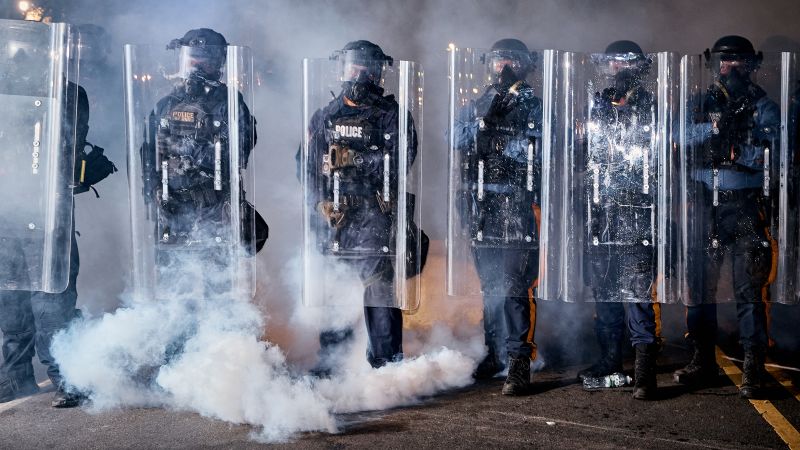
The curfew followed renewed confrontations between protesters and law enforcement outside Delaney Hall on Saturday night. Witnesses described a tense standoff where demonstrators, some wearing masks, breached the protective barrier around the facility and engaged in aggressive acts against police. These actions included the use of barriers as weapons, the throwing of projectiles, and the lighting of tires in the street, according to Sherrill.
“Last night, masked individuals at Delaney Hall attacked the barrier in the protected protest area and began aggressive and dangerous actions against Newark and New Jersey State Police, including throwing projectiles, utilizing the barriers as weapons, and lighting tires on fire in the street,” Sherrill said.
Video footage from the scene showed mounted officers moving through the crowd, with tear gas visible in the air. Protesters, meanwhile, used chairs and debris to start fires, creating a chaotic environment. The clashes occurred hours after a pro-ICE group had previously faced off with anti-ICE demonstrators at the same location, escalating the already volatile atmosphere.
Hunger Strike and Allegations of Poor Conditions
Detainees’ legal representatives indicated that tensions intensified during the Memorial Day weekend, citing a widespread hunger strike over deteriorating food quality and poor living conditions. Some lawyers claimed hundreds of detainees had participated in the protest, demanding better treatment and highlighting the presence of worms in their meals. However, the Department of Homeland Security contested the existence of the hunger strike, dismissing it as a politically motivated event.
Statements from Homeland Security Officials
Homeland Security Secretary Markwayne Mullin has faced criticism for his comments during his initial two months in office, including remarks on the conditions at Delaney Hall. “No lawbreakers in the history of human civilization have been better treated than illegal aliens. They are provided 3 meals a day, medical care, and receive full due process,” Mullin asserted in a statement.
“Many detainees have been subjected to having worms in their food, and I wouldn’t say, as Mr. Mullin stated, that is an ‘ethnic choice of food’ – I think they just don’t want to eat worms,” said Alex Minogue, an attorney at Nova Law Group representing individuals at the facility.
Mullin’s defense of the facility has drawn sharp responses from critics, who argue that the conditions reflect systemic neglect. Congressional oversight visits to the center continue, with House Minority Leader Hakeem Jeffries visiting on Sunday and reporting unsanitary living conditions, insufficient medical care, and substandard food quality. “I learned of unsanitary living conditions, lack of adequate medical care, and unhealthy food,” Jeffries said, vowing to ensure detainees are treated with dignity.
Law Enforcement Response and Protest Orderliness
Despite the chaos, law enforcement officials maintained that the protests remained orderly. State Police Lieutenant Colonel David Sierotowicz noted at an afternoon news conference that demonstrators had acted within bounds, even as a SWAT team arrived in full riot gear to support officers. “The protest remained orderly,” he stated, underscoring the balance between security and peaceful assembly.
Extremist Groups and Public Safety Concerns
Sherrill acknowledged the involvement of certain “national extremist groups” in Saturday’s protest, though she did not specify which organizations were responsible. “I do not know why these individuals attacked or what they wanted to accomplish, but I refuse to let these dangerous actions detract from New Jersey’s dedication to ensuring public safety, keeping people safe from ICE, and that the people detained inside Delaney Hall are treated with dignity,” she added.
Community and Political Reactions
As the protests continue, the community and political leaders have voiced mixed reactions. While some advocate for stricter oversight, others emphasize the need for swift action to prevent further escalation. The situation at Delaney Hall has become a flashpoint for broader debates about immigration policy, with critics accusing the administration of prioritizing deportations over humane treatment.
Protesters have consistently highlighted the alleged mistreatment of detainees, with conditions in the facility under scrutiny for months. The repeated clashes between demonstrators and law enforcement have raised questions about the effectiveness of security measures and the potential for violence. Meanwhile, the governor’s decision to restore family visitation has been seen as a concession to public pressure, though officials maintain that the facility operates within legal standards.
The ongoing protests reflect a growing divide between those supporting the immigration enforcement agency and those opposing its practices. With the curfew in effect and the hunger strike controversy unresolved, the situation at Delaney Hall remains a focal point for activism and political discourse. As the week progresses, the city and state continue to monitor the situation, balancing the need for safety with the right to protest.
Summary of Key Developments
Delaney Hall’s role in the protests underscores the challenges faced by the U.S. immigration system. The curfew, family visitation resumption, and clashes highlight the intensity of the public’s concern. While the Department of Homeland Security defends its operations, legal representatives and lawmakers argue for greater transparency and accountability. As the situation evolves, the impact on detainees and the broader community will remain a central issue in the national conversation about immigration policy.