
An ICE officer fired at an SUV fleeing a car stop in Pennsylvania. That’s not how it should happen, policing experts say
Immigration Enforcement Vehicle Stops Under Scrutiny After Pennsylvania Incident
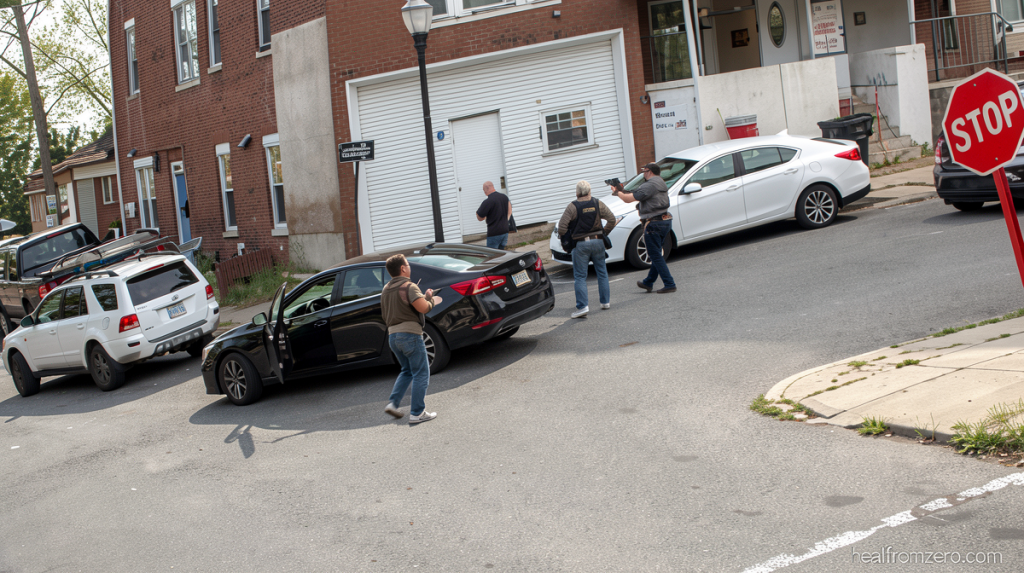
An ICE officer fired at an SUV – Surveillance footage from Harrisburg, Pennsylvania, has cast new light on the tactics employed by federal immigration officers during routine traffic stops. The video, acquired by local affiliate WGAL, captures a tense early morning encounter on July 1 that experts say reveals significant shortcomings in how ICE agents handle vehicle pursuits.
According to the recorded footage, officers initiated a traffic stop involving a white SUV. An unmarked Immigration and Customs Enforcement vehicle positioned itself directly ahead of the SUV to prevent escape, while additional law enforcement cars secured the rear position. One officer approached the driver’s side door and issued a command for the occupant to exit the vehicle immediately.
When the driver failed to respond to repeated orders, an officer broke through the window. The SUV then accelerated away, apparently making contact with the stationary ICE vehicle before proceeding in the wrong direction along a one-way street. During this escape attempt, an ICE officer discharged his firearm as the SUV struck a parked automobile.
Conflicting Accounts of the Incident
In an official statement, an ICE representative characterized the driver as someone with a documented criminal background including assault charges, hit-and-run offenses, and a domestic disturbance. The agency claimed the individual “weaponized his car and rammed an ICE law enforcement vehicle” before fleeing the scene with an officer’s weapon discharged.
However, Kenneth Corey, the former chief of department for the New York Police Department, offered a different interpretation based on the surveillance evidence. He noted that while the vehicle sustained minor damage, it certainly did not ram its way through the blockade.
“The vehicle pulls in front to stop the car from fleeing, but isn’t even effective at doing that. It’s not even properly positioned to do that because the guy’s pretty easily able to get around him,” Corey explained. “He takes a little sideswipe damage, but he doesn’t ram his way out of that, by any means.”
Training Deficiencies Exposed
Corey identified several missed opportunities for a safer resolution to the car stop. He attributed these errors partly to the agents’ limited experience managing such scenarios, suggesting this inexperience may be fueling similar confrontations nationwide.
“I think that just goes to the lack of practice in these situations where the agents are almost having to kind of make it up as they go along,” Corey stated. “While they received some training a number of years ago on how to do this, it’s not something that they’ve really executed well in the real world.”
The Harrisburg episode occurred within a narrow timeframe of two other fatal ICE-related shootings. Days earlier, an agent in Houston fatally shot a 52-year-old man during a vehicle stop. Less than seven days after Harrisburg, another ICE officer killed a 25-year-old man in Maine. Neither victim was the specific target of immigration enforcement actions.
Shifting Immigration Enforcement Strategy
These incidents sparked community vigils and intensified criticism of the Trump administration’s immigration policies. Following the Maine shooting, ICE temporarily suspended most vehicle stops, though President Donald Trump quickly reversed this decision. Mass deportations have become a defining feature of his second term.
Experts noted that vehicle stops were not historically central to ICE operations. Agents traditionally apprehended individuals from local jails or targeted locations like homes and workplaces. However, the administration’s objective of achieving 2,000 immigration-related arrests daily has transformed this approach.
“They didn’t really try to pick people up off the street the way they are now,” Corey observed. “So now you’ve shifted these tactics into really what’s more akin to local policing.”
While all federal law enforcement officers receive vehicle stop training upon joining, experts emphasize that ICE’s recent tactical shift occurred without corresponding additional education. Former acting ICE director John Sandweg highlighted that experienced agents had not performed these operations for eight to ten years.
Concerns about officer preparation have grown, particularly after the administration reduced mandatory training days for ICE agents. A CNN analysis revealed that these officers receive substantially less training than nearly every other federal agent carrying a badge and firearm.
“I really feel for the agents,” Corey expressed. “There’s been this change in approach without the commensurate retraining and practice that’s kind of needed.”
A Department of Homeland Security spokesperson informed CNN that the agency plans to implement supplementary training programs, including specialized instruction for high-risk vehicle stops and crowd management situations. The agency also re-extended certain operational guidelines to address these concerns.