
A chance encounter led to one of the largest T. rexes ever found. Now, it could be ‘lost to science’
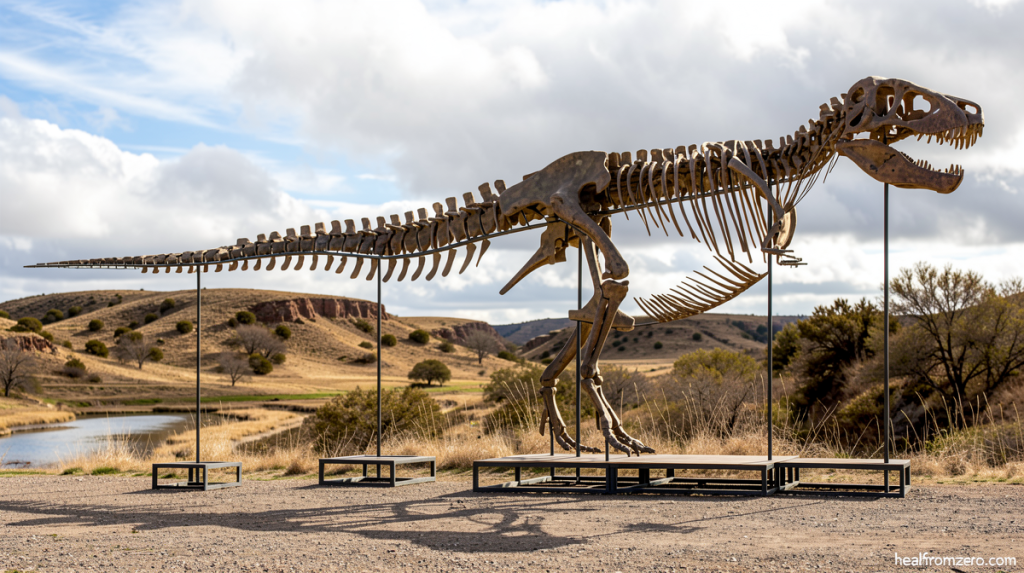
Gus the T. Rex: A Giant Fossil Headed for the Auction Block
A chance encounter led to one of the most significant paleontological discoveries of recent decades. Long before this massive creature earned its title among history’s greatest hunters, or found itself mentioned in the fine print of an auction catalog, the late Gary “Gus” Licking held a deep conviction. The South Dakota cattle rancher believed his sprawling property concealed something extraordinary. His estate rests inside the famous Hell Creek Formation, a legendary geological repository spanning Montana, Wyoming, and both Dakotas. This region stands as the premier location globally for uncovering Tyrannosaurus rex, the most iconic dinosaur species. The very name T. rex was derived from fossils unearthed within these boundaries, and the first skeleton of this predator was recovered here in 1902.
Not far from Licking’s land, another nearly intact skeleton called Stan was unearthed. That remarkable specimen shattered records when it sold for $31.8 million in 2020. Today, the rancher’s 6,500-acre holding in Harding County is contributing its own legacy to the Hell Creek narrative. A new fossil, comparable in magnitude to Stan, has emerged from the soil. Named Gus in tribute to Licking, this skeleton is scheduled for sale at Sotheby’s in New York City on Tuesday. If the bidding goes as expected, it could claim the title of the world’s most costly fossil ever sold.
A Chance Meeting Changes History
The journey of Gus began with an unexpected encounter. Licking had collected dinosaur teeth and bones over many years, always hoping for a monumental discovery. That hope materialized when he met a stranger who would help turn his dream into reality. Thomas Heitkamp, a commercial paleontologist leading Theropoda Expeditions, had the Licking ranch on his list of prime excavation sites due to its prime location within the Hell Creek formation.
“I was passing by the ranch randomly one day and Gary was checking a watering trough near the road, so I stopped and introduced myself,” Heitkamp recalled. “The Licking ranch had been on my radar because of its location within the Hell Creek formation. Gary had always been interested in fossils and artifacts, and he had quite a good collection of things he had found in his home.”
Heitkamp noted that Licking understood the richness of his land better than most. He believed that with enough searching, a significant find was inevitable. Heitkamp and his crew located Gus on the property in 2021. Although Licking pointed out the general area where the skeleton lay, he passed away before the digging was finished, never witnessing the full reveal of his prized possession. This timing adds a poignant layer to the story, as the rancher who first suspected greatness would not live to see his discovery auctioned to the highest bidder.
Dimensions and Scientific Significance
According to Sotheby’s, Gus measures 38 feet in length and stands 12.5 feet tall, with a skull spanning 54 inches. It ranks among the largest T. rex specimens ever documented. The fossil comprises 183 distinct bone elements. By bone count, it is approximately 61 percent complete, while mass-based calculations place its completeness between 75 and 80 percent. While this makes Gus one of the most thorough examples found, it falls slightly short of Stan’s 70 percent bone count and Sue’s impressive 90 percent completeness. Sue remains the benchmark, having been the first dinosaur fossil sold at auction back in 1997.
Beyond its size, Gus displays fascinating physical evidence of its life. The fossil bears bite marks and shows signs of healed fractures, suggesting the dinosaur survived injuries during its lifetime. Sotheby’s suggests these features could enhance the scientific value of the specimen. However, formal scientific papers regarding Gus are currently absent. Many researchers hope the auction will eventually lead to the fossil being acquired by a museum or research institution where it can receive proper study. Without such documentation, there is genuine concern that Gus could be lost to science if purchased by a private collector who keeps it in storage or displays it without conducting thorough analysis.
The potential loss of Gus to scientific research highlights a growing debate in paleontology. As private collectors increasingly enter the market, the question of whether fossils should remain accessible to the public and scientific community becomes more pressing. Gus represents not just a magnificent specimen, but a piece of Earth’s history that could provide valuable insights into the behavior and biology of Tyrannosaurus rex. Whether it finds a permanent home in a museum or becomes part of a private collection, one thing is certain: this fossil, discovered through a chance encounter, has already captured the world’s attention and will continue to do so for years to come.