
The American town that keeps rising from the ashes
The American town that keeps rising from the ashes
The American town that keeps rising – Lawrence, Kansas, is a city where history and modernity coexist in a delicate balance. Its downtown area, particularly the iconic Massachusetts Street, stands as a testament to resilience, blending independent commerce, cultural vibrancy, and a rich tapestry of social movements. Though the street is lined with charming boutiques, eateries, and art spaces, it’s far more than a commercial corridor—it’s a living chronicle of the town’s turbulent past and enduring spirit.
A battleground of ideals
Massachusetts Street, affectionately dubbed “Mass” by locals, is a microcosm of Lawrence’s dual identity. On one hand, it radiates the warmth of a small-town community, with its sidewalks bustling with locals and students. On the other, it has been a site of significant conflict, symbolizing the broader struggles that have shaped American history. The street’s charm is matched only by its role as a stage for social and political upheaval, from violent clashes to peaceful protests.
Lawrence’s story began in 1854, when abolitionists established the town as a beacon of hope for those seeking freedom from slavery. Just months after its founding, it became a target of pro-slavery forces, who attacked the community in a bid to suppress its ideals. The town endured further devastation in 1863, when Confederate raiders led by William Quantrill unleashed a brutal assault, killing over 150 residents. Yet, Lawrence’s spirit was unbroken, and it rose again, eventually becoming a critical node on the Underground Railroad, aiding countless escapees to liberty.
The soul of a town in the spotlight
Today, Lawrence’s downtown thrives with energy, but its legacy of resistance remains palpable. The heart of the city is a brick-lined space where history and contemporary life intertwine. The Eldridge Hotel, rebuilt twice after destruction, stands as a symbol of perseverance. This summer, it even hosts the Algerian national soccer team, a nod to its global influence and enduring appeal.
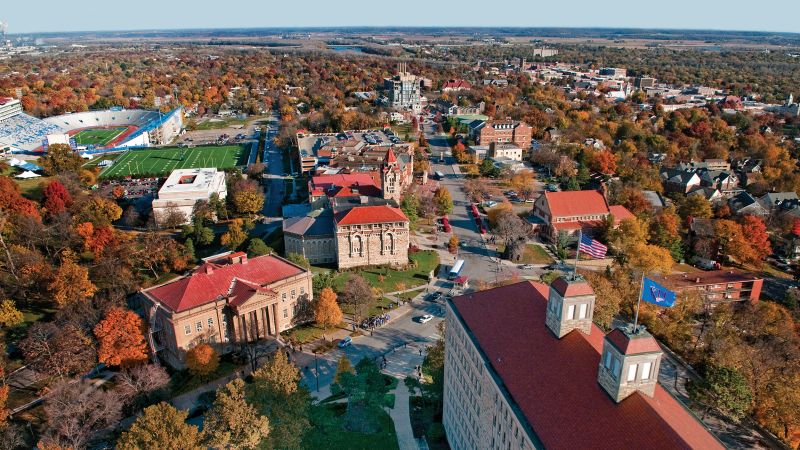
Despite its progress, Lawrence continues to be a place where tradition meets transformation. The University of Kansas, founded on Mount Oread, has played a pivotal role in shaping the city’s character. From its inception, the university was a hub for progressive thought, but the 1970s brought new challenges. Racial tensions and anti-war protests culminated in a summer of unrest centered on campus, prompting the institution to create groundbreaking programs like the African and African-American Studies department. These initiatives cemented Lawrence’s reputation as a sanctuary for activism and social change, welcoming movements that would later redefine equality in America.
A fight for preservation
In the 1980s, Lawrence faced another defining moment: the threat of urban development. As malls spread across the country, the city resisted proposals to replace its historic downtown with a sprawling retail complex. This battle was not just about preserving architecture—it was about safeguarding the cultural essence of a place that had always been more than its physical infrastructure.
“Closing Massachusetts is a dead end,” reads a protest button from the 1980s, displayed at the Watkins Museum of History. This museum, located in a 19th-century bank building at the southern end of Mass Street, offers a window into the town’s past. It showcases how the street became a focal point of commerce and conflict, particularly during the 20th century. For many residents, the struggle to keep Mass Street alive was a defining act of civic pride.
Sarah Fayman, owner of Sarah’s Fabrics, recalls those pivotal years. “It was a very Lawrencian kind of thing,” she says. When the threat of a mall loomed, Fayman and a coalition of small-business owners formed Downtown Lawrence Inc. to rally public support. Their efforts were instrumental in thwarting the plans, ensuring that the city’s heritage remained intact. The fight was not just about saving buildings—it was about protecting a way of life that values community and independent enterprise.
Lawrence’s ability to adapt while staying true to its roots is what makes it remarkable. The town has weathered countless storms, both literal and metaphorical, yet it continues to flourish. Its streets echo with the footsteps of those who fought for freedom, justice, and cultural identity. From the fiery clashes of the 1860s to the quiet resistance of the 1980s, the narrative of Lawrence is one of tenacity and reinvention.
A town that never sleeps
Even as it honors its history, Lawrence remains a dynamic, evolving place. On warm days in late spring or early summer, the town feels like a sanctuary, with its people exuding warmth and a sense of possibility. There’s an unspoken energy, as if the community is always on the verge of something meaningful—whether it’s a local event, a grassroots campaign, or a celebration of its past.
Yet, beneath this optimism lies a deeper truth: Lawrence is a city that has always been at the crossroads of change. Its past is not a distant memory but a living influence on its present. The fights that defined it—whether in the 19th century or the 21st—are not just historical footnotes; they are the foundation of its identity. As the town continues to grow, it does so with the awareness that its soul is as precious as its skyline.
Today’s Lawrence is a city that balances its storied past with a forward-looking vision. It’s a place where the echoes of history meet the hum of everyday life, and where the same ideals that once drove abolitionists now inspire new generations to protect their community’s character. The ongoing battle to preserve its downtown is a reminder that the fight for identity is never complete—it’s a continuous act of creation, defiance, and hope.
The town’s journey is a mirror of America’s own. Through war, social movements, and economic shifts, Lawrence has remained a place of transformation and unity. Its ability to rise from the ashes, time and again, is a testament to the power of collective action and the enduring value of preserving what makes a community unique. As the sun sets over Mass Street, the lights of its storefronts flicker like a beacon, illuminating a path forward for a city that has always been about more than just bricks and mortar.