
National Geographic’s new $300 million museum lets you relive 138 years of exploration
National Geographic’s New $300 Million Museum: A Journey Through 138 Years of Exploration
National Geographic s new 300 million – At the heart of Washington, D.C., the National Geographic Society has unveiled its latest landmark—a $300 million museum dedicated to chronicling 138 years of global discovery. This innovative space, nestled just blocks from the White House, replaces the former museum that closed in 2023. Designed to immerse visitors in the spirit of exploration, the facility blends historical narratives with modern technology, offering a dynamic experience that bridges the past and future of scientific and cultural inquiry.
Preserving a Legacy of Adventure and Conservation
The National Geographic Society, founded in 1888, has long been a pioneer in documenting Earth’s wonders. From its iconic yellow magazine to countless expeditions, the society has supported explorers, scientists, and conservationists in safeguarding our planet’s biodiversity. The new museum aims to honor this legacy by showcasing the evolution of exploration, from early voyages to contemporary efforts tackling climate change and ecological preservation.
Interactive Exhibits and Immersive Technology
Stepping into the museum feels like entering a living archive of discovery. The entrance is adorned with life-sized statues of wildlife—such as a jaguar stalking prey or a penguin tending to its chick—while a vulture perches nearby, symbolizing the fragility of ecosystems. The curved wooden walls in the lobby display dynamic footage of glaciers, deep-sea trenches, and nomadic communities, creating a visually engaging backdrop. A massive circular skylight bathes the space in natural light, enhancing the sense of wonder and scale.
One of the museum’s highlights is the “In Focus” gallery, which celebrates National Geographic’s enduring passion for photography. Here, visitors can explore a digital archive of every magazine cover ever published, trace the lifecycle of a story from concept to publication, and even experiment with the photographic process in a modern darkroom. The centerpiece includes rare images, such as the first nighttime wildlife photographs and a poignant farewell to Sudan, the last male northern white rhinoceros, who died in 2018.
Engaging All Ages with Playful Learning
The National Geographic’s $300 million museum caters to diverse audiences, blending education with entertainment. A mysterious bookcase swings open to reveal a hidden corridor, guiding visitors to interactive learning zones. Among these is the “Geoverse,” a 270-degree theater that plunges guests into the cloud forests of Peru and the deserts of Australia. The immersive environment is crafted to spark curiosity in both children and adults, emphasizing the interconnectedness of global ecosystems through hands-on exploration.
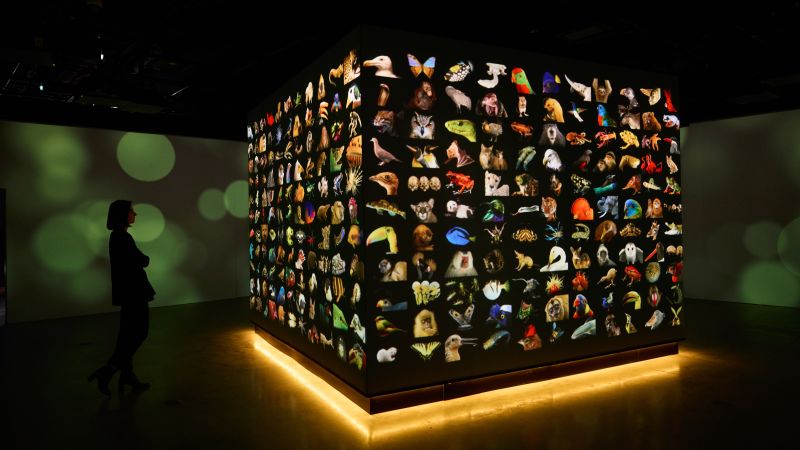
Further into the museum, the “Photo Ark: Animals of Earth” gallery showcases Joel Sartore’s project, which has captured over 18,000 species in human care. The 360-degree space is illuminated by vibrant colors, drawing attention to the striking portraits of animals. “After you’ve seen these creatures and looked them in the eye,” said Emily Dunham, the museum’s chief campus and experiences officer, “how can you not feel compelled to protect them?” The exhibit serves as a powerful reminder of conservation’s urgency.
Tools and Innovations That Shaped Exploration
Upstairs, the “Rolex Explorers Landing” exhibit delves into the instruments that have enabled groundbreaking discoveries. Visitors can examine replicas of tools used by National Geographic explorers, including binoculars passed down through generations. Steve Boyes, a conservationist featured in the exhibit, shared a memory about his grandfather’s equipment: “I still remember watching four leopards in a single scene through those binoculars,” he recalled, “a moment that ignited my lifelong dedication to the natural world.”
Among the display items is a mokoro, a traditional dugout canoe that has traversed the Okavango basin in southern Africa. This vessel, which has covered over 20,000 miles of exploration, highlights the blend of old-world methods and modern conservation efforts. The museum also showcases technological advancements like the JIM suit, a diving apparatus worn by Sylvia Earle in the 1970s to reach depths of 1,250 feet. Earle’s record-breaking dive remains a milestone in marine science, and the replica on exhibit underscores humanity’s capacity to push boundaries in the pursuit of knowledge.