Dondurma: The stretchy, chewy ice-cream that never drips

Dondurma: The stretchy, chewy ice-cream that never drips
Dondurma – In the world of frozen desserts, there’s no one-size-fits-all. While American-style ice cream leans on heavy cream and a light, airy texture, Italian gelato takes its time in the churner and warms to a creamy consistency. Indian kulfi, on the other hand, is dense and unwhipped, a testament to its traditional roots. But in Turkey, a unique marvel of confectionery artistry exists: Maraş dondurma. This dessert defies the typical melting fate of ice cream, instead offering a texture as pliable as taffy and a flavor profile that’s almost impossible to forget.
A Magical Fusion of Science and Tradition
The secret to dondurma’s extraordinary resilience lies in an ingredient exclusive to Turkey—salep, a flour derived from the orchid Dactylorhiza romana. Harvested from the southern European and northern African regions, as well as the mountainous heartlands of south-central Turkey, salep is ground into a fine powder and mixed into the ice cream base. Its molecular magic, glucomannan, allows it to bind water in such a way that the dessert maintains its shape even in warmer temperatures. This makes dondurma not only a treat for the taste buds but also a scientific marvel, with properties that rival the viscosity of gelatin and the elasticity of rubber.
What sets this frozen delight apart is its theatrical presentation. In Istanbul’s bustling tourist areas, street vendors dressed in vibrant embroidered waistcoats and red fezes become performers in their own right. They manipulate the dondurma with long metal rods, stretching and folding it as if kneading dough. This process, reminiscent of a Naples pizzaiolo’s deft hands, transforms the dessert into a spectacle. Customers are drawn into a playful dance, where the vendor flicks the ice cream toward them, then snatches it away, flipping it upside down and weaving a narrative that blends wonder with indulgence.
Unlike the soft, creamy texture of standard ice cream, dondurma is a tactile experience. Its stretchy consistency allows it to be pulled and twisted, creating ribbons of flavor that cling to the tongue. This is no ordinary frozen treat—it’s a bulky titan, bold and unyielding, with a presence that commands attention. Yet, for those seeking the pinnacle of dondurma craftsmanship, the street vendors’ flair may not be the best guide. Instead, a journey to an artisanal parlor reveals a more refined version, where the focus is on flavor, not flourish.
The Rise of a Gourmet Legacy
One such haven for dondurma lovers is Serez Gurme Dondurma, a chain with nine locations across Istanbul. Founded in 2010 by Serdar Kemahlı, the brand emerged from a personal revelation. Kemahlı, who had previously worked in the sandwich industry, recalls his inspiration during a visit to a small coastal town on the Aegean Sea. “I was unemployed, but that evening I realized I was not just looking for a job. I was looking for something that had been lost,” he explains.
“The people were patient and happy; the adults wore the expressions of children on their faces. But the ice creams in their hands were bright blue, bright yellow, bright green colors that no real fruit and no real nut could ever produce,” Kemahlı says.
This moment marked a turning point. Kemahlı, who grew up in the 1970s, remembers a simpler era when dondurma was limited to plain and chocolate flavors. “The same man who sold ice cream in summer became the pickle seller in winter,” he recalls. This stark contrast fueled his ambition to revive the dessert’s original charm while elevating its quality. After a year of trial and error, he perfected a formula that balanced tradition with innovation, leading to the opening of his first shop in Caddebostan, a seaside neighborhood on Istanbul’s Asian side.
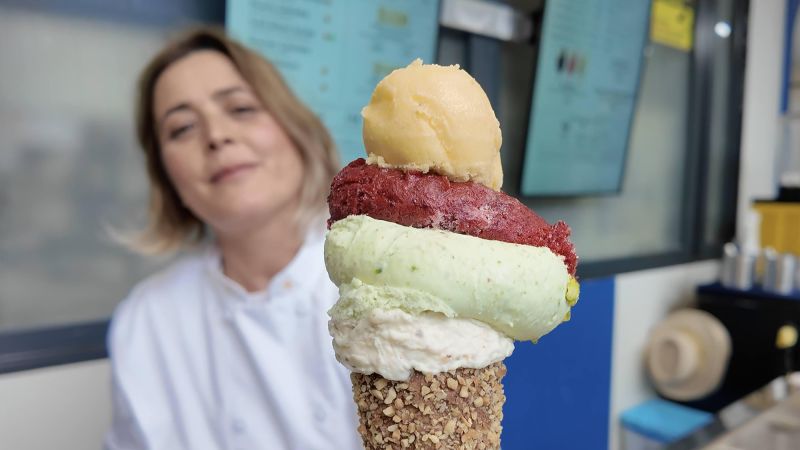
Kemahlı’s creations are a celebration of natural ingredients. The menu features a range of flavors, from the rich depth of pistachio—Turkey’s leading producer of the light-green nut—to the vibrant sweetness of Madagascar vanilla, chocolate, walnut, and Bodrum mandarin. A standout offering is the sour cherry variant, which delivers a tart yet balanced finish. Each serving is crafted with raw, unprocessed components, free from artificial additives, ensuring a purity that’s both refreshing and indulgent.
The higher melting point of dondurma means it’s served slightly warmer than conventional ice cream, enhancing its creamy texture while preserving its structure. This temperature allows the flavors to burst with intensified vibrancy, a sensation Kemahlı likens to the fantastical world of Willy Wonka. “Lick an orange. It tastes like an orange! The strawberries taste like strawberries!” he says. If snozzberries were on the menu, he jokes, he’d have grabbed them too.
While salep is the star of the show, another element adds to the complexity: mastic, a resin that further boosts the dessert’s elasticity. Historically, salep has been a staple in Turkish cuisine, used to make nourishing drinks and traditional sweets. Today, it’s not only found in dondurma but also in dishes like salep tea, a comforting drink with a velvety texture and a hint of cinnamon. At Serez Gurme Dondurma, the salep is often sprinkled with cinnamon, offering a flavor that’s both sweet and aromatic, like a bowl of thick hot chocolate infused with vanilla.
As the demand for dondurma grows, so does its cultural significance. For many, it’s more than just a dessert—it’s a symbol of Turkish ingenuity and tradition. Whether enjoyed in its raw, street-side form or refined in a modern parlor, dondurma remains a frozen marvel that bridges the gap between science and artistry. Its unique properties continue to captivate, proving that even in the age of gourmet trends, some treats are best experienced as they were meant to be: a little bit of magic in every scoop.