
Morocco beats World Cup co-host Canada 3-0 to make it to the quarterfinals
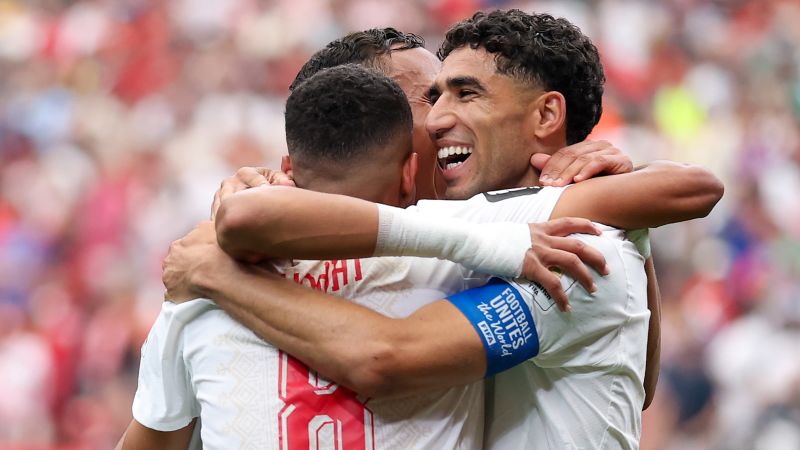
France and Paraguay’s Winner to Face Morocco in Quarterfinals After Dominant 3-0 Victory Over Canada
Morocco beats World Cup co host – In a pivotal Round of 16 encounter in Houston on Saturday, Morocco secured a 3-0 triumph against co-host Canada, becoming the first team to advance to the quarterfinals at the World Cup. The Atlas Lions’ performance, marked by clinical finishing and tactical resilience, will see them face the winner of France and Paraguay in Foxborough’s Gillette Stadium on Thursday. This result highlights Morocco’s consistent form in recent major tournaments, including their 2022 World Cup semifinal run and a controversial African championship earlier this year.
A Heroic Performance by Morocco’s Midfield
The match, held at the NRG Stadium, showcased Morocco’s ability to capitalize on opportunities despite early challenges. Azzedine Ounahi, the team’s midfield maestro, proved instrumental in the victory, scoring two goals in the 50th and 82nd minutes. His composure under pressure and precision in execution set the tone for Morocco’s success. The third goal came from Soufiane Rahimi, whose late strike in the 89th minute capped off a remarkable display of teamwork and efficiency.
Canada, however, started the match with vigor, pressing Morocco effectively and threatening to break the deadlock early. The team’s forward, Tani Oluwaseyi, had a golden chance in the 11th minute after a high press disrupted Morocco’s rhythm. The Villarreal player’s quick turn and drive toward goal was met with a stunning save by Yassine Bounou, who made a crucial stop to preserve his team’s lead. This moment underscored the tension in the contest, as Canada’s attack seemed poised to make an impact.
Injury and Setbacks for Morocco
Despite their early control, Morocco faced a setback in the 23rd minute when star midfielder Ismael Saibari – set to join Bayern Munich – left the field injured. The incident, initially thought to be a hamstring strain, disrupted the team’s midfield balance and forced adjustments in their strategy. The break for hydration provided a brief respite, but the Atlas Lions struggled to find momentum as the match progressed.
Referee Michael Oliver’s decisions also played a role in shaping the game’s narrative. In the 39th minute, Achraf Hakimi and Richie Laryea engaged in a collision after a failed Moroccan attack, resulting in yellow cards for both players. While the incident energized Morocco, it also highlighted the challenges they faced in maintaining their intensity. Bilal El Khannouss added to the caution tally in the first half, becoming the fourth Moroccan player to receive a yellow card, further testing the team’s cohesion.
Canada’s persistence was evident in the second half, as they continued to press and create chances. A key moment came when Tajon Buchanan was brought down by Redouane Halhal, prompting a penalty appeal. However, the assistant referee flagged offside, negating the potential for controversy. This decision reflected the tight officiating that often defines high-stakes matches, leaving both teams with mixed emotions.
Turning Point and Late Dominance
The tide of the game shifted dramatically in the 76th minute when Morocco regained control after a defensive lapse. A free kick awarded to the Atlas Lions following a cynical challenge by Luc De Fougerolles became a turning point. Hakimi’s delivery to Ounahi, a well-placed cross into the box, allowed the midfielder to curl a low shot into the bottom right corner, breaking the deadlock. This goal sparked a wave of momentum, with Morocco asserting their dominance and reducing Canada’s chances of a comeback.
Canada’s efforts to equalize were thwarted by Bounou’s reflexes. Buchanan’s swerving long-range shot in the 82nd minute forced a fine save, keeping the scoreline unchanged. However, Morocco’s attacking prowess shone through once more in the 82nd minute. Brahim Díaz, playing for Real Madrid, orchestrated a swift counterattack, drawing two defenders before laying the ball back to Ounahi for his brace. The assist and goal highlighted the Moroccan star’s ability to exploit spaces and convert opportunities with composure.
As the clock neared 90 minutes, Rahimi’s header on the breakaway nearly extended the lead. The ball clanged off the crossbar, a moment of near-misses that added drama to the game. Yet, Morocco’s clinical finishing was on full display when Rahimi sealed the victory with a well-placed shot across goal, leaving Crepeau with no chance to stop it. This goal ensured a decisive 3-0 result, ending Canada’s campaign with a mix of pride and regret.
Analysis of the Match’s Dynamics
Canada’s performance, while commendable, revealed vulnerabilities in their transition from defense to attack. Despite Alphonso Davies’ absence at the start, the team’s pressing game was effective in the early stages. However, their inability to convert chances into goals became a recurring theme. Morocco’s defense, though not flawless, managed to hold firm, with Bounou’s saves and the team’s collective organization preventing Canada from capitalizing on their early momentum.
The match also reflected the physical and tactical demands of World Cup football. Morocco’s resilience in the face of setbacks, including Saibari’s injury and the yellow cards, showcased their depth and adaptability. In contrast, Canada’s high-intensity play faltered as the game wore on, particularly after the pivotal free kick. The Atlas Lions’ ability to maintain focus and capitalize on moments of opportunity proved decisive, while Canada’s frustration with missed chances underscored their reliance on individual brilliance.
Although the result may have seemed harsh to some, the narrative of the game was clear: Morocco’s tactical discipline and finishing ability edged them past a valiant Canada. As
“To many, the result would seem a bit unfair to Canada as it seemed to be holding the reins for much of the contest,”
noted fans and analysts, the performance by Canada’s players was not without merit. Their early dominance and relentless pressing were admirable, but the inability to translate pressure into goals left them with a sense of unfinished business.
The victory marks a significant milestone for Morocco, reinforcing their status as a team on the rise. Their 2022 World Cup semifinal appearance and recent African championship have set the stage for a potential deep run in this tournament. As they prepare to face the winner of France and Paraguay, the Atlas Lions will aim to build on this momentum, blending their attacking flair with defensive solidity. For Canada, the loss serves as a learning experience, highlighting the need for improved finishing and resilience in high-pressure situations.