
Trump is racing to finish his border wall. Here’s how he is planning to do it
Trump’s Border Wall Initiative: Speeding Up Construction with Eminent Domain
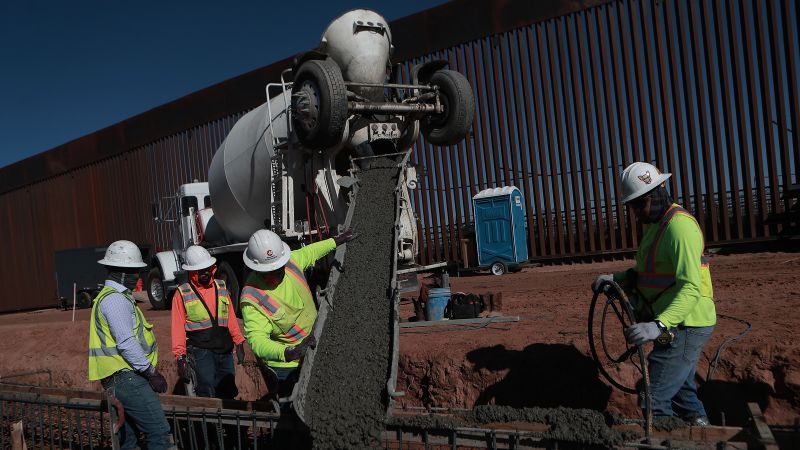
Trump is racing to finish his border – As the Trump administration nears its final year, officials are intensifying efforts to complete the border wall project, aiming to finalize construction before the end of their term. The plan hinges on acquiring private land through legal mechanisms, a process that has become central to expanding the barrier system along the U.S.-Mexico border. With the Department of Justice actively engaging attorneys to pursue eminent domain cases, the government is working to secure necessary plots quickly, particularly in regions where federal land ownership is limited.
Legal Framework and Land Acquisition Challenges
Eminent domain, a legal principle allowing the government to claim private property for public use, has emerged as a critical tool for the administration. This approach, however, has faced scrutiny from landowners and critics, who argue it bypasses traditional property rights. Despite this, federal officials maintain that it is essential for meeting their ambitious targets. For instance, the U.S. Customs and Border Protection (CBP) has noted that without the ability to seize private land, progress on the wall would be significantly delayed.
“It’s taken too long to buy land at the pace they’re building. They’re running out of land faster than they can get land,” said a former Homeland Security official, speaking to CNN. This sentiment reflects the urgency driving the current strategy. In areas like Texas, where much of the terrain is privately owned, the use of eminent domain has become a necessity to ensure the wall’s completion by the projected deadline.
Progress and Projected Milestones
The U.S.-Mexico border spans 1,954 miles, and officials estimate that by the end of the Trump administration, approximately 1,400 miles of this stretch will be secured with barriers. This includes both primary and secondary walls, with additional segments fortified by advanced technology. The scale of the project is staggering, requiring the construction of around 775 miles of new primary wall by 2027 and 608 miles of secondary barriers by 2028.
According to CBP data, the administration has already added roughly 80 miles of primary wall and 24 miles of secondary wall since Trump’s first year in office. The agency is on track to complete the remaining sections, though final numbers may shift as contracts are awarded. CBP Commissioner Rodney Scott highlighted the progress, stating that the wall is “ahead of schedule and below budget” compared to previous estimates.
A federal document reviewed by CNN indicates that land acquisition will be prioritized to ensure construction can proceed without interruption. Once properties are secured, work will begin “on a rolling basis,” allowing for continuous progress. This strategy aims to streamline the process, though it remains a complex and sometimes contentious endeavor.
Key Exceptions and Strategic Decisions
While the administration is pushing to cover most of the border with barriers, certain areas will remain untouched. For example, the 30-foot-high walls planned for Big Bend National Park, Big Bend Ranch State Park, and the Black Gap Wildlife Management Area are being excluded due to environmental and logistical considerations. These regions, characterized by rugged terrain, are deemed less critical for immediate wall construction.
Scott, speaking at a Center for Immigration Studies event, emphasized that the primary wall will extend from San Diego to the Gulf of Mexico, with some gaps in remote areas. “The only places we’re not building border wall is places where we’ve made a conscious decision that we don’t need it,” he explained, pointing to regions where natural barriers or other security measures are sufficient.
Speeding Up the Process
To meet the timeline, the administration has implemented measures to expedite construction. The Department of Homeland Security has waived certain regulations, enabling faster approvals and reducing bureaucratic delays. This has allowed the government to focus on large-scale projects while minimizing obstacles. Meanwhile, the Department of Justice has filed 39 land condemnation cases in Trump’s second term, primarily through the Southern District of Texas’s U.S. Attorney’s Office, according to a spokesperson.
Landowners in Texas, New Mexico, Arizona, and California are being actively engaged in the process, though the use of eminent domain has sparked debate. The administration is also projecting an increase in construction rates, with approximately 10 miles of barrier planned for August and a steady rise in weekly milestones. “They want to say they’re finished by the end of this administration,” the former Homeland Security official remarked, underscoring the political imperative behind the timeline.
The combination of legal action, strategic planning, and resource allocation is shaping the final phase of the border wall initiative. While challenges persist, the administration remains focused on delivering a comprehensive security system. The success of this effort will depend on the ability to navigate both legal and logistical hurdles, ensuring the wall is completed within the set timeframe.