
Top general fired by Trump administration criticizes use of military for political missions
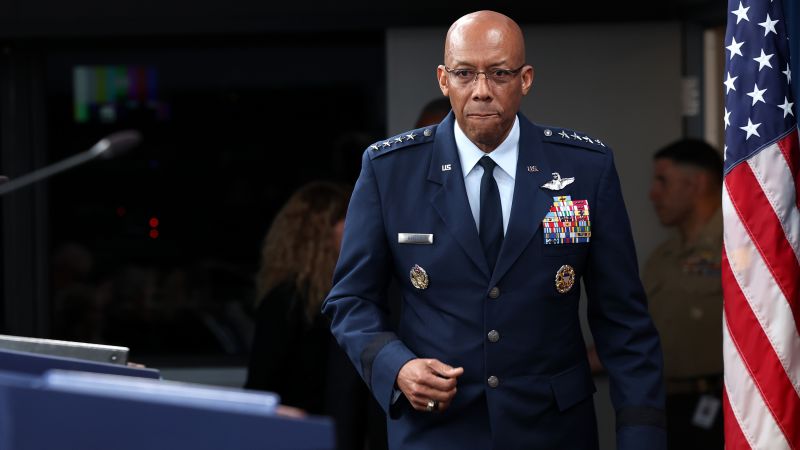
Former Top General Criticizes Military’s Political Role in Op-Ed
Top general fired by Trump administration – Last year, Defense Secretary Pete Hegseth dismissed a former top US general who recently voiced criticism over the use of the military for political objectives. Charles Q. Brown, the former Chairman of the Joint Chiefs of Staff, penned an op-ed in Foreign Affairs that highlighted concerns about the armed forces being leveraged to address domestic issues, such as crime in urban centers. This critique came amid the Trump administration’s strategy to deploy troops to major cities like Washington, DC, and Los Angeles to combat rising criminal activity.
A Focus on Political Missions
“When presidents utilize the military for more politically charged missions, such as addressing domestic crime, the role of the armed forces becomes increasingly politicized,” Brown wrote alongside two other contributors: Duke political science professor Peter Feaver and North Carolina attorney Andrew Kragie. The trio argued that relying on military solutions instead of fixing weaknesses in civilian institutions risks diverting the armed forces from their core combat duties.
“Resorting to a military solution rather than fixing the underlying incapacity or dysfunction in civilian institutions diverts the military from focusing on its primary combat mission,” the authors continued. “And… it is not the military’s job to save the republic from political impasses. Indeed, if you ask too much of the military, you risk the entire enterprise.”
Brown, a retired Air Force general and the second Black individual to hold the position of America’s highest-ranking military officer, was relieved of his duties in February 2025. He was not the only high-ranking official to lose their post during this period; Admiral Lisa Franchetti, who had previously served as the Navy’s chief and the first woman on the Joint Chiefs of Staff, was also removed. The administration’s decision to oust these leaders coincided with broader efforts to restrict diversity and inclusion initiatives across the military and federal government.
Political Implications of Military Deployments
At the Aspen Ideas Festival, Brown expressed worries about the administration’s pattern of firing Pentagon officials, stating that the current wave of dismissals was no longer about professional competence. “What’s starting to happen now is not about merit,” he said. “It’s important we understand that all these people that are being removed are very well experienced, and my concern is that the impact it has on those that are still continuing to serve,” Brown added. “Are they going to have a fair opportunity to advance in their career going forth?”
The op-ed published in Foreign Affairs did not directly target President Donald Trump or any current government officials. However, the authors noted that both Trump and former President Joe Biden had turned to the military for significant roles during the COVID-19 pandemic. “Both leaders looked to the military to play a leading role in responding to the pandemic,” they observed, though the piece focused on specific actions taken under Trump’s leadership.
Expanded Military Role Under Trump’s Return
Since Trump’s comeback to the presidency, his administration has intensified the military’s involvement in domestic affairs, with Hegseth playing a central role in this shift. Last year, thousands of National Guard troops and hundreds of Marines were deployed to major cities as part of efforts to restore order and tackle crime. Hegseth recently praised the National Guard’s efforts in Washington, DC, during protests, calling the demonstrators “ingrates” who failed to recognize the value of law and order.
“They can’t see law and order and common sense in front of them, that there’s nothing ideological about this group, there’s nothing political about this exercise,” Hegseth said. “Law and order is something all Americans deserve.”
Brown and his co-authors also reflected on the United States’ 250th anniversary, emphasizing the significance of national unity and shared purpose. “Patriotism means recognizing the promise of America’s founding, the progress of its past, and the potential of a shared future,” they wrote. “Service to a cause greater than oneself, a virtue cultivated in military training, is accessible to all regardless of whether they wear the uniform,” the authors noted. They argued that the 250th anniversary was an opportunity to revive the interdependence that the nation’s founders championed.
Legacy and Current Challenges
Brown’s op-ed underscores a broader debate about the military’s role in American society. While the armed forces are expected to defend the nation, their use in domestic political campaigns raises questions about the balance between military and civilian responsibilities. The article also touches on the long-term consequences of such strategies, suggesting that overburdening the military could weaken its effectiveness and credibility.
The administration’s approach has sparked discussions about the politicization of the military. Critics argue that deploying troops to enforce order in cities risks turning the armed forces into tools of partisan agendas rather than neutral institutions. Brown’s perspective adds to this discourse, highlighting the importance of preserving the military’s primary mission as a combat force.
As the debate continues, the roles of figures like Hegseth and Brown remain central. Their differing views on the military’s involvement in domestic affairs reflect the evolving dynamics of political leadership and military strategy in the United States. With the nation marking a significant historical milestone, the conversation about patriotism, unity, and the military’s purpose has taken on new urgency.
CNN’s Oren Liebermann and Haley Britzky contributed to this report. Their coverage highlights the intersection of military service and political influence, offering insights into how leaders shape the armed forces’ role in national affairs. The article serves as a reminder of the delicate balance between using the military for political goals and maintaining its independence as a critical pillar of national security.