
Fact check: Trump’s false and unproven claims about the Reflecting Pool
Trump’s Claims About the Reflecting Pool Under Scrutiny
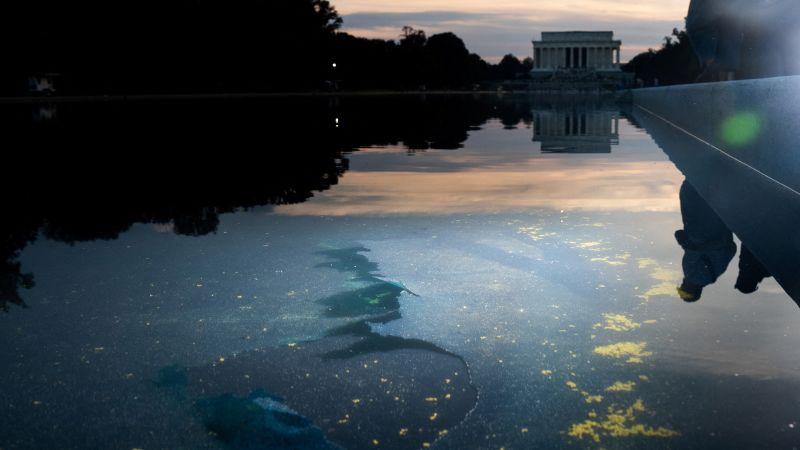
Fact check – President Donald Trump has sparked controversy with his unverified assertions regarding the Lincoln Memorial Reflecting Pool, casting doubt on the cause of its recent issues and the financial resources allocated to its maintenance. During a weekend statement, Trump suggested that visible flaws in the pool were the result of “vandals” rather than the recent repair efforts he had previously claimed would restore its former grandeur. This narrative contrasts sharply with the facts, as the pool’s condition has been a topic of discussion for years, and its appearance after the latest restoration has not been as pristine as Trump implied.
Vandalism or Repair Project?
Trump’s weekend posts on social media emphasized that the pool’s damage was caused by individuals using “a knife or blade” to create a 250-foot-long gash in its surface. However, this claim lacks concrete evidence. The National Park Service (NPS) has documented the repair project, which was completed in early June, and the pool has been open to the public since then. Despite Trump’s insistence that it “worked perfectly” before the vandalism, the water has already shown signs of algae growth within days of refilling. Even after the administration declared the pool’s water “crystal clear,” the algae persisted, undermining Trump’s assertion of its immediate beauty.
“While National Park Service workers found two cuts in sections of foam between the pool’s expansion joints, those were not directly related to the ‘American flag blue’ coating that is now peeling, or to the algae that has turned the pool a bright shade of green.”
The New York Times highlighted this discrepancy in its Tuesday report, noting that internal government documents referenced two 171-foot blade cuts, which could account for the 350-foot length Trump later described. Yet, the documents did not explain how these cuts were inflicted or their connection to the pool’s current state. This lack of clarity raises questions about the credibility of Trump’s narrative, which has evolved over time. For instance, he initially claimed a 250-foot gash, then adjusted it to 300 feet, 350 feet, and finally described it as “numerous slashes over a very long 350-foot length.”
Cost Exaggerations and Timeline Confusions
Trump’s criticism of the pool’s condition has been accompanied by inflated figures about the costs of past repairs. During a Monday event, he asserted that a two-year project under former President Barack Obama cost “over $100 million.” However, the actual contract was valued at approximately $35 million, and Trump’s White House could not provide evidence to support his higher estimate when CNN inquired in May. This discrepancy suggests a pattern of exaggeration, which extends to his claims about President Joe Biden’s involvement in the pool’s maintenance.
Trump also suggested that Biden had spent tens of millions of dollars on the reflecting pool. The Times noted that the Biden administration did not pursue a major repair initiative, contradicting Trump’s portrayal. Chuck Sams, who served as the National Park Service director during Biden’s presidency, confirmed that a cost estimate “above $100 million” for a “full rehabilitation” was received but not implemented. This implies that Trump’s claims about Biden’s spending may be based on incomplete or speculative information.
Video Evidence and Uncertainty
To bolster his vandalism allegations, the Interior Department provided Fox News with a video clip allegedly showing individuals damaging the pool. The footage, aired on Tuesday night, depicts two people bending or crouching near the pool’s edge, with others passing by. However, the video does not clearly capture the extent of the damage or the exact actions taken by the individuals. Fox host Jesse Watters acknowledged this uncertainty, stating, “We don’t know if they’re committing a crime.”
Despite the video’s release, it fails to demonstrate the creation of two 171-foot gashes, which align with the earlier cuts mentioned in the documents. The lack of visible evidence in the footage and the absence of a definitive explanation for the pool’s condition raise doubts about the validity of Trump’s claims. The National Park Service has not confirmed the presence of such gashes, leaving the narrative open to interpretation.
Historical Context and Public Perception
Trump’s criticism of the reflecting pool is not isolated. He has consistently pointed to past administrations as responsible for its deteriorating state, even though the pool has been in use since the 1920s. During a Monday event, he claimed that the pool “never even opened” after Obama’s repair project, a statement that ignores the fact it reopened in August 2012. While the pool has experienced short closures for maintenance and minor repairs, these have been exceptions rather than the norm over the past 13 years.
The repair project under Obama, which Trump criticized, was part of a broader effort to address long-standing issues with the Lincoln Memorial complex. The pool’s closure in October 2012 and its extended shutdowns in 2015 and 2016 were necessary to fix damage caused by nearby construction. These periods of inactivity were brief compared to the pool’s overall operational history. Trump’s repeated emphasis on the “gash” and his failure to provide clear evidence has led to public skepticism about the accuracy of his claims.
Conclusion and Ongoing Investigations
As the debate over the reflecting pool’s condition continues, Trump’s assertions remain unproven. While the National Park Service has documented the repair efforts and the minor cuts in the foam, the link between these findings and the visible damage is still unclear. The Interior Department’s video, though presented as proof of vandalism, does not conclusively show the scale of destruction Trump described. Fact-checkers and journalists are still working to uncover the full story, emphasizing the need for transparency and evidence in public discourse.
Trump’s claims about the reflecting pool serve as a broader example of his tendency to present unverified information as fact. By altering his descriptions of the damage and exaggerating the costs of past repairs, he has created a narrative that shifts blame away from his own administration and onto previous leaders. This pattern highlights the importance of scrutinizing political statements, especially when they are used to critique policies or justify new initiatives. As the investigation into the pool’s condition progresses, the facts will play a critical role in shaping the public’s understanding of the issue.