
Hobbit-like humans may have scavenged Komodo dragons’ leftovers to survive
Hobbit-like Humans May Have Scavenged Komodo Dragons’ Leftovers to Survive
Hobbit like humans may have scavenged – Ancient human relatives, known as “hobbits” for their small stature, may have relied on scavenging rather than actively hunting large animals or mastering fire, according to a recent study. This discovery challenges earlier assumptions about their advanced capabilities and positions them as more opportunistic feeders than skilled predators. The research, published in *Science Advances*, builds on decades of debate about the lifestyle and intelligence of *Homo floresiensis*, a species that lived on the Indonesian island of Flores between roughly 190,000 and 50,000 years ago.
The Discovery in Liang Bua Cave
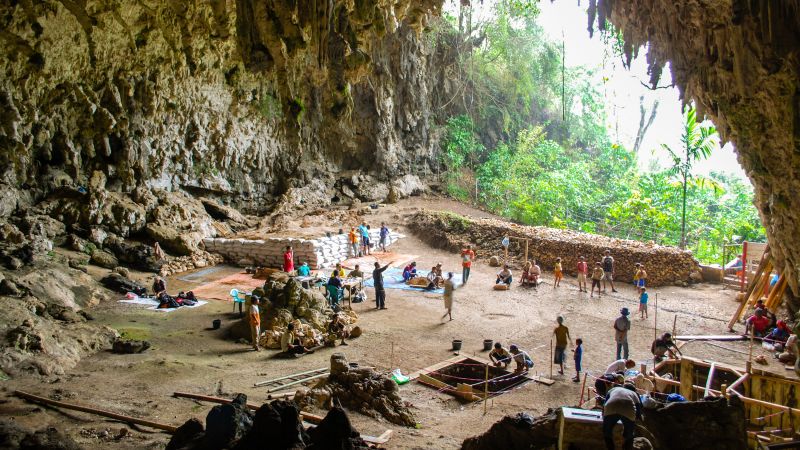
The “hobbits” were first identified in 2003 when archaeologists uncovered fossils in the Liang Bua cave on Flores. These remains included a skull no larger than a grapefruit and a body height of about 3.3 feet (1 meter), suggesting a species much smaller than modern humans. Alongside these bones, researchers found tools crafted from chert and remnants of *Stegodon florensis insularis*, an extinct elephant relative weighing around 1,260 pounds (570 kilograms) and standing about 5 feet (1.5 meters) tall at the shoulder. These findings initially led scientists to speculate that *Homo floresiensis* had hunted these massive herbivores using their primitive tools.
However, new evidence hints at a different scenario. The presence of burned bones among the fossils suggested that fire might have been used to cook meat, a trait typically linked to advanced hominins like Neanderthals or *Homo sapiens*. Yet, the latest analysis of the bones and tools casts doubt on this idea, proposing instead that the “hobbits” were scavengers, not hunters. This shift in understanding could redefine their place in the timeline of human evolution.
Examining Tool Marks and Carnivore Behavior
To investigate further, researchers conducted a unique experiment involving Komodo dragons, the only carnivorous predator native to Flores. Dr. Elizabeth Grace Veatch, a paleoanthropologist who studies early human diets and interactions with animals, led the study. Her team observed how a Komodo dragon named Rinca at Zoo Atlanta fed on a goat carcass, documenting the patterns of tooth marks left on the bones. These observations were then compared with cut marks made by *Homo floresiensis* tools and the damage seen on *Stegodon* remains.
The findings revealed striking similarities between the tooth marks on *Stegodon* bones and those produced by Komodo dragons. Veatch noted that the most significant bite marks were consistently found on the animal’s meatiest parts, such as the torso and limbs. In contrast, the cut marks from the hobbits’ tools were more prevalent on less desirable sections, like the bones and joints. This pattern suggests that *Homo floresiensis* was likely consuming leftover meat after the dragons had killed the *Stegodon*, rather than hunting them themselves.
“I wanted to see if we really could show that *H. floresiensis* was the hunter that it had been portrayed as for decades,” Veatch wrote in an email. “But the results indicate they may have been more like scavengers, adapting to the resources available on an isolated island.”
Tool Use and Survival Strategies
The study also examined how the hobbits utilized their tools. Thousands of stone artifacts have been found near *Homo floresiensis* fossils, implying they crafted tools for processing meat and bones. However, the location and nature of these tools—many of which were likely used for breaking apart bones—raise questions about their primary role. If the tools were meant to hunt, they would have been applied to the most tender parts of the *Stegodon*. Instead, the analysis points to a scavenging strategy, where the hobbits exploited the remains of animals already killed by Komodo dragons.
Veatch and her colleagues used 3D scanning techniques to analyze the bone fragments. By comparing the damage patterns on the *Stegodon* remains with those from the goat carcass and the stone tools, they determined that the hobbits were not the main predators. The study also highlights the importance of understanding the ecological context of Flores. With no other large carnivores, the Komodo dragons were the dominant predators, making scavenging a practical survival strategy for *Homo floresiensis*.
Implications for Human Evolution
The research reshapes how scientists view the evolutionary path of *Homo floresiensis*. While they were undeniably intelligent, capable of creating tools and adapting to their environment, their reliance on scavenging suggests they may not have been as advanced as previously thought. This aligns with the idea that their brain size, only slightly larger than that of chimpanzees, limited their ability to develop complex hunting techniques or use fire for cooking.
Briana Pobiner, a paleoanthropologist and coauthor of the study, emphasized the importance of the findings. “The tools we found indicate *Homo floresiensis* was processing meat, but the location and distribution of the cuts tell a different story,” she said. “They weren’t hunting the *Stegodon*; they were taking what the dragons left behind.” This interpretation challenges the notion that the species was a key player in the development of advanced human traits, such as cooking and large-scale hunting, which are often associated with larger-brained hominins.
The Role of Komodo Dragons in the Ecosystem
The study’s methodology was as unconventional as its findings. By observing Komodo dragons in controlled settings, researchers gained insight into how these reptiles interact with their prey. The dragons’ ability to deliver a venomous bite and tear through flesh with their powerful jaws makes them formidable hunters. Yet, the hobbits were not competing with them for food. Instead, they likely benefited from the dragons’ kills, a strategy that would have required less energy and risk.
This collaboration between predators and scavengers may have been a crucial adaptation for *Homo floresiensis*. On an isolated island, where resources were limited, scavenging allowed them to survive without needing to develop the full range of hunting skills seen in other hominins. The researchers speculate that the hobbits could have used their tools to remove meat from bones, a task that would have been easier with the dragons’ initial work.
Reassessing the Family Tree of Hominins
The new evidence adds to a growing body of research that questions the advanced nature of *Homo floresiensis*. While they were clearly part of the human family tree, their survival strategies may have been simpler than those of their relatives. This could mean that the species occupied a different ecological niche, relying on the environment and other animals for sustenance.
Veatch’s team also considered the broader implications for human evolution. If *Homo floresiensis* was not a hunter, their tools might have been used for other purposes, such as preparing food or crafting shelters. This flexibility in tool use could still be a sign of intelligence, but it might not equate to the same level of technological innovation as seen in *Homo erectus* or modern humans.
As the study continues to gain attention, it is prompting experts to rethink the narrative of human evolution on Flores. The island’s unique environment may have shaped a different path for hominins, one where scavenging and tool-making coexisted as key survival traits. This research underscores the importance of examining ancient species not just through their physical characteristics, but also through their ecological interactions and behavioral patterns.
The findings also raise intriguing questions about the relationship between *Homo floresiensis* and other hominins, such as *Homo erectus*. While some researchers have theorized a close evolutionary link, the scavenging hypothesis suggests that their development was influenced by the specific challenges of island life. As more data emerges, the story of the “hobbits” may continue to evolve, revealing new insights into the adaptability and diversity of early human species.