
Keiko Fujimori declared winner of razor-edge Peru election
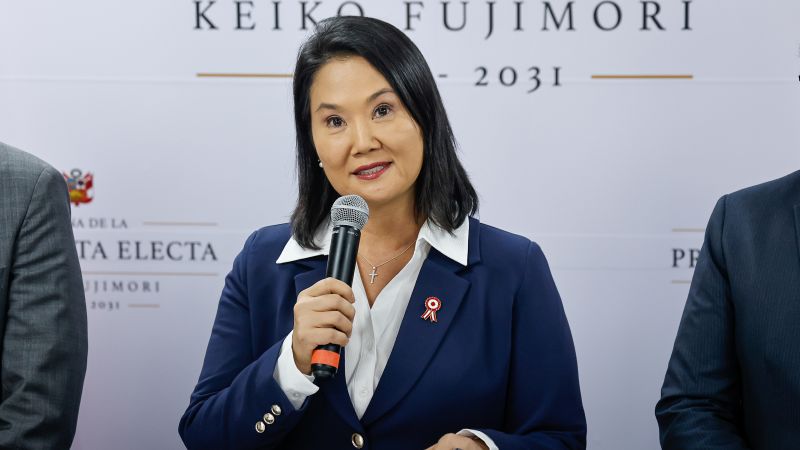
Keiko Fujimori Announced as Peru’s Presidential Winner After Tight Election
Keiko Fujimori declared winner of razor – Peru’s National Office of Electoral Processes confirmed on Friday that Keiko Fujimori, the eldest daughter of former President Alberto Fujimori, has emerged victorious in the country’s highly contested presidential runoff. The outcome marks the culmination of a weeks-long recount that concluded with a razor-thin margin separating Fujimori from her opponent, leftist candidate Roberto Sánchez. With a lead of just 49,641 ballots out of approximately 18 million, Fujimori’s Popular Force party secured 50.13% of valid votes, narrowly edging out Sánchez’s 49.86%. The result is expected to reshape Peru’s political dynamics after one of the most closely fought elections in recent memory.
Fourth Attempt, First Triumph
This marks Fujimori’s fourth bid for the presidency, following unsuccessful campaigns in 2011, 2016, and 2021. Her path to victory has been steep, requiring resilience and strategic recalibration across multiple electoral cycles. The June 7 runoff was not only her latest attempt but also a critical moment for her political career, as she now stands on the brink of assuming the highest office in Peru. Her win is a testament to her ability to navigate the country’s deeply polarized landscape and appeal to a broad spectrum of voters.
Fujimori, 51, will be sworn in as president on July 28, beginning a five-year term. She will be joined by Luis Fernando Galarreta as first vice-president and Miguel Ángel Torres Morales as second vice-president. The transition comes at a pivotal time, with Peru grappling with political instability that has persisted for over two decades. Analysts argue that this instability is closely tied to the legacy of her father, Alberto Fujimori, whose tenure as president remains a subject of intense debate.
A Legacy of Controversy
Alberto Fujimori, who governed Peru from 1999 to 2000, was ousted in a congressional vote for alleged authoritarian practices and later convicted of corruption, embezzlement, and human rights violations. His downfall was followed by a decade of political turmoil, marked by frequent changes in leadership and widespread public dissent. However, in 2023, Fujimori received a controversial pardon, which has reignited discussions about his legacy and its impact on current events.
Keiko Fujimori’s own political journey has been shaped by her father’s influence. She first entered the public spotlight as first lady at the age of 19, a role she held during Alberto Fujimori’s presidency. Her subsequent political endeavors have drawn both admiration and criticism, with supporters praising her leadership and opponents accusing her of continuing her father’s policies. The 2026 election, however, has positioned her as a unifying figure for many Peruvians weary of the country’s fractured political environment.
Fujimori’s campaign emphasized stability and economic reform, promising to address Peru’s chronic issues of inflation, unemployment, and infrastructure deficits. Her ability to consolidate support across key regions, including urban centers and rural areas, has been a significant factor in her victory. The election results also reflect a broader trend of public fatigue with leftist governance, which has faced challenges in implementing progressive policies amid economic uncertainty and social unrest.
Contested Votes and Legal Challenges
The narrow victory has not gone unchallenged. Roberto Sánchez, the leftist contender, has vowed to contest the outcome, claiming irregularities in the overseas vote count. In a post on X, he expressed his intention to appeal to the Inter-American Commission on Human Rights (IACHR), asserting that the margin of victory was insufficient to justify the proclamation of Fujimori as the winner. Sánchez’s skepticism is part of a larger narrative of distrust in Peru’s electoral system, which has been a recurring theme in recent years.
Despite these claims, the National Jury of Elections has maintained that the recount process was thorough and that no inconsistencies were found in the vote tally. The commission’s final declaration, released on Friday, rejected the appeal filed by Sánchez’s Together for Peru party. This decision has been welcomed by Fujimori’s supporters, who see it as a validation of the election’s legitimacy. However, the close margin of victory has left room for speculation and debate, with some analysts suggesting that the outcome could still be contested in the weeks ahead.
A New Chapter for Peru
In a public statement following the official announcement, Fujimori expressed gratitude to the voters, stating, “Peru is entering a new chapter.” She pledged to lead the transition with “responsibility, humility, and a profound sense of duty,” signaling her intent to balance reform with respect for democratic processes. Her words resonate with a nation that has long been divided between progressive and conservative factions, each vying for influence in a system that has struggled to deliver consistent governance.
The election result also underscores the challenges of Peru’s political landscape, where polarization has intensified in recent years. Fujimori’s victory may signal a shift toward more traditional conservative values, though her party’s platform includes a mix of centrist and right-leaning policies. The opposition, however, remains skeptical, with Sánchez’s party arguing that the final vote count was manipulated to secure Fujimori’s win. This dispute highlights the fragile state of Peru’s democracy and the potential for political tension to escalate in the coming months.
As Fujimori prepares to take office, her administration will face the daunting task of stabilizing a country in flux. The legacy of her father’s presidency looms large, with his conviction and subsequent pardon serving as a reminder of the country’s historical struggles with accountability. Fujimori’s success may depend on her ability to distance herself from her father’s controversies while delivering on her campaign promises. Her first 100 days in office will be critical in determining whether her vision for Peru can take root amid lingering doubts and opposition.
Meanwhile, the political landscape is set to undergo significant changes. Fujimori’s victory could lead to a realignment of power, with her party gaining traction in key constituencies. The opposition’s refusal to acknowledge the result may result in prolonged disputes, but the electoral commission’s endorsement of the count provides a foundation for stability. As Peru moves forward, the nation’s citizens will be watching closely to see if Fujimori’s leadership can restore faith in the country’s democratic institutions and chart a course toward lasting progress.
The outcome of this election not only redefines Fujimori’s political trajectory but also reflects the broader aspirations of Peru’s electorate. For many, the narrow margin of victory is a sign of divided loyalties and the difficulty of achieving consensus in a nation where political ideology often overshadows practical governance. Yet, for Fujimori, the win represents a hard-earned triumph that could position her as a leader capable of steering Peru through its current challenges. The road ahead remains uncertain, but the declaration of her victory has set the stage for a new era in Peruvian politics.