Using the stars and paddles, indigenous Taiwanese recreate risky sea journey of Great Pacific Migration

Recreating the Ancient Pacific Voyage: Indigenous Taiwanese Navigators Embark on a Historic Journey
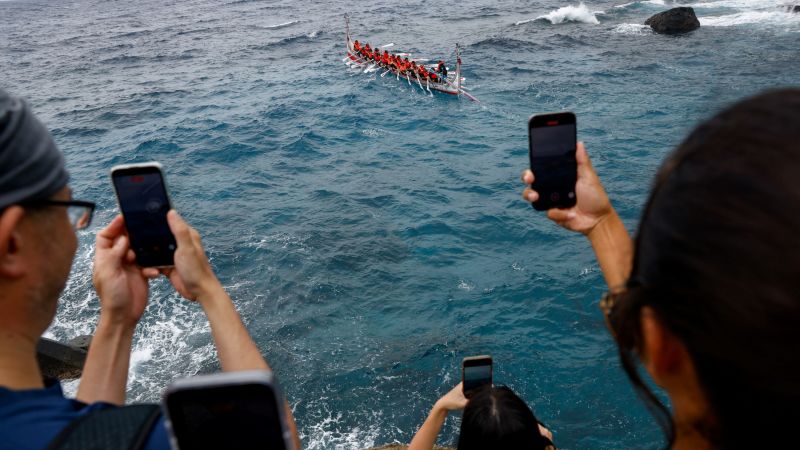
Using the stars and paddles indigenous – On Monday, a team of indigenous seafarers from Taiwan set out on a remarkable 111-mile expedition across the Pacific, using only a traditional wooden canoe and the stars as their guide. This daring venture, which culminated in a successful arrival at Batan Island in the Philippines, mirrors an ancient journey believed to have taken place over 4,000 years ago. The event not only honors the seafaring skills of Taiwan’s indigenous peoples but also underscores their role in one of humanity’s most profound migrations.
The Legacy of the Great Pacific Migration
Historians and geneticists propose that Taiwan’s indigenous communities are the ancestral progenitors of many Austronesian-speaking groups spread across vast oceanic regions. From Hawaii and Easter Island in the Pacific to Madagascar in Africa, these peoples share linguistic ties and cultural heritage. Their ability to navigate the open sea using primitive vessels and celestial cues is considered one of the most extraordinary feats in human history. The recent voyage by the Tao people of Orchid Island serves as a vivid reminder of this enduring legacy.
The journey retraced a path once used by early navigators, a route that had been dormant for more than three centuries. These ancient mariners, equipped with little more than their knowledge of the stars and the tools of their time, managed to cross the Pacific to reach distant lands. Today’s participants, however, have modern technology and support to assist them, yet they still paddle manually against powerful currents, paying homage to the resilience of their ancestors.
Traditional Craft and Collective Effort
The expedition’s success hinges on the construction of a canoe named “Ovayan,” or “Golden Friendship,” crafted through a collaborative effort involving over 200 individuals from six tribal communities. Using time-honored techniques, these artisans bound specially cut wood without nails, creating a vessel that embodies both cultural pride and historical accuracy. The process required meticulous attention to detail, as Hsieh Chen-Hsiung, a shipbuilder involved in the project, explained: “If the surface is uneven, with slight bumps here and there, the resistance from the sea will be much greater.”
The Tao people, one of Taiwan’s smaller indigenous groups, have a population of just 5,120 according to recent government data. Though they constitute only 3% of Taiwan’s 23 million residents, their contributions to the Great Pacific Migration are deemed vital. This voyage, supported by the Taiwanese government, aims to revive a route that once connected Taiwan to the Philippines and beyond, showcasing the enduring connection between these communities and their maritime traditions.
Commemorating Austronesian Heritage
Upon arrival at Batan Island, the crew was greeted by a celebration of music and dance, a tribute to the Ivatan people who have preserved their cultural ties to the original seafarers. “This is not only a significant day for the Pacific Ocean but also a day of commemoration for the Austronesian people,” said Maraos, chairperson of the Indigenous Peoples Cultural Foundation (IPCF) in Taiwan. Maraos, who uses a single name like many Tao individuals, emphasized the importance of reconnecting with ancestral practices.
The Austronesian migration theory suggests that Taiwan was the starting point of a widespread dispersal across the Pacific. “It’s absolutely certain that the journey began in Taiwan maybe 5,000 years ago,” stated Emeritus Professor Peter Bellwood of Australian National University. “Then, it spread into the Philippines, and then onwards.” This theory, backed by archaeological records and genetic evidence, posits that early navigators carried not only their knowledge but also vital crops like yams and taro, as well as livestock, which were essential for survival on isolated islands.
According to Victoria Chen, a senior lecturer at Victoria University of Wellington in New Zealand, Taiwan is also the first identifiable location in the chain of Austronesian language evolution. While many of these languages retain common roots—such as the word “five” shared by Bahasa Indonesian, Māori, and Hawaiian—the diversity found in Taiwan is particularly rich. “The high-level diversity suggests that Taiwan was the original dispersal of the family,” Chen noted, highlighting the linguistic significance of the island.
Contested Origins and Cultural Identity
Despite its widespread acceptance among scientists, the “Out of Taiwan” theory has faced challenges from mainland Chinese academics. These scholars argue that the origins of Austronesian peoples may instead lie in southern China, a claim that Taipei’s government interprets as an effort to bolster Beijing’s territorial claims over Taiwan. Yet, the indigenous communities of Taiwan remain steadfast in their identity, viewing the migration as a testament to their ancestors’ ingenuity and perseverance.
The recent voyage is more than a physical reenactment; it is a symbolic act of reclaiming history. By replicating the conditions faced by early navigators, the Tao seafarers demonstrate the connection between their cultural practices and the broader narrative of Austronesian migration. This effort also highlights the challenges they endured, such as navigating without maps and relying on rudimentary boats to traverse thousands of miles of open water.
Indigenous leaders and researchers stress that this journey is part of a larger movement to preserve and celebrate the heritage of Taiwan’s original inhabitants. “The skills and knowledge of our ancestors are not just historical artifacts—they are living traditions,” said one participant, reflecting the community’s commitment to honoring their maritime past. The expedition’s completion marks a pivotal moment in understanding the complex interplay of culture, language, and navigation that shaped the Pacific region.
Lessons from the Past and Implications for the Future
The voyage’s success offers insights into how early Austronesian navigators managed to thrive in remote environments. Bellwood noted that these early travelers relied on an intuitive understanding of the stars, which guided them both forward and backward. “They had a basic knowledge of astronomy, so they could see where they were going, and they could also record maybe where they’d come from and where the direction was to go back home again,” he added, underscoring the sophistication of their navigational methods.
As the Tao people paddle through the waves, their journey becomes a bridge between ancient and modern times. It not only celebrates their unique heritage but also challenges the notion that history is static. By reviving traditional techniques, the expedition redefines how we perceive human exploration and the role of indigenous knowledge in shaping global cultures. The event has sparked renewed interest in the Austronesian dispersal, encouraging further research and fostering a deeper appreciation for the resilience of these seafarers.
The significance of this voyage extends beyond the physical act of paddling. It is a statement of cultural continuity and a reminder of the shared history that connects people across the Pacific. As the canoe reached its destination, the participants embodied the spirit of their ancestors, proving that the legacy of the Great Pacific Migration is still alive and vibrant in the present day.