Who was Niño Guerrero? The alleged drug kingpin the US killed in Venezuela

Who Was Niño Guerrero? The Alleged Drug Kingpin Killed in Venezuela
Who was Niño Guerrero The alleged – On Friday evening, just after 9 p.m., US President Donald Trump made a rare public statement on his social media platform, Truth Social, revealing a joint operation with Venezuela. The target of the mission was Héctor Rusthenford Guerrero Flores, a criminal figure known as “Niño Guerrero,” whom the US government had labeled the head of the notorious Tren de Aragua gang. Designated a Foreign Terrorist Organization during Trump’s second term, the gang’s activities have spanned decades, with Guerrero Flores emerging as its central figure. The attack, described as “swift and lethal,” marked a pivotal moment in the US-Venezuela collaboration against organized crime.
“Find these vicious murderers and drug lords anytime, anyplace, and send them to the depths of hell where they belong,” Trump declared in his post, accompanied by a 10-second video capturing a dramatic scene. The footage, shot from above, showed a building with a galvanized metal roof being shattered by an explosion. The location of the operation was identified as the southeast of Bolívar state, according to a statement by Venezuela’s acting President Delcy Rodríguez, who highlighted the intelligence and technical support exchanged between the two nations.
Until the operation’s announcement, Guerrero Flores’ whereabouts had remained a mystery. Authorities described him as a long-term fugitive, with a criminal history dating back years. His name, however, was not widely recognized among Americans, despite his role in the Tren de Aragua’s rise. The State Department’s official profile on him includes minimal details: a grainy black-and-white photo, along with his full name and date of birth—1983—though this conflicts with records from Venezuelan courts. This discrepancy underscores the limited public knowledge surrounding the man who once led one of the region’s most feared criminal networks.
The Escape from Tocorón Prison
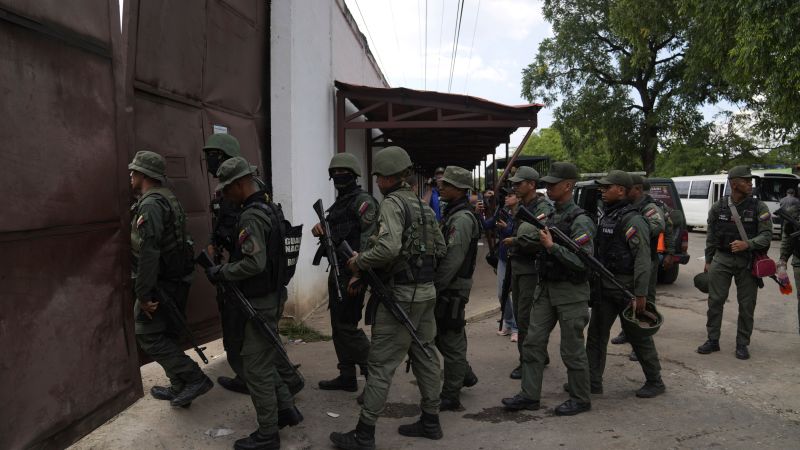
Guerrero Flores’ criminal journey began in 2005, when he was arrested for the murder of a government official, according to a 2018 ruling by the Venezuelan Supreme Court. His prison term, however, did not last long. In September 2012, he escaped from Tocorón Prison, a notorious facility in Aragua state. The escape was part of a larger pattern of defiance, as the Tren de Aragua had already established a stronghold within the prison walls. Years of prison life had allowed the gang to build its influence, with structures like swimming pools and restaurants constructed within the facility. This control made it nearly impossible to contain its members, even after recapturing Guerrero Flores in 2013.
The Rise of Tren de Aragua
Following his recapture, Tren de Aragua began to take shape as a dominant force. The gang gradually expanded its reach, securing territories and forging alliances with other criminal groups. By the mid-2010s, it had established a presence in San Vicente, a neighborhood in Guerrero Flores’ hometown of Maracay. According to InSight Crime, the organization’s influence extended beyond Venezuela, with reported operations in Colombia, Ecuador, Peru, Bolivia, and Chile. Transparencia Venezuela, the local branch of Transparency International, added Brazil and Costa Rica to the list of countries where the group was active. Mexican authorities had also documented arrests of suspected Tren de Aragua members, suggesting the network’s far-reaching impact.
Guerrero Flores’ leadership was central to this expansion. His ability to manipulate both prison systems and criminal hierarchies allowed the Tren de Aragua to evolve into a powerful syndicate. In 2016, a trial court in Aragua state sentenced him to 17 years and two months for multiple charges, including intentional homicide, weapon concealment, and drug trafficking. Yet, the gang’s grip on Tocorón Prison remained so strong that even after his imprisonment, Guerrero Flores continued to operate effectively. It wasn’t until October 2023, when the Venezuelan government took full control of the facility, that he disappeared from view.
The US’ Role in the Operation
US officials had been tracking Guerrero Flores for years, offering a $5 million reward for his capture or conviction. In December 2025, the US Attorney’s Office for the Southern District of New York charged him with orchestrating acts of terrorism within the United States. This legal move came after a CNN investigation documented the gang’s activities on American soil. The collaboration between the US and Venezuela in his elimination was seen as a strategic effort to dismantle a network that had grown increasingly sophisticated. Despite the operation’s success, questions remain about how the US managed to locate Guerrero Flores after years of eluding authorities.
Guerrero Flores’ death in Venezuela raises broader implications about the Tren de Aragua’s operational capabilities. The group’s ability to coordinate attacks across borders, including alleged operations in Europe, highlights its global ambitions. While the US emphasized its role in bringing the criminal leader to justice, Venezuela’s involvement suggests a shared goal of combating regional drug trafficking and organized violence. The operation also reflects the shifting dynamics between the two countries, with mutual trust in intelligence efforts playing a key part in the mission’s execution.
The Legacy of a Fugitive Leader
Despite his infamy, Guerrero Flores’ personal details remain sparse. His height and weight are listed as “unknown” in government records, and his biography on the State Department’s website is brief. This lack of information contrasts sharply with the extensive documentation of his criminal exploits. The Tren de Aragua, under his leadership, became a symbol of corruption and violence, with ties to drug smuggling, money laundering, and political influence. His death, however, may not end the group’s reach. Reports indicate that its structure continues to function, with members operating in multiple countries and maintaining a decentralized network.
As the US and Venezuela celebrated the elimination of a major threat, the incident also sparked debate about the effectiveness of joint operations. Some critics questioned the reliability of intelligence leading to the attack, while others praised the swift action. For those unfamiliar with the Tren de Aragua, the event provided a glimpse into the complex world of transnational crime. The gang’s ability to survive even after years of imprisonment and evade capture until its final moments underscores its resilience. In the wake of the operation, the focus now shifts to the future of the organization and the role of international cooperation in dismantling such networks.
Guerrero Flores’ story is a testament to the challenges of combating organized crime in Latin America. His journey from a young prisoner to a feared drug kingpin illustrates the adaptability of criminal groups in hostile environments. As the Tren de Aragua continues to operate in shadow, the question remains: how far will its reach extend, and who will be next to face its wrath? The joint US-Venezuela mission has brought attention to the gang’s global footprint, but its legacy in the region is far from complete.