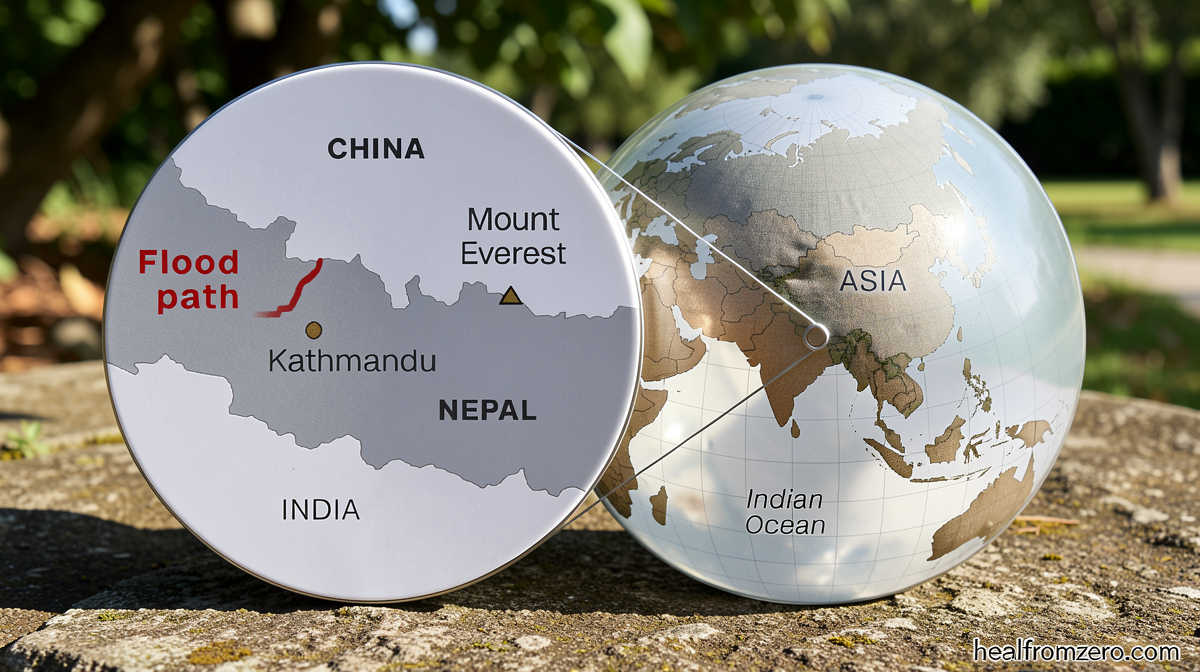
Landslides and floods have wreaked havoc in Nepal and China. Follow the river down the path of destruction.

Daftar Isi
Mountains Give Way: Nepal-China Border Region Faces Devastating Cascade of Landslides and Floods
Healfromzero.com – The Himalayan footholds along the Nepal-China frontier have been torn apart by a sequence of catastrophic geological events that began on August 26, when a massive landslide triggered cascading flash floods through narrow river valleys. In the days since that initial collapse, at least 675 people have been confirmed dead, and roughly 3,000 residents remain unaccounted for across both the Nepali and Chinese sides of the border. Homes have been flattened, bridges that served as the only crossings between isolated villages have vanished into swollen waterways, and entire communities now sit cut off from roads, hospitals, and supply lines.
The disaster has unfolded during the tail end of the South Asian monsoon, a period when saturated soils and saturated river channels make the region extraordinarily vulnerable to slope failure. What began as a single landslide event quickly escalated into a chain reaction of secondary flooding, debris flows, and river-channel blockages that turned normally manageable waterways into walls of rushing water and sediment.
Infrastructure Wiped Out
Video footage captured by residents and satellite imagery released in the aftermath reveal the sheer physical scale of the destruction. In the hardest-hit stretches, the river corridors appear unrecognizable: banks have been stripped of vegetation, sediment deposits have buried farmland, and the infrastructure that connected mountain settlements to the outside world has been reduced to rubble. Houses built on unstable slopes have been swept away or buried under meters of mud and rock. Bridges spanning the affected valleys—often simple timber or concrete spans serving as the sole link between a village and the nearest town—have been carried off entirely.
The loss of these crossings compounds the humanitarian crisis. Without bridges, relief convoys cannot reach trapped populations, and injured survivors cannot be transported to medical facilities. Helicopter operations, the primary alternative in such terrain, are constrained by overcast skies, high winds, and the limited number of airframes available in both countries’ mountain rescue inventories.
Two New Lakes, Two New Timed Bombs
Among the most pressing concerns facing officials on both sides of the border are two newly formed barrier lakes—bodies of water dammed in place by landslide debris that has plugged river channels upstream. These lakes are not natural features; they are temporary, unstable accumulations of water held back by walls of loose rock, soil, and vegetation that have not yet been consolidated by time or engineering.
The danger is straightforward and well documented in mountain hydrology: if the debris dam fails—whether through gradual seepage, overtopping, or sudden structural collapse—the stored water will release in a matter of minutes, sending a wall of floodwater downstream with far greater force than the original rainfall event. For communities situated below these lakes, the next few days represent a window of acute risk. Officials on both the Nepali and Chinese sides have placed monitoring teams at the lakes, tracking water levels, dam integrity, and downstream flow rates around the clock.
Additional rainfall is forecast for the flood-affected areas over the coming weekend. Even moderate rain falling on already-saturated slopes can trigger further slope failures, add volume to the barrier lakes, or push river levels past the capacity of remaining channels. Meteorological services in both countries are issuing rolling advisories, and local authorities have begun pre-emptive evacuations in villages directly downstream of the two lakes.
The Geography That Makes Rescue Nearly Impossible
The Nepal-China border runs through some of the most rugged terrain on Earth. Villages in this corridor are often accessible only by footpaths or single-lane mountain roads that wind along cliff edges. When a landslide removes the road or a flood removes the bridge, the only remaining access may be a helicopter flight of uncertain duration over peaks exceeding 5,000 meters. Communication infrastructure—cell towers, fiber lines—has been damaged or destroyed in several sectors, leaving search-and-rescue teams operating with limited real-time information about where survivors might be.
The figure of approximately 3,000 missing persons reflects not only those who have perished but have not yet been located, but also those trapped in isolated settlements where rescue has not yet been physically possible. In mountain disaster response, the distinction between “missing” and “dead” can take days or weeks to resolve, particularly when terrain prevents systematic search.
Broader Implications
The August 26 event and its aftermath underscore a pattern that mountain communities across the Himalayan belt have faced with increasing frequency: monsoon rainfall of greater intensity, combined with decades of infrastructure built on slopes that were never engineered for the loads now being imposed, produces failure cascades that outpace the response capacity of local governments. The two barrier lakes now forming along the border rivers are a reminder that a single landslide is rarely the end of a disaster sequence—it is often the beginning of a longer, slower threat that demands sustained vigilance long after the initial shock has passed.
For the residents of the affected valleys, the immediate question is not whether the next flood will come, but whether the warning will arrive in time to move families out of the channel before the water does.
Related Reading
Frequently Asked Questions
What is Landslides and floods have wreaked havoc?
Landslides and floods have wreaked havoc is the main topic of this guide. The article explains the context, practical details, and next steps readers should understand.
Why does Landslides and floods have wreaked havoc matter?
Landslides and floods have wreaked havoc matters because readers are looking for a useful answer, not just a short summary. Good content should match search intent and help them decide what to do next.