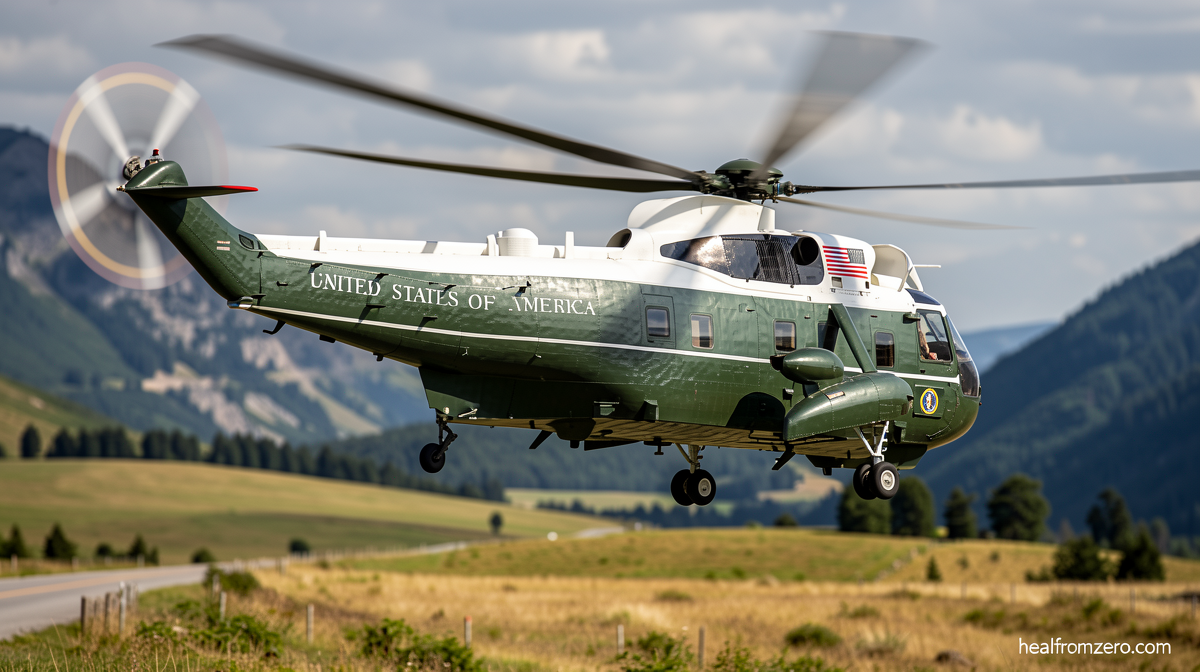
Trump’s Marine One again struggles to communicate with air traffic control before takeoff after similar incident this month

Daftar Isi
Marine One’s Radio Silence Over Washington: A Pattern That Won’t Break
Healfromzero.com – For the second time in under three weeks, the helicopter carrying President Donald Trump sat on the tarmac at Ronald Reagan Washington National Airport, unable to reach the air traffic control tower by radio. Controllers scrambled to find alternate channels, enlisting other aircraft already airborne to carry messages back and forth, before Marine One finally cleared for departure on Thursday. The episode underscores a persistent vulnerability in the communication link between the nation’s most heavily guarded aircraft and the infrastructure meant to keep it safe.
Thursday’s Four-Minute Standoff
Air traffic control audio from the incident shows Marine One attempting to establish contact with the Washington tower for roughly four minutes before any response came through. During that window, a separate aircraft in the vicinity relayed information to the controller, who then replied, “Oh, I couldn’t hear any of that.”
About a minute later, the same controller turned to another plane and asked for help.
“Do me a favor, I can’t hear Marine One. If you hear Marine One, can you let me know?”
Only after approximately four minutes of fragmented attempts did the tower and the presidential helicopter achieve mutual intelligibility. The Federal Aviation Administration confirmed that communication was ultimately established before takeoff.
“The three-minute notification was communicated by alternate means, acknowledged by a controller and positive contact was established with Marine One before takeoff,” the FAA stated.
The White House, when asked for comment, directed inquiries to the FAA.
The August 4 Near-Miss That Set the Stage
Thursday’s episode mirrors a far more consequential failure that occurred on August 4. On that date, Marine One departed the Ellipse — a temporary operating site used while construction work proceeds at the White House — after two unsuccessful attempts to make the mandatory radio call to the tower, both occurring within three minutes of liftoff. The National Transportation Safety Board’s preliminary report on that event details what went wrong.
Because the tower never received the required notification, departing commercial flights were not grounded as standard procedure dictates for a presidential helicopter movement. The result: Marine One closed to within 0.82 nautical miles laterally and 700 feet vertically of an Envoy Air passenger jet that had just lifted off. In aviation terms, that margin is thin enough to warrant a formal investigation, which the NTSB has opened.
Why the Signal Fails
Aviation radios operate on a fundamentally different principle from cellular networks. They depend on a relatively unobstructed line-of-sight path between transmitting and receiving antennas. Obstacles — terrain, buildings, temporary structures, or even the geometry of a helipad positioned behind a ridge — can degrade or eliminate the signal entirely.
The NTSB attributed the August 4 communications breakdown to inadequate line-of-sight between FAA radio equipment and the Ellipse, where Marine One had been temporarily based. Investigators noted that the helicopter’s first attempt to contact the tower was never received at all, while the second transmission arrived broken and unreadable. The physical relocation of the operating site, necessitated by ongoing White House construction, apparently placed the aircraft outside the coverage envelope of existing tower antennas.
Corrective Actions and Official Posture
The FAA said it “took immediate action” following the August 4 event. Among the steps cited were the relocation of an antenna to improve the radio link between DCA controllers and Marine One pilots, along with a review of the procedures governing presidential helicopter departures. Whether those measures fully resolved the geometry problem remains to be seen, given that Thursday’s incident still required third-party aircraft to serve as human repeaters.
White House spokesperson Kush Desai addressed the August 4 episode in a statement, emphasizing confidence in the flight crew and the broader security apparatus.
“Marine One flights are piloted by the finest aviators in the world, and the White House maintains the utmost confidence in these patriots and other security officials who are responsible for ensuring the President’s safety.”
Desai added that while the president was “at no point in harm’s way” during the momentary loss of separation on August 4, the administration would continue coordinating with military, FAA, and other security personnel to safeguard future flights.
Broader Implications
The recurrence of communication failures within a single month raises questions about whether the corrective steps announced after August 4 were implemented quickly enough, or whether the temporary Ellipse operating arrangement creates a structural gap that antenna relocation alone cannot close. Aviation radios are point-to-point systems; they do not self-heal when geometry shifts. If the White House construction timeline extends the Ellipse’s role as a departure point beyond the period for which the FAA’s interim fixes were calibrated, the risk of another near-miss — or worse — persists until a permanent solution is engineered.
For the thousands of commercial passengers who fly through Washington’s airspace daily, the standard operating procedure exists precisely so that no civilian jet and no presidential helicopter share the same corridor at the same altitude. When that procedure is bypassed because a radio call never lands, the margin between routine and catastrophe narrows to a fraction of a mile. Thursday’s four-minute silence, while ultimately resolved, is a reminder that the margin is thinner than public perception of presidential aviation might suggest.
Related Reading
Frequently Asked Questions
What is Trump s Marine One again struggles?
Trump s Marine One again struggles is the main topic of this guide. The article explains the context, practical details, and next steps readers should understand.
Why does Trump s Marine One again struggles matter?
Trump s Marine One again struggles matters because readers are looking for a useful answer, not just a short summary. Good content should match search intent and help them decide what to do next.