
Houthi forces enter Iran conflict with missile attacks on Israeli military sites
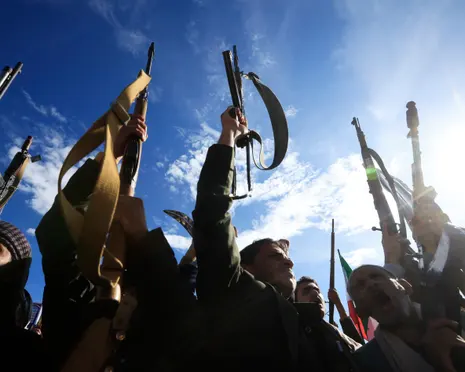
Houthi forces enter Iran conflict with missile attacks on Israeli military sites
The escalation of the US-Israeli-Iran war has taken a new turn as Houthi rebels in Yemen have launched missile strikes against Israeli military installations. This development signals a broader conflict involving regional actors, intensifying fears of economic repercussions on a global scale. Pakistan has stepped forward to host a gathering of Middle Eastern nations on Monday, aiming to foster a collective strategy to resolve the crisis. However, the absence of direct participation from the conflicting parties has raised questions about the effectiveness of the diplomatic efforts, despite US assurances of progress.
Houthi representatives, who are closely aligned with Iran, declared on Saturday that they had launched ballistic missiles at “strategic Israeli military sites” and vowed to persist with military actions until hostilities ceased across all fronts. Israel confirmed it had intercepted one missile originating from Yemen, highlighting the group’s growing role in the conflict. While US officials have claimed to cripple a significant portion of Iran’s missile and drone arsenal, intelligence sources suggest that Washington has only definitively neutralized a third of it, leaving room for further escalation.
Regional tensions escalate with dual attacks
On Saturday, a missile and drone assault targeted Prince Sultan airbase in Saudi Arabia, injuring at least 12 US personnel, including two in critical condition. Simultaneously, drones struck Kuwait International Airport, causing substantial damage to its radar systems. These strikes underscore the conflict’s expanding reach, with Yemen’s Houthi forces now threatening critical maritime routes. The Bab al-Mandab Strait, a vital passage between Yemen and the Horn of Africa, is particularly at risk, compounding the economic strain caused by Iran’s near-complete blockade of the Hormuz Strait.
“The Houthis’ involvement in the broader Middle East conflict marks a significant and troubling escalation,” remarked Farea Al-Muslimi, a researcher at Chatham House. “The potential disruption to key commercial maritime corridors, especially in the Red Sea and Bab al-Mandab, is immense. Meanwhile, essential economic and military infrastructure in the Gulf could face heightened vulnerability.”
As the conflict transitions into its second month, Pakistan has emerged as a potential mediator. The nation’s prime minister, Shehbaz Sharif, and military chief, Field Marshal Asim Munir, sought to incentivize US-Iran negotiations. However, the recent attacks have tested this role, with Iran reportedly agreeing to allow additional Pakistani ships through the strait—two per day—to ease tensions. Meanwhile, the United States has deployed cluster munitions, drawing condemnation from experts who linked Iranian mines to banned weapons used in strikes on Israel.
Iran’s central command announced that it had targeted a Ukrainian anti-drone system depot in Dubai, which it accused of supporting US operations. While the strike remains unconfirmed by Dubai authorities, Ukraine has been supplying anti-drone technology to Gulf states since the war began, leveraging its experience with Russian attacks. In a related development, President Volodymyr Zelenskyy revealed on Saturday that his country had finalized defense pacts with the United Arab Emirates and Qatar, following a recent agreement with Saudi Arabia.
With the Houthis now operating as proxies for Iran, the conflict’s geographic scope has widened. Analysts warn that further attacks on the Bab al-Mandab could trigger a renewed Saudi-Yemen confrontation, exacerbating the humanitarian toll that has persisted for over seven years. The strategic implications of such a move are profound, as it threatens to disrupt energy and trade flows critical to the global economy.