
More than 11,000 canceled flights: Middle East travel chaos in 5 charts
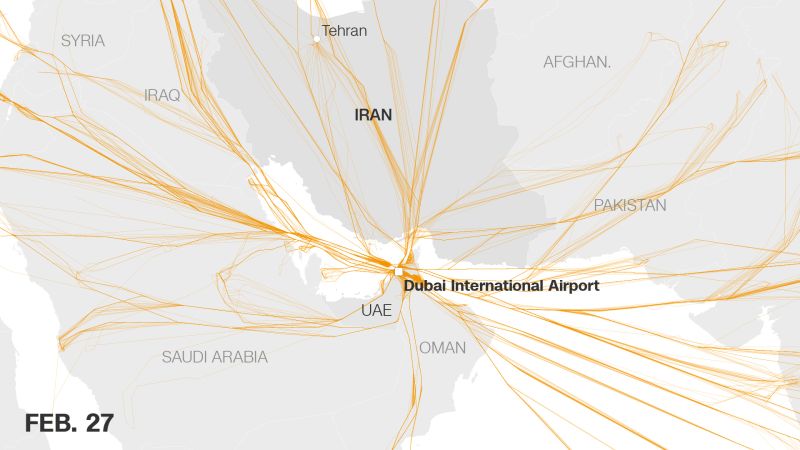
Travel Disruptions in the Middle East Amid Regional Conflict
Travelers across the Middle East are now facing significant disruptions due to a surge in flight cancellations. As of March 4, airspace closures or partial suspensions have affected 10 countries, according to Flightradar24 data. The conflict intensified after the United States and Israel launched attacks on Iran on February 28, leading to a cascade of cancellations across major airports in the region.
Flight Cancellations and Airspace Changes
Flightradar24 reports that over 11,000 flights were canceled since the strikes. This has left the usual congestion in the skies eerily quiet. Several Persian Gulf airports, including Dubai International, have drastically reduced operations. Dubai International, a global hub linking 291 destinations, saw its scheduled flights drop by 87% in the week following the attacks.
Other key airports also experienced steep declines. Sharjah, an emirate adjacent to Dubai, canceled approximately 91% of its flights, while Doha, Qatar, recorded a 93% reduction. These figures highlight the scale of the disruption, with the loss of thousands of seats impacting both residents and transiting passengers.
Resumption of Operations
Despite the turmoil, some airports have started to restore services. On Wednesday, Dubai, Abu Dhabi, and King Khalid International near Riyadh, Saudi Arabia, began to resume flights. This partial recovery suggests a gradual return to normalcy as the situation stabilizes.
“More than 300,000 British citizens live in or are in transit across Gulf countries,” noted the British foreign secretary.
The U.S. State Department also reported that over 17,500 American citizens returned to the United States from the Middle East since February 28. These movements underscore the growing concern among expatriates and the impact of the conflict on international travel patterns.