
Salman Rushdie Fast Facts
Salman Rushdie: A Life in Literature
Salman Rushdie Fast Facts –
Origins and Early Years
Salman Rushdie, whose full birth name is Ahmed Salman Rushdie, entered the world on June 19, 1947, in Bombay—now known as Mumbai—India. His father, Anis Ahmed Rushdie, worked as a businessman, while his mother, Negin Rushdie, pursued a career in education as a teacher. These formative years in India would later influence much of his literary output.
After relocating to England, Rushdie attended Rugby School, where he encountered both challenges and growth. His time there was marked by racist taunts and bullying from fellow students, experiences that would shape his perspective on identity and belonging. This period of his life provided rich material for his future writings about cultural displacement and personal resilience.
Education and Professional Foundations
Rushdie’s academic journey led him to King’s College at the University of Cambridge, where he completed his studies and graduated in 1968. Before committing fully to writing, he worked intermittently as an advertising copywriter in London, developing his craft through words while navigating the professional world. This dual experience—both in creative writing and commercial communication—would prove valuable throughout his career.
In an interview with The Sunday Telegraph, Rushdie revealed that acting was his alternative dream had he not pursued literature. This passion for performance and storytelling would later manifest in his willingness to engage publicly and his appearances in film.
Family and Personal Life
Throughout his life, Rushdie has been married five times. His most recent marriage began in 2021 to Rachel Eliza Griffiths and continues to the present. Previous marriages include Padma Lakshmi (2004-2007, divorced), Elizabeth West (1997-2004, divorced), Marianne Wiggins (1988-1993, divorced), and Clarissa Luard (1976-1987, divorced). He has two children: Milan, born to Elizabeth West, and Zafar, born to Clarissa Luard.
Major Literary Milestones
Rushdie’s publication history spans decades of significant work. His first novel, “Grimus,” appeared in 1975. In 1981, he achieved critical acclaim by winning the Booker Prize for “Midnight’s Children.” “Shame” followed in 1983, and then came the pivotal work that would change his life forever.
The 1988 release of “The Satanic Verses” triggered widespread demonstrations, riots, and bans across Muslim-majority nations due to perceived blasphemy. The controversy escalated dramatically when Iran’s Ayatollah Ruhollah Khomeini issued a fatwa in 1989—a religious edict calling for the death of Rushdie and all those involved in producing the book.
The consequences were severe and far-reaching. Ettore Capriolo, an Italian translator of the novel, was stabbed. Hitoshi Igarashi, a Japanese translator, was murdered. William Nygaard, a Norwegian publisher, was shot and wounded. These attacks demonstrated the global reach of the controversy.
Life Under Protection
Following the 1989 fatwa, Rushdie entered hiding with British police assistance. For more than a decade, he limited public appearances and restricted his movements. During this period, he adopted the alias “Joseph Anton,” combining elements from two literary giants: Joseph Conrad and Anton Chekhov.
Over time, the situation evolved. In 1998, the Iranian government pledged not to pursue enforcement of the fatwa against him. This gradual de-escalation allowed Rushdie to eventually resume a more public life while maintaining awareness of the ongoing threat.
Honors and Recognition
Rushdie’s contributions to literature earned him numerous accolades. On June 16, 2007, Queen Elizabeth II knighted him for his services to literature, though he formally collected his knighthood on June 25, 2008. He also became a United States citizen in 2016 while retaining his British citizenship.
Academically, he joined Emory University’s English Department as Distinguished Writer in Residence in 2006, beginning his teaching role in 2007. He served as University Distinguished Professor of the College of Arts and Sciences there from 2011 to 2015. His work has also reached cinema audiences, with his appearance as himself in “Bridget Jones’s Diary” in 2001 and the 2012 film premiere of “Midnight’s Children.”
The 2022 Attack and Recovery
On August 12, 2022, tragedy struck again. Rushdie was stabbed multiple times onstage before his scheduled lecture at the Chautauqua Institution in western New York. According to Chautauqua County District Attorney Jason Schmidt, he suffered three stab wounds to his neck, four to his stomach, puncture wounds to his right eye and chest, and a laceration on his right thigh.
Hadi Matar, aged 24, was accused of the attack and pleaded not guilty to attempted murder in the second degree and other charges on August 13, 2022. By October 22, 2022, Rushdie’s literary agent Andrew Wylie reported to Spanish newspaper El País that the author had lost sight in one eye and one hand was incapacitated.
US Secretary of State Antony Blinken announced new sanctions on the “15 Khordad Foundation” on October 28, 2022, in response to the attack. Rushdie gave his first interview since the incident to The New Yorker on February 6, 2023, and his first television interview to CBS’s “60 Minutes” on April 14, 2024, where he mentioned having a “premonition” of the event days beforehand.
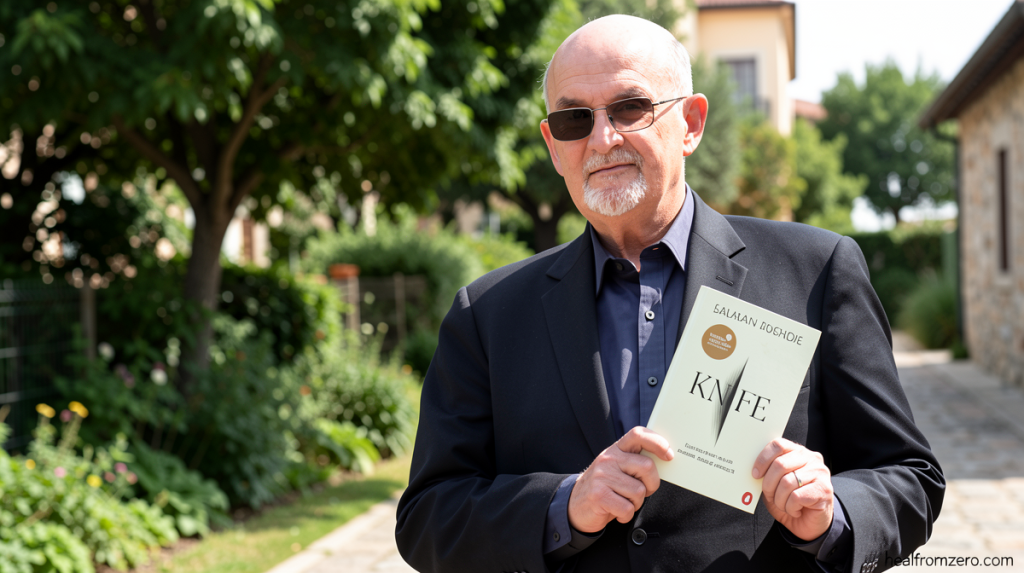
His memoir, “Knife: Meditations After an Attempted Murder,” was published on April 16, 2024. His first book since the attack, “Victory City,” appeared on February 7, 2023, though he chose not to participate in a press tour. On May 15, 2023, in a rare public video message at The British Book Awards, Rushdie warned that freedom of expression remains under threat. Most recently, on February 11, 2025, he testified in court against Matar, showing a jury his blind eye as part of his legal proceedings.