
Is Trump celebrating the country, or himself, on America’s 250th?
Is Trump Celebrating the Country, or Himself, on America’s 250th?
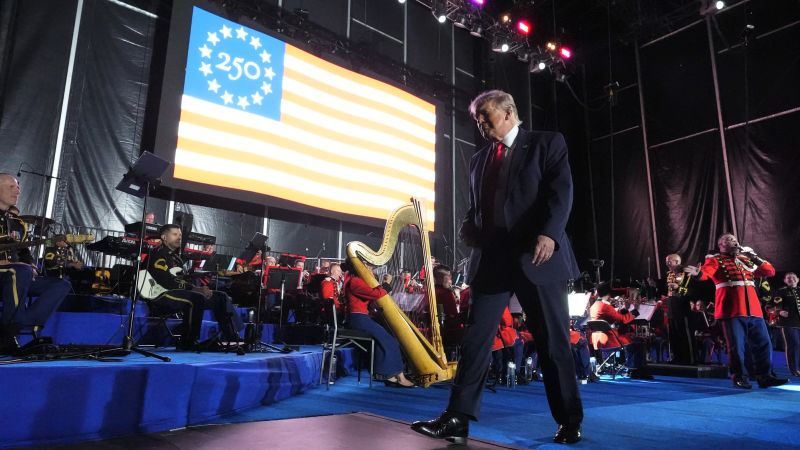
Is Trump celebrating the country or himself – President Donald Trump’s recent address marked America’s 250th anniversary of the Declaration of Independence with a focus that raised questions about his intent. Speaking on Wednesday night at a semi-quincentennial event on the National Mall, he framed the nation’s milestone as a testament to his leadership, suggesting that the country’s current prosperity owed much to his tenure. The ceremony, which included a dramatic display of military jets and the Marine Band’s patriotic rendition of “America the Beautiful,” set the stage for a speech that seemed more self-congratulatory than reflective of the nation’s historical journey.
The Semi-Quincentennial Event
As the sun set over the Mall, Trump took the podium, his words echoing the grandeur of the occasion. Yet the tone of his remarks leaned heavily toward personal achievement. He spoke of America’s resurgence, declaring that the country had been “rescued” from decline under his administration. The narrative he crafted left little room for the complexities of the past, instead emphasizing the present as a direct result of his policies. His campaign anthem, “God Bless the USA,” played over the crowd, reinforcing a message that blended patriotism with self-praise.
The event’s structure was designed to highlight Trump’s vision of national greatness. After nodding to the foundational ideals of the Declaration of Independence, he pivoted to a list of accomplishments, real or contested, that he claimed solidified his legacy. From securing the southern border to passing tax-cut legislation, he positioned himself as the architect of America’s revival. His comparison to the Biden administration, which he labeled a “total disaster,” underscored his belief that his leadership had restored the country’s former glory.
Critics’ Concerns
Yet the president’s approach to commemorating the nation’s founding sparked debate among observers. Critics argued that his focus on personal success overshadowed the broader themes of history, such as the nation’s struggles for equality and its evolving identity. Democratic National Committee chair Ken Martin voiced this sentiment, stating in a statement that Trump was “blowing money on flashy, Trump-themed events while forcing Americans to foot the bill.” Martin’s critique highlighted a growing concern that the event had become a platform for Trump’s political ambitions rather than a celebration of collective progress.
Trump’s speech also revealed a tension between his rhetoric and the current state of public opinion. With his approval rating at 36% in the latest CNN Poll of Polls, a majority of Americans now oppose him. This dissonance made his celebration of the country’s 250th birthday all the more striking. In a normal era, a leader might have taken a moment to reflect on the nation’s triumphs and tribulations, acknowledging both its strengths and its flaws. But Trump’s narrative seemed less about honoring the past and more about solidifying his place in the present.
The president’s decision to exclude performing artists who criticized the event’s politicization added to the scrutiny. When several artists withdrew, citing concerns about the ceremony’s bias, Trump reacted with what some described as a blend of indignation and determination. He doubled down by hosting a campaign rally immediately after, framing the event as a victory for his vision of American renewal. This reaction illustrated a pattern in his political strategy: turning national celebrations into opportunities to reinforce his personal brand.
Contrasting Perspectives
While Trump’s speech resonated with his base, it left many others questioning its intent. The crowd, which appeared overwhelmingly composed of his supporters, applauded his remarks with fervor. Yet millions of Americans who are not MAGA voters still cherish the country’s history and its values. For them, the 250th anniversary of the Declaration of Independence represented a moment for unity and reflection, not a platform for partisan boasting.
Trump’s comments on the military and his efforts to improve safety in Washington, DC, were met with mixed reactions. While some residents appreciated his focus on reducing crime and cleaning up public spaces, others bristled at the spectacle of his renovations. His proposed triumphal arch and the farcical reworking of the Reflecting Pool on the Mall became symbolic of his style—grandiose yet divisive. These gestures, though intended to showcase his legacy, also drew criticism for their extravagance and perceived disconnect from the nation’s core values.
The president’s speech hinted at a broader strategy to shape the nation’s narrative. By emphasizing his policies as the driving force behind America’s resurgence, he positioned himself as a central figure in the country’s story. This approach, while effective in rallying his supporters, risked alienating those who view the 250th anniversary as a time for collective celebration rather than individual acclaim. His claim that “we have taken power back from the far-off political class” was met with both agreement and skepticism, depending on the listener’s perspective.
Despite the controversies, Trump’s remarks were framed as a call to action. He announced plans for a “favorite president” speech on July Fourth, suggesting that his celebration was only the beginning of a larger campaign to redefine America’s historical narrative. This move raised questions about whether his speech was a prelude to further attempts to dominate the national conversation. For critics, the event underscored a pattern of self-centered leadership, where the country’s milestones are used to elevate the individual rather than the collective.
As the nation reflects on its 250-year journey, the debate over Trump’s approach to the anniversary continues. While his speech was praised by supporters for its energetic tone and bold assertions, it also highlighted the challenges of balancing personal ambition with national unity. The question remains: is Trump’s celebration of America’s birthday a genuine tribute to its founding ideals, or a calculated effort to solidify his own historical legacy? The answer may depend on how future generations interpret the events of this pivotal moment in American history.