Tucker Carlson says he will no longer support the Republican Party

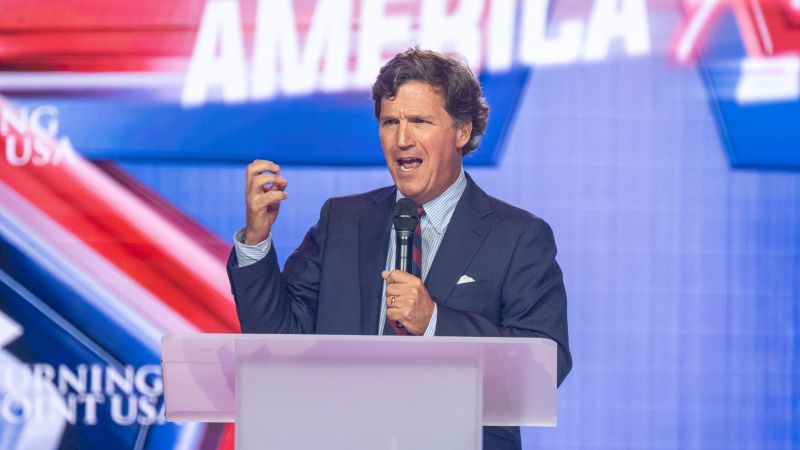
Tucker Carlson Says He Will No Longer Support the Republican Party
Tucker Carlson says he will no longer – Tucker Carlson, a prominent figure in conservative media, has made a significant declaration that marks a turning point in his political alignment. During a recent episode of his podcast, he stated that he would not support the Republican Party in the upcoming November midterm elections. This decision comes after years of staunchly defending the party’s values as a commentator and a host on Fox News Channel, where he built a massive following. The announcement, made late last week on the show “Can’t Be Censored,” signals a deepening rift between Carlson and the Republican Party, which he has long championed.
Podcast Statement and Political Shift
Carlson’s remarks on the podcast were sharp and unequivocal. He emphasized that his support for the Republican Party was no longer viable, stating, “There’s no chance I would support the Republican Party.” This sentiment contrasts sharply with his previous role as a defender of the party’s principles. He quickly clarified his stance by adding, “Not gonna support the Democratic Party,” highlighting his continued loyalty to his ideological roots despite his decision to distance himself from the Republicans.
The former Fox News host, who has gained substantial traction through his own podcast since leaving the network in 2023, has increasingly questioned the party’s direction. His disillusionment appears to be intensifying, particularly following President Donald Trump’s decision to take military action against Iran in February. This event has acted as a catalyst for Carlson’s growing criticism, prompting him to reassess his political affiliations. Although he endorsed Trump in the 2024 presidential race, his stance has since evolved, leading to a public apology for his initial support and a reevaluation of his views on the candidate’s policies.
Disillusionment and Criticisms
Carlson’s break with the Republican Party is framed as a result of the party’s perceived prioritization of external interests over domestic priorities. In a direct critique, he asserted, “They are making decisions on the basis of other criteria, what’s best for this company, what’s best for Israel, what’s best for our donors.” This statement encapsulates his frustration with what he describes as a self-serving agenda. He further labeled these decisions as “unacceptable, that’s treasonous, it’s immoral, it can’t continue,” underscoring the gravity of his disapproval.
His recent departure from the Republican Party is not merely a personal choice but a broader critique of the party’s leadership. Carlson, who has been a consistent advocate for the Republican Party for over three decades, now argues that its current trajectory is at odds with its foundational values. “I’ve been a consistent defender for 35 years of the Republican Party, I mean very consistent defender, but there’s no defending this,” he stated. This admission reflects a shift in his perspective, as he now sees the party’s actions as betraying its core principles.
The war in Iran has become a focal point of his criticism, with Carlson accusing the party of aligning too closely with Israel’s interests. He has repeatedly highlighted what he perceives as the conflict’s impact on American citizens, suggesting that the decision was driven more by geopolitical considerations than by the nation’s best interests. This critique has resonated with his audience, many of whom have followed his career from its early days on Fox News to his independent platform.
Carlson’s move has sparked discussions about the implications for the Republican Party. His public criticism has intensified the perception that the party is losing its grip on its base, especially among voters who feel their concerns are being sidelined. By openly distancing himself from the party, he has positioned himself as a critic of its internal dynamics, arguing that its decisions are increasingly disconnected from the needs of the American people. This has led to a broader reflection on the party’s ability to represent its constituents in a rapidly changing political landscape.
The former Fox News host’s actions have also raised questions about the future of conservative media. His departure from the network in 2023 was a pivotal moment, allowing him to build a new platform where his voice could be heard without the constraints of corporate politics. His independent podcast has grown into a significant influence, with many of his followers now viewing him as a potential leader or alternative voice within the conservative movement. This shift has created a new dynamic, where Carlson’s views are no longer confined to the Fox News framework but are now part of a wider discourse on political loyalty and party alignment.
Despite his public stance, Carlson has not entirely severed ties with the Republican Party. He has acknowledged that his decision to distance himself is part of a larger trend, stating, “If I’m out, then I think a lot of other people are out.” This suggests that his break may be indicative of a broader movement within the conservative community, where dissatisfaction with the party’s direction is growing. His words have been interpreted as a call to action, urging others to reconsider their support and align themselves with more principled positions.
Carlson’s journey from a Fox News stalwart to a critic of the Republican Party illustrates the complexities of political loyalty in the modern era. His ability to maintain a large following despite his departure from the network highlights the power of independent media in shaping political discourse. As he continues to articulate his views, the question remains whether his departure will inspire a significant shift in the Republican Party’s strategy or signal the beginning of a deeper ideological divide within the movement.
Legacy and Impact
Carlson’s decision to no longer support the Republican Party is a testament to the evolving nature of political allegiance. His long-standing role as a commentator has provided him with a platform to influence public opinion, and his recent statements have amplified the debate over the party’s current priorities. While his departure from Fox News in 2023 was a personal and professional milestone, his current position adds a new layer to his legacy, positioning him as both a critic and a potential disruptor within the conservative movement.
His words carry weight, not only because of his historical influence but also due to the current political climate. The Republican Party faces mounting pressure to address the concerns of its base, and Carlson’s criticism serves as a reminder of the expectations placed on its leaders. His arguments, rooted in a combination of ideological conviction and personal experience, have the potential to reshape the conversation around political loyalty and the responsibilities of party members to their constituents.
In conclusion, Tucker Carlson’s decision to distance himself from the Republican Party is a multifaceted development that reflects his personal journey and broader political dynamics. His statements on the podcast, coupled with his ongoing critiques, highlight the challenges faced by the party in maintaining its integrity and representing its voters. As the November midterms approach, his stance will be closely watched, not only for its implications on the Republican Party but also as a barometer of shifting political sentiments within the conservative community.