Judge rejects bid to stop UFC fight at White House

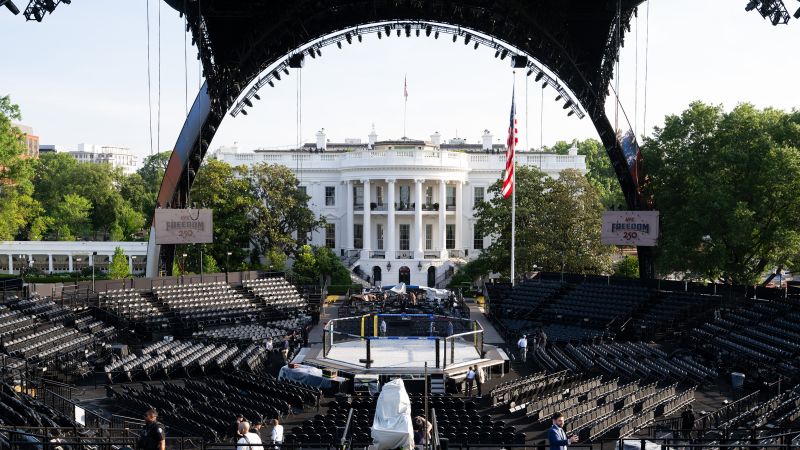
Judge Rejects Bid to Stop UFC Fight at White House
Judge rejects bid to stop UFC fight – A federal court in Washington, D.C., has ruled against a legal challenge aimed at preventing President Donald Trump from hosting a UFC event at the White House this weekend. The decision, issued by US District Judge Amit P. Mehta on Friday afternoon, denied the request from two Virginia residents to block the fight. The case was initiated last weekend by the plaintiffs, who argued that the privately organized event should not be held on the South Lawn of the White House or at the Lincoln Memorial, where preparatory activities are scheduled to occur on Friday before the main event on Sunday.
Plaintiffs’ Legal Challenge
The lawsuit centered on the claim that the UFC fight was improperly using federal spaces without proper permits. The plaintiffs, consisting of a political activist and a Vietnam War veteran, contended that the event was not aligned with the 250th anniversary of American independence but was instead a celebration of Trump’s birthday, which coincides with the event’s date. They emphasized that the White House and Lincoln Memorial are public landmarks, and events held there should comply with standard regulatory procedures. According to their legal team, the administration had bypassed necessary permits by invoking a federal rule that temporarily exempts events tied to the nation’s 250th birthday from certain permitting requirements.
“The event is neither ‘for the celebration of the 250th anniversary of American Independence’ nor, crucially, being ‘planned, organized, and executed’ by the federal government,” the plaintiffs’ lawyers stated in court filings.
The plaintiffs also highlighted that the event’s private organizers, including the UFC, had not followed routine regulations such as conducting an environmental assessment. They argued that the federal government’s involvement in providing emergency services, food, and security for the event did not justify its use of public spaces without prior approval. The case became a focal point for debates over the balance between presidential authority and public oversight of federal property.
Judge’s Rationale and Legal Standing
Mehta, who was appointed by former President Barack Obama, determined that the plaintiffs lacked the legal standing to contest the event. In his ruling, he noted that while the administration’s use of the White House grounds for the fight might be contentious, the plaintiffs had not demonstrated a direct injury that warrants judicial intervention. The judge acknowledged the administration’s argument that halting the event would cause significant harm, including financial losses and disruptions to the planned festivities.
“The potential loss of those dollars resulting from a last-minute, court-ordered stoppage cannot be ignored,” Mehta wrote in his decision.
The UFC event has already incurred over $60 million in production, labor, construction, and promotion costs, according to court documents. The federal government, meanwhile, is covering expenses such as medical services, law enforcement, and security for the venue. White House management director Joshua Fisher confirmed in a sworn declaration that the government is also providing perishable food items for the anticipated 4,000 South Lawn guests and more than 120,000 spectators at the Ellipse. However, the judge did not address whether these services were justified under federal law, leaving that question unresolved.
Federal Government’s Defense
Defense attorneys from the Justice Department countered the plaintiffs’ claims, asserting that the administration had adhered to all relevant federal rules. They argued that the event’s use of the White House grounds did not violate any permitting requirements, as temporary structures like the “claw” — a temporary stage erected for the fight — are routinely used for special events without congressional approval. The DOJ emphasized that such structures are common at the White House, from concerts to holiday celebrations, and that the 250th anniversary exemption was a valid basis for the event’s organization.
“Temporary structures are ubiquitous on the White House grounds, erected for nearly every special event, yet nobody has ever before suggested that Congress somehow needs to pass legislation for every concert tent or Easter egg roll kiosk,” DOJ lawyers stated in their filings.
The administration maintained that the event was a legitimate use of federal resources, with the UFC bearing the majority of the costs. Fisher’s declaration outlined the government’s role as limited to logistical support, ensuring the event’s safety and efficiency. Despite this, the plaintiffs accused the administration of using the anniversary exemption to circumvent standard permitting processes, potentially allowing private entities to exploit public spaces for their own benefit.
Implications and Next Steps
The ruling marks a pivotal moment in the legal battle over the event’s legality. While the judge dismissed the immediate request to block the fight, the case remains active, with further proceedings likely to explore the broader implications of the administration’s actions. The plaintiffs had sought a temporary injunction to delay the event until the legal arguments could be fully examined, but Mehta’s decision clears the way for the UFC fight to proceed as planned.
Some legal analysts suggest the ruling could set a precedent for future events at the White House, particularly those involving private organizers. The decision also underscores the administration’s argument that federal spaces can be used flexibly for large-scale events, provided they align with national milestones or public interest. However, critics argue that the exemption could be misused, allowing political events to overshadow cultural or historical commemorations.
As the event approaches, the administration has announced plans to dismantle the temporary structures, including the “claw,” beginning Monday. This timeline adds urgency to the legal proceedings, as the fight is set to take place this weekend. The outcome of the case may influence how federal agencies handle similar requests in the future, balancing presidential discretion with public accountability.
With the plaintiffs’ legal arguments still in play, the focus now shifts to whether the federal government’s use of the White House grounds for the event constitutes a proper exercise of its authority or an overreach. The decision also raises questions about the extent of private influence in shaping public events, especially when corporate interests are tied to the presidency. As the UFC fight nears, the case remains a symbol of the ongoing tension between executive power and the need for transparency in the use of national resources.
Additional details were incorporated into the story following the judge’s ruling, highlighting the financial stakes and the logistical scale of the event. The administration’s defense, which emphasized the routine use of temporary structures, aims to position the UFC fight as a standard public event rather than a political maneuver. Meanwhile, the plaintiffs continue to assert that the event’s primary purpose is to celebrate Trump’s birthday, not the nation’s founding, and that this misalignment warrants closer scrutiny.
Regardless of the outcome, the decision has already sparked discussion about the role of the White House as a venue for both public and private gatherings. The case exemplifies how legal challenges can test the boundaries of presidential authority and the flexibility of federal regulations in accommodating large-scale events. As the fight unfolds, the debate over its legitimacy will likely persist, reflecting broader concerns about the intersection of politics and public space in the United States.