Tear your eyes away from the ballroom. This courthouse is the real face of Trump-era architecture

Tear Your Eyes Away from the Ballroom: Chattanooga Courthouse Embodies Trump’s Architectural Vision
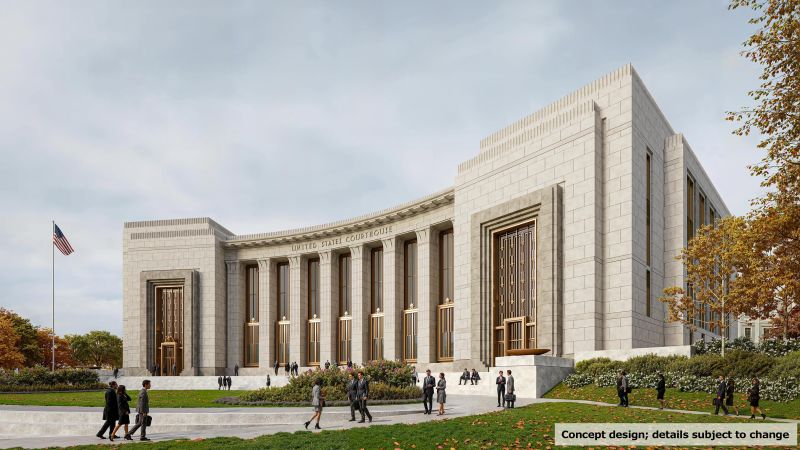
Tear your eyes away from the ballroom – While President Donald Trump’s opulent $400-million White House ballroom and the proposed triumphal arch in Washington, DC, dominate headlines for their extravagance, a more subtle yet significant representation of his architectural philosophy has emerged in Tennessee. This week, officials unveiled the design for Chattanooga’s new federal courthouse—a project that, though far from the capital, offers a tangible glimpse into the visual legacy of the Trump administration. Scheduled to open in 2030, the structure blends Art Deco aesthetics with Greek architectural motifs, creating a bold statement that has sparked both admiration and scrutiny within the design community.
A Political Statement in Stone
The courthouse’s design, crafted by the contemporary firm HOK, reflects a muscular interpretation of classical architecture. Its rectangular form, flanked by two hefty, mausoleum-like volumes, evokes the grandeur of ancient temples while incorporating modern materials. This approach, termed “Greco-Deco” by its proponents, is seen as a direct response to Trump’s executive order, “Making Federal Architecture Beautiful Again,” which prioritized classical and traditional styles over modernist or postmodern designs. The project serves as the first major federal building to materialize under this directive, marking a shift in how public spaces are conceived and constructed.
“Classicism is still alive, can be done well, and can be both traditional and original,” said Justin Shubow, president of the National Civic Art Society (NCAS), which helped draft the executive order. He emphasized that the design exemplifies the balance between heritage and innovation, aligning with the president’s vision of restoring a sense of order and dignity to federal architecture.
Yet, the courthouse’s grandeur has not gone unchallenged. Critics argue that its imposing silhouette risks transforming judicial spaces into symbols of political power rather than functional institutions. Kevin D. Murphy, a professor at Vanderbilt University, pointed to the design’s resemblance to 1930s classicism, a style historically linked to fascist regimes. “This isn’t just about aesthetics; it’s about the message it sends,” Murphy stated, questioning whether the building’s solidity and formality align with the values of transparency and accessibility that modern courthouses are meant to embody.
The Legacy of a Directive
Trump’s executive order, issued last year, sought to reorient federal architecture toward a more “timeless” aesthetic. By mandating classical styles for major projects, the directive aimed to replace the abstract forms of modernism with structures that evoke tradition and authority. However, the slow pace of large-scale federal projects has made Chattanooga’s courthouse a rare and revealing test case. While the order has influenced design trends, its practical impact remains to be seen, with this building serving as the first concrete example of its execution.
The new courthouse’s design draws heavily from its 1930s predecessor, the Joel W. Solomon Federal Building, which itself was a product of the New Deal era. This continuity suggests that Trump’s vision may not represent a radical departure but rather a reinforcement of established norms. For some, this is a deliberate move to create a sense of stability and permanence, especially in an era of political polarization. However, others see it as a consolidation of power, with architectural choices mirroring the president’s broader rhetoric.
“To me, it isn’t at all transparent. It is very formidable and very solid, in a very conventional way,” Murphy said over the phone, adding, “Is that the message you want to send about the judiciary? That it’s intimidating?”
Christopher Hawthorne, a former architecture critic for the Los Angeles Times and current editor of the Punch List newsletter, offered a more measured perspective. He called the design “handsome” and acknowledged its competence, though he noted its lack of deeper societal commentary. “Architecture has a responsibility to say something fundamental about contemporary society,” Hawthorne remarked. “I don’t think this courthouse design has anything to say, except reflecting the current occupant of the White House.” His critique highlights the tension between form and function, as well as the potential for architecture to become a tool of political symbolism.
Public Sentiment and the Debate Over Tradition
Despite the architectural debate, public opinion suggests a growing preference for traditional designs in federal spaces. A 2020 Harris Poll commissioned by the NCAS found that over 70% of Americans, regardless of political affiliation, favored classic styles for courthouses and office buildings. This sentiment has been further reinforced by recent events, such as the FBI’s decision to vacate the J. Edgar Hoover Building—a structure often criticized for its outdated design—or the potential demolition of the Dallas City Hall, which features sharp, angular architecture. These developments, while not generating widespread outcry, underscore a public appetite for familiarity and visual gravitas.
However, the architecture profession remains divided. Many in the field view Trump’s directive as a nostalgic attempt to curb the influence of avant-garde movements, which have often been accused of prioritizing style over substance. Op-eds have warned that this focus on tradition could lead to a culture of pastiche, where innovation is stifled in favor of derivative imitations. The challenge, as some argue, lies in maintaining the essence of classical architecture while adapting it to modern needs. “Many judges, regardless of whether they were appointed by a Democrat or a Republican president, want a courthouse that looks like a courthouse,” Shubow said in a video call. His words hint at a broader desire for institutions to project clarity and authority, even if it means leaning on historical templates.
The ongoing discussion raises questions about the role of architecture in political narratives. While the courthouse is intended to symbolize justice and permanence, its design also embodies the ideological priorities of its era. For supporters of the order, the structure is a testament to the enduring appeal of classical forms. For skeptics, it represents a subtle yet powerful assertion of authority, potentially blurring the line between architectural artistry and political propaganda. As HOK prepares to bring this vision to life, the building stands as both a monument to Trump’s aesthetic agenda and a focal point for the evolving dialogue about the intersection of design and democracy.
The debate over the courthouse’s style is not merely academic. It reflects a larger struggle between innovation and tradition, between the need for symbolic clarity and the risk of stagnation. Whether it is seen as a revival of classical ideals or a new chapter in political architecture, the building will serve as a physical reminder of the Trump era’s priorities. As the years pass and the structure rises, its influence will extend beyond aesthetics, shaping the way the public perceives the institutions that govern them.