Several states are bowing out of Trump’s ‘Great American State Fair’

Several States Are Bowing Out of Trump’s ‘Great American State Fair’
Several states are bowing out of Trump – President Donald Trump has launched the “Great American State Fair” as a national celebration marking the 250th anniversary of the United States. The event, set to open on June 25 and run for approximately two weeks, aims to showcase each state and territory through dedicated pavilions. However, recent reports indicate that a growing number of states are choosing not to take part, raising questions about the event’s political neutrality and financial feasibility.
State Participation in Question
Officials from Oregon, Washington, and North Carolina have confirmed their decision to decline invitations from the Trump administration. These states, led by Democratic governors, cited concerns that the fair has become increasingly aligned with the president’s partisan agenda. Oregon’s spokesperson, Luke Harkin, emphasized that while cost was a factor, the event’s tone in Washington D.C. has shifted toward a more ideological celebration, departing from its original patriotic vision.
“The State of Oregon will not be participating in the Great American State Fair due to both the cost of participating in the Fair and growing concerns that the event in Washington D.C. is shaping up to be a more partisan affair than originally presented,” Harkin stated.
Pennsylvania, meanwhile, remains undecided, with its officials yet to commit. The state’s hesitation highlights broader uncertainties about the fair’s appeal. Despite these withdrawals, the organizers of Freedom 250, the Trump-backed nonprofit behind the event, have assured that every state and territory will be represented, regardless of their involvement in the planning process.
Freedom 250’s Vision for the Fair
Freedom 250, a group closely tied to the Trump administration, is working to transform the National Mall into a sprawling exhibition of state contributions. The organization has already received proposals from 21 states, each offering unique cultural and historical elements. For instance, Arizona plans to feature an immersive recreation of Antelope Canyon’s iconic sandstone formations, while Michigan will highlight a mechanical milking cow, a nod to the state’s agricultural roots.
Other pavilions include Minnesota’s interactive pond of miniature Common Loons, the state bird, and Wyoming’s augmented reality rodeo experience, allowing visitors to engage with the state’s cowboy heritage. These designs underscore the effort to celebrate the diversity of American states, even as some question the event’s political undercurrents.
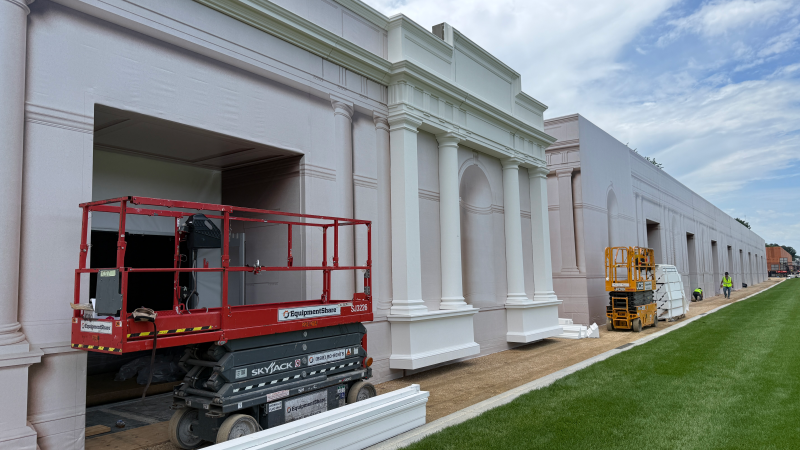
The fair’s layout will include large white tents adorned with neo-classical columns, housing dozens of state exhibits. Additionally, a scaled-down version of Trump’s proposed 250-foot “triumphal arch” and an 110-foot Ferris wheel will be part of the attractions. The group has also outlined plans for movie screenings, musical performances, and military flyovers, positioning the fair as a multifaceted celebration of national identity.
Controversies and Concerns
The event has not been without controversy. Earlier this month, the fair had to cancel its opening concert after several artists withdrew their support. This decision followed backlash over the administration’s involvement in other 250th-anniversary events, such as the UFC match held at the White House. Critics, including Democrats, argue that the government should prioritize cost reduction efforts rather than hosting high-profile, partisan events.
Despite these criticisms, Freedom 250 remains confident in its approach. A spokesperson noted that the fair’s activities are part of a larger initiative to honor the nation’s legacy. “Every state’s story will be told in a way that’s authentic to its people, history, and culture,” they said, emphasizing that participation could come from a variety of state entities, including tourism boards or local organizations.
Some states, like North Carolina, have faced challenges in their participation. A representative from the North Carolina 250 planning team mentioned that the state was invited “but due to the expenditures required to participate, the state is unable to fully commit.” This highlights the financial burden on states, which are expected to fund their own pavilion decorations while relying on Freedom 250 for infrastructure and event coordination.
State-Specific Attractions
The fair’s planned attractions reflect the distinct identities of each participating state. For example, Arizona’s pavilion will immerse visitors in the natural beauty of Antelope Canyon, with detailed recreations of its wave-like rock formations. In Michigan, attendees will witness a mechanical milking cow, a playful tribute to the state’s farming traditions. Minnesota’s offering, a pond filled with scaled-down Common Loons, aims to engage visitors with a blend of nature and local culture.
Wyoming’s exhibit, perhaps the most innovative, will let participants experience the state’s rodeo heritage through augmented reality. Courtny Hinds, the general manager of the Wyoming State Fair and lead for the state’s pavilion, described the event as a once-in-a-lifetime opportunity. “Every single state kind of has their own pieces of their identity, so whoever our neighbors will be, we’re excited to make friends with them and the rest of states and territories too,” she said.
While the fair’s organizers stress its inclusive nature, the absence of key states like Oregon, Washington, and North Carolina has sparked debate. Critics argue that the event’s focus on Trump’s vision may overshadow the collaborative spirit the 250th anniversary is meant to embody. Nevertheless, Freedom 250 continues to promote the fair as a unifying celebration, blending American history with modern entertainment.
As the event approaches, the Trump administration faces pressure to balance its political messaging with the broader goal of honoring national heritage. The fair’s success will depend not only on its ability to showcase state diversity but also on its capacity to address concerns about partisanship and cost. With the National Mall set to become a hub of American culture, the question remains: will Trump’s influence shape the event into a symbolic political showcase or a genuine celebration of unity?