Protesters set vehicles and homes on fire as violence flares over knife attack in Northern Ireland

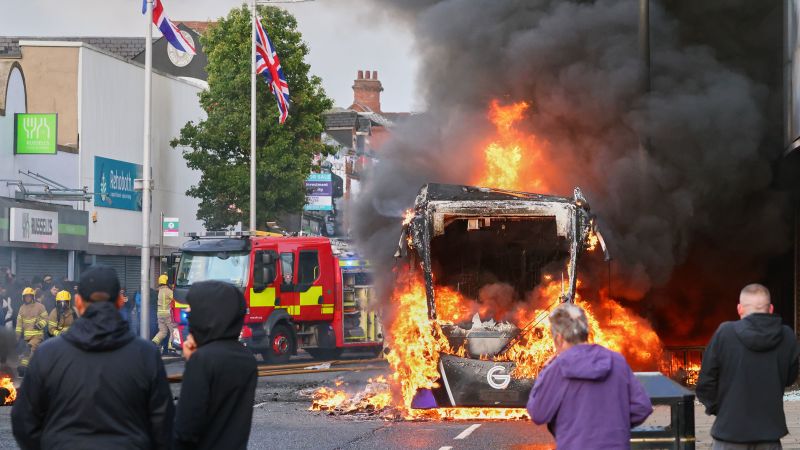
Violence Escalates in Northern Ireland After Knife Attack
Protesters set vehicles and homes on fire – Following a violent knife assault in Belfast that left one man hospitalized with severe injuries, tensions in Northern Ireland have intensified, prompting widespread protests and acts of arson. A 30-year-old Sudanese man was charged with attempted murder on Tuesday, a decision that has sparked outrage and demonstrations across the region. UK Prime Minister Keir Starmer described the incident as “horrific” and “sickening,” emphasizing its impact on public safety and the broader political landscape.
Residents Take to the Streets in Outrage
On Tuesday evening, masked crowds gathered in Belfast, igniting fires that spread to homes, a public bus, vehicles, and barricades. According to geolocated video footage shared by CNN, similar unrest unfolded in Newtown Abbey and Kilkeel, where two and one cars, respectively, were set ablaze. The footage captures dramatic scenes of flames consuming properties and emergency services rushing to contain the chaos, with firefighters and bystanders working to stabilize the situation.
“Groups of masked individuals are burning families out of their homes, creating outright scenes of thuggery,” stated Northern Ireland First Minister Michelle O’Neill. The statement, posted on X, criticized the violence as an attempt to exploit the attack for political gain, while condemning racism and intimidation as unacceptable behaviors.
The attack, which occurred on Monday night in northern Belfast, was captured on video by a witness. The footage shows a man pinning another to the ground, with the victim’s head covered in blood, before bystanders and police officers intervene. The video has since gone viral on social media, amplifying public concern and fueling debate about the incident’s broader implications. Starmer, who has been vocal about maintaining order, called for unity and reassurance that the attack was not part of a larger terrorist strategy.
Political Reactions and Calls for Calm
While Northern Ireland’s Assistant Chief Constable Ryan Henderson clarified that there is currently no evidence linking the attack to terrorism, he noted that the investigation is still in its early stages. The suspect, who holds legal residency in the region, has not been connected to any extremist groups, according to police statements. Meanwhile, Police Chief Constable Jon Boutcher urged citizens to remain composed, emphasizing that protests should be conducted peacefully and responsibly.
“The attack in North Belfast was heinous and wrong. But there are dangerous attempts to exploit that to target and attack innocent people who are simply trying to live, work and raise their families here,” O’Neill reiterated. She further stressed that “racism, intimidation and violence are wrong wherever they occur,” highlighting the need for accountability in the face of unrest.
Additional protests have emerged in other parts of the UK, including Bangor, Glasgow, and London. Far-right demonstrators in these cities confronted law enforcement and chanted anti-immigration slogans, drawing attention to the growing divide in public opinion. Starmer, however, dismissed these protests as part of a broader effort to undermine democratic processes, particularly after far-right figures linked the Belfast incident to mass migration.
Historical Context of Racial Tensions
The current turmoil follows a pattern of racial unrest seen in Northern Ireland a year ago. In Ballymena, several nights of violent demonstrations erupted after two Romanian teenagers were accused of sexually assaulting a local girl. All charges against the pair were ultimately dropped, yet the incident left lasting scars on the community and fueled fears of targeted violence. This history has resurfaced as the Belfast attack continues to stir debates about race, identity, and the role of political rhetoric in escalating tensions.
Starmer’s recent criticism of far-right groups aligns with his broader stance on protecting democratic institutions. Last week, the release of bodycam footage showing the death of White student Henry Nowak, who was fatally stabbed and handcuffed by police in December, sparked national controversy. Critics accused law enforcement of excessive force, while far-right leaders were blamed for using the incident to stoke racist sentiments and political agendas. Starmer reiterated his stance, calling for swift action to address the root causes of such violence.
Authorities Address the Spread of Disorder
Police confirmed that isolated instances of chaos have occurred throughout Northern Ireland, with some vehicles and properties damaged in the wake of the attack. While the situation remains under control, officials warn against the potential for further escalation if protesters continue to act recklessly. “We must not let those who know little about Northern Ireland influence the behaviors of our people from afar,” said Boutcher, urging the public to stay informed and act with responsibility.
“There is no place for masked thugs to take to the streets and threaten, intimidate, disrupt, and cause wanton damage,” stated Justice Minister Naomi Long. “It is simply disingenuous to claim this is being carried out for the good of Northern Ireland.” She emphasized that while concerns over the attack are valid, hate-driven actions cannot be justified under the guise of protection.
As the investigation continues, authorities are working to determine whether the knife attack was a targeted act or a random incident. The suspect’s legal status in Northern Ireland adds another layer to the debate, with some arguing that the attack reflects broader societal tensions rather than a specific act of terrorism. Meanwhile, the viral footage of the attack has become a focal point for discussions on public safety, racial profiling, and the power of social media to shape protests.
With the political climate already volatile, the Belfast incident has reignited conversations about how to balance justice, security, and community trust. As tensions simmer, residents and officials alike are called upon to reflect on the role of media, historical grievances, and the urgency of addressing the root causes of the unrest. The challenge remains to ensure that the anger over the attack does not devolve into a broader campaign of violence and scapegoating, as the First Minister and other leaders warn against the dangers of allowing fear to dictate public behavior.
Ultimately, the events in Belfast serve as a reminder of the complex interplay between local issues and national politics. While the immediate focus is on the suspect and the victim, the broader implications of the attack continue to shape the discourse on safety, identity, and the state of unity in the UK. As the situation unfolds, the public will be watching closely to see how these tensions are managed and whether the voices of those affected are heard in the process.