Tricycle ambulances are saving lives in Ghana

Tricycle Ambulances Are Saving Lives in Ghana
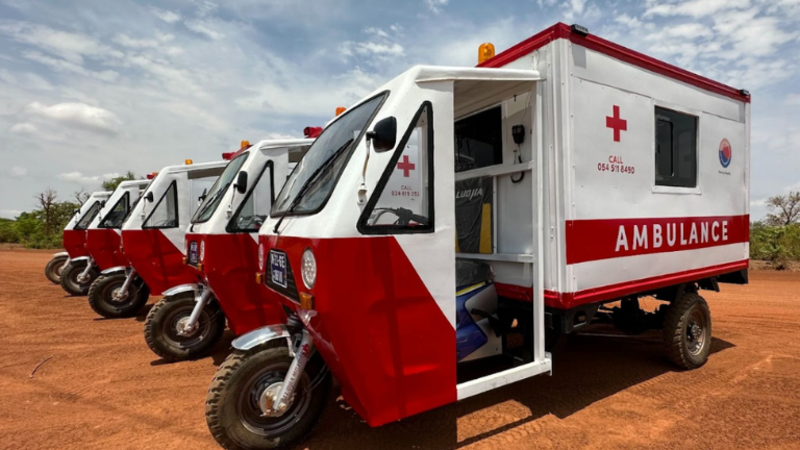
Tricycle ambulances are saving lives in Ghana – In the heart of Ghana’s Upper West Region, where roads twist through dense forests and villages are often separated by miles of dirt, a simple yet revolutionary solution has emerged. For years, expectant mothers in remote areas faced a dire challenge: the time it took to reach a hospital for emergencies could be fatal. Now, a fleet of motorized tricycles, transformed into mobile health units, is bridging the gap between life and death. These vehicles, known as tricycle ambulances, are designed by Moving Health, a nonprofit organization dedicated to reducing maternal mortality in the country. Their impact is profound, offering hope where traditional transport once failed.
A Mother’s Crisis
Billeh Rosemount, a 24-year-old farmer from a rural community, recounted her harrowing experience in October 2024. She was bleeding heavily during a miscarriage, and the midwife at her local clinic had no means to stabilize her condition. “I was in extreme pain and feared for my life,” she said. The nearest health facility required a long journey, but conventional ambulances were either too few or too slow to navigate the rugged terrain. Instead, Rosemount was carried by a tricycle ambulance, a vehicle that not only reached her in time but also carried essential medical equipment. “Without this, the trip would have taken hours on a motorbike—maybe even days if no one was willing to help,” she added, emphasizing the critical role of the tricycle in her survival.
“I was bleeding and the midwife could not control the blood,” recalled Billeh Rosemount. “The journey, which usually takes two hours for rural communities, would have been on the back of a motorbike if my neighbor had lent one. You have to go and beg for somebody to get the vehicle… It was very, very, very difficult for us.”
Designing a Solution
Moving Health’s tricycle ambulances are engineered to tackle the unique challenges of Ghana’s rural landscape. By adapting motorcycle engines to create compact, robust vehicles, the nonprofit has developed a transport system that operates on narrow, uneven paths where standard ambulances struggle. Each tricycle ambulance is equipped with a full-length stretcher, space for a family member, and medical tools including oxygen concentrators and emergency birthing kits. These features make them ideal for carrying patients during critical moments, such as childbirth complications or severe bleeding.
According to the World Health Organization, Sub-Saharan Africa accounted for approximately 70% of global maternal deaths in 2023. While Ghana’s maternal mortality rate has seen a gradual decline, it remains significantly higher than in the United States, with 234 deaths per 100,000 live births compared to just 17 in the U.S. The disparity is stark, especially in rural regions where access to healthcare facilities is limited. For many, the distance to a hospital is a life-threatening obstacle, as delays in treatment can lead to preventable deaths.
The Initiative’s Journey
Moving Health’s mission began as a student project at MIT in 2016, where the idea was conceived by Emily Young, its CEO and co-founder. The concept evolved from a simple observation: rural communities lacked reliable transport for emergencies. By 2019, the organization had established permanent operations in Ghana, focusing on the Upper West Region. Since then, they have expanded their reach, deploying a network of tricycle ambulances across five districts. These vehicles now serve over 230,000 people, providing care in areas where the National Ambulance Service struggles to cover demand.
In 2020, a local news outlet highlighted the scarcity of conventional ambulances, noting that only 55 operated across the entire country. By 2024, this number had grown to 356, but the demand in remote areas remained unmet. “Most of these deaths occur in rural regions because of the distance,” said Young, underscoring the importance of localized solutions. Tricycle ambulances, she explained, are not just a cost-effective alternative—they are a lifeline for communities where waiting hours for a conventional ambulance could mean losing a mother or child.
A Life-Saving Innovation
Isaac Quansah, Moving Health’s chief technology officer and country director, experienced the urgency of this problem firsthand after his wife suffered postnatal complications. Unable to find an ambulance, he drove her to the hospital in a small car, forcing her to sit upright in excruciating pain. “When I design an ambulance, I know I have a reason,” he told CNN. “A life-fulfilling purpose for me to help other mothers not go through what my wife went through.” This personal struggle became the catalyst for the organization’s approach, blending engineering with community-driven care.
The tricycle ambulances are maintained and upgraded annually based on feedback from local health workers. For example, early designs struggled with the reality that women often give birth during transit, sometimes at night. This led to adjustments in the vehicle’s layout to accommodate both the patient and the midwife, ensuring safety and efficiency. The process of upgrading involves collaboration with engineers and health professionals, ensuring the vehicles remain adaptable to the needs of those they serve.
Community Empowerment
Moving Health’s model is not just about providing transportation—it’s about empowering local communities. The nonprofit trains engineers and health workers to assemble, maintain, and operate the tricycle ambulances, fostering a sense of ownership and responsibility. This approach ensures sustainability, as the vehicles are tailored to the specific challenges of each region. “Proximity is important when cell connection is unreliable,” explained Quansah. “We need to make sure the ambulances are accessible, even if the signal is weak.”
The tricycle ambulances are stationed at community clinics, which serve as hubs for emergency dispatch. Patients can reach these clinics via a hotline or by bike messenger if necessary. This decentralized model allows for rapid response, as the vehicles are often just a short distance from where they’re needed. The cost of manufacturing is also a key factor: Moving Health claims their tricycles are priced at one-tenth of conventional ambulances, making them an affordable option for rural healthcare systems.
“Sometimes the biggest barrier to surviving a medical emergency isn’t the lack of hospitals,” said Emily Young. “It’s being able to get there in time.”
Since their launch, the tricycle ambulances have significantly reduced transport time for patients. Moving Health reports a 64% decrease in the average travel duration to hospitals for rural communities, a statistic that underscores the effectiveness of their approach. For families like Rosemount’s, this means the difference between survival and tragedy. The organization continues to innovate, with each new ambulance designed to address evolving needs and improve outcomes for mothers and children alike.
The success of this initiative highlights the potential of combining local knowledge with global resources. By focusing on the specific challenges of Ghana’s rural areas, Moving Health has created a model that could inspire similar efforts worldwide. As the country’s maternal mortality rate continues to drop, the tricycle ambulance remains a symbol of resilience and ingenuity, proving that even in the most remote corners of the world, access to life-saving care is possible.