
Kim Jong Un inspects new nuclear plant, plans ‘exponential’ weapons production ramp-up
Kim Jong Un Inspects New Nuclear Plant, Plans ‘Exponential’ Weapons Production Ramp-Up
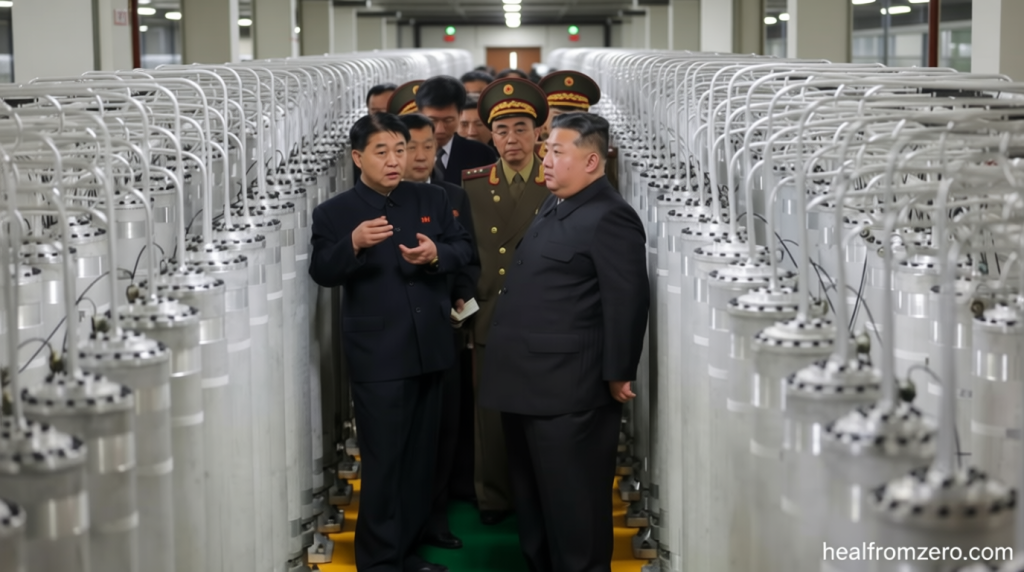
Kim Jong Un inspects new nuclear – North Korean leader Kim Jong Un visited a newly constructed facility on Wednesday designed for the production of weapons-grade nuclear material, according to a report by state-run media. The visit was accompanied by statements indicating that Pyongyang aims to significantly enhance its nuclear capabilities, with the new plant expected to contribute to this goal. The Korean Central News Agency (KCNA) highlighted that the country’s nuclear production capacity has increased more than double in the last five years, positioning the facility as a key component in strengthening the nation’s nuclear deterrence.
Shift in Nuclear Strategy
The recent inspection signals a strategic pivot for North Korea, moving focus from research and development to large-scale production. Kim’s remarks suggest a commitment to accelerating the development of nuclear weapons, emphasizing the country’s ability to rapidly expand its arsenal. The leader’s comments, as reported by KCNA, reflect a broader vision of nuclear power, describing the nation’s capabilities as “inconceivable” and underscoring the importance of the new plant in achieving this ambition.
“Pyongyang plans to beef up our state’s nuclear forces at an exponential rate,” stated KCNA, citing Kim Jong Un’s declaration following his tour of the facility. The report also noted that the new plant employs “more sophisticated technology,” with images showing the leader interacting with rows of centrifuges.
The expansion of nuclear capacity comes amid ongoing geopolitical tensions, particularly as Washington seeks to conclude a months-long conflict with Iran. The US-Israeli standoff has been a focal point for diplomatic efforts, with the goal of securing Tehran’s agreement to relinquish nuclear materials that could be converted into weapons. North Korea’s nuclear advancements, however, are seen as a separate but significant development in the region.
Infrastructure and Monitoring
The International Atomic Energy Agency (IAEA) has been tracking North Korea’s nuclear infrastructure, noting that a new building at Yongbyon has been completed with infrastructure comparable to the Kangson enrichment facility. This facility, which includes power supply and cooling systems, is believed to be part of the country’s broader enrichment operations. The IAEA’s March report confirmed that North Korea operates at least two active enrichment plants, one in Yongbyon and another in Kangson, further supporting the claim of heightened production.
According to the Congressional Research Service, North Korea already possesses sufficient nuclear material to manufacture up to 90 warheads, with approximately 50 reportedly assembled. The new plant is expected to play a pivotal role in increasing this stockpile. Lt. Gen. James Adams, head of the Defense Intelligence Agency, testified in April that Pyongyang is likely constructing an additional uranium enrichment facility at Yongbyon, suggesting a coordinated push to scale up production capabilities.
Uncertainty Over Facility Location
While the KCNA report did not specify the location of the new plant, the images released show Kim inspecting a facility that appears to be in operation. This ambiguity has led to speculation about whether the site is the previously mentioned Yongbyon plant or a newly established location. Hong Min, a senior research fellow at the Korea Institute for National Unification, pointed out that the repeated publication of photos depicting Kim’s inspections of nuclear facilities underscores a deliberate effort to project readiness and operational maturity.
“The new facility reveals a maturation and scaling of North Korea’s nuclear program,” Hong Min explained. “The report gives the impression that the center of gravity has shifted from ‘research and production’ to ‘mass production and munitions’,” he added, noting the presence of officials from both the munitions industry and the Nuclear Weapons Institute during the inspection. By showcasing the control room, processing pipes, and module zone, North Korea is highlighting its completed infrastructure, according to Hong. This move aims to demonstrate the country’s capability to sustain a robust nuclear deterrent.
Context of Failed Denuclearization Talks
The surge in nuclear production follows the collapse of denuclearization negotiations with the United States. These talks, which included three meetings with former President Donald Trump during his first term, failed to achieve a breakthrough. Kim’s five-year plan, introduced after these talks ended in stalemate, has since driven the country’s focus on expanding its nuclear arsenal. The new plant is part of this initiative, which prioritizes rapid increases in nuclear material output.
Meanwhile, the US-Israeli conflict with Iran has intensified, with Washington attempting to negotiate a deal to halt Iran’s nuclear program. North Korea’s nuclear advancements, however, are not directly linked to this conflict but instead highlight the country’s independent push to bolster its strategic position. The IAEA’s monitoring of North Korea’s facilities has also provided insight into the progress of its nuclear program, with reports indicating that the new building at Yongbyon is fully operational.
Global Nuclear Trends
North Korea’s nuclear expansion aligns with a global trend of nations prioritizing arms production. The 2026 Annual Threat Assessment from the Office of the US Director of National Intelligence noted that North Korea has successfully tested intercontinental ballistic missiles (ICBM) capable of reaching any part of the United States. This capability has been cited as a key concern in international security discussions, with critics arguing that Trump’s administration has shifted focus from preventing Iran’s nuclear ambitions to addressing North Korea’s own growing arsenal.
Operation Epic Fury, a Trump-led initiative aimed at curbing Iran’s nuclear program, is now seen as a secondary effort compared to the ongoing challenges posed by North Korea. Critics of Trump’s policies point out that his first term saw the termination of an Obama-era agreement designed to monitor Iran’s enrichment activities. The current diplomatic push with Iran, following a months-long war, is considered a continuation of this strategy, though its effectiveness remains uncertain.
As North Korea continues to advance its nuclear capabilities, the implications for regional and global security are significant. The country’s ability to produce weapons-grade material at an accelerated pace underscores its commitment to maintaining a strong deterrent. This development not only reinforces North Korea’s strategic posture but also serves as a reminder of the persistent challenges in containing nuclear proliferation across the world.