
US Marine Corps retires the first fighter jet that didn’t need a runway
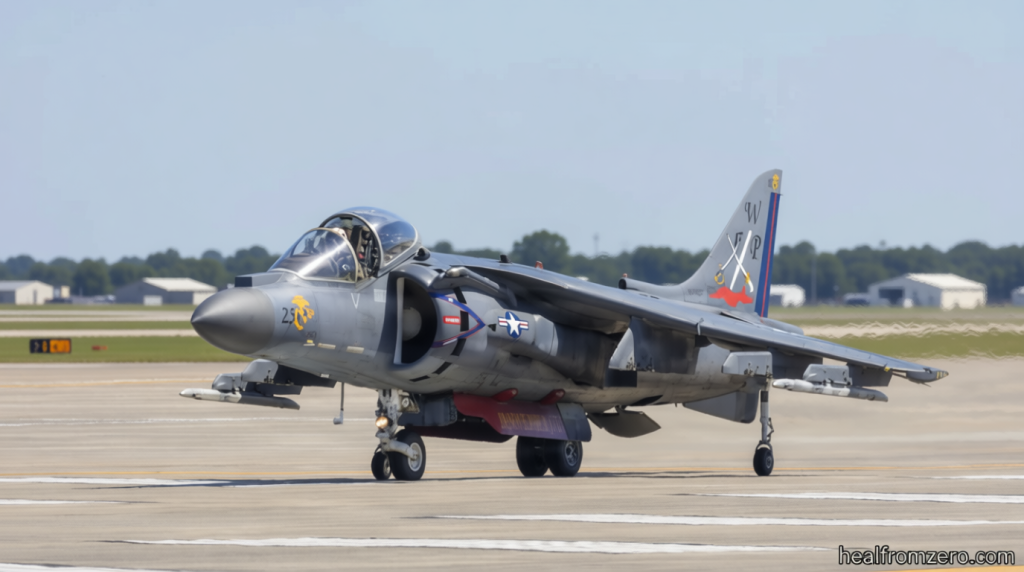
US Marine Corps Retires the First Fighter Jet That Didn’t Need a Runway
US Marine Corps retires the first – The United States Marine Corps has marked the end of an era with the retirement of the AV-8B Harrier II, a revolutionary vertical takeoff and landing (V/STOL) aircraft that served for 55 years. The last operational unit of this iconic jet was honored at a farewell ceremony held on Wednesday at Marine Corps Air Station Cherry Point in North Carolina, drawing a crowd of approximately 5,000 spectators. The event celebrated the Harrier’s legacy as a versatile combat asset and its unique ability to operate in environments where traditional runways were unavailable.
A Legacy of Innovation and Flexibility
The Harrier’s design, which allowed it to take off and land vertically, redefined military aviation. During the ceremony, Lt. Col. John B. Cumbie, commanding officer of Marine Attack Squadron 223, highlighted the jet’s contributions to global operations. “The Harrier’s combat legacy, its V/STOL capabilities, and the service members who flew it will be remembered for decades,” he said. This adaptability made the Harrier a favorite among air show enthusiasts and a critical tool for rapid deployment in diverse theaters of war.
The Harrier’s powerplant, a single turbofan engine, was a key element of its design. By directing thrust through four nozzles that could pivot between horizontal and vertical positions, the jet could hover and maneuver in tight spaces. This feature enabled its operation from amphibious assault ships and unprepared landing sites, giving the Marines a strategic advantage. Unlike conventional fighters, which required extensive airfields, the Harrier could respond to threats with minimal infrastructure, a capability that proved invaluable during conflicts.
Aircraft in Action: From Iraq to the Caribbean
The Harrier’s service history is as varied as its operational roles. It saw action in numerous conflicts, including Operations Desert Shield and Desert Storm in the 1990s, where US General Norman Schwarzkopf hailed it as one of the seven most critical weapons of the campaign. The jets also participated in the NATO-led campaign against the former Yugoslavia, the wars in Afghanistan and Iraq, the 2011 Libya intervention, and counter-ISIS operations in the Middle East. Recently, they were deployed in the Caribbean Sea as part of a US naval force off the coast of Venezuela, supporting operations before the capture of Nicolás Maduro in January.
Retired Marine Lt. Col. Mike Rountree, a former Harrier pilot, emphasized the jet’s simplicity and effectiveness. “The Harrier didn’t need an airfield. All it needed was a Marine flying it—and a few support crew to fuel it and arm it at makeshift landing sites,” he told Task & Purpose. This ability to operate in austere conditions made the Harrier a symbol of Marine Corps ingenuity and readiness. Its versatility was further demonstrated by its use in both air superiority and ground-attack roles, showcasing a range of capabilities that few other aircraft could match.
Pop Culture and Controversial Promotions
Beyond its military prowess, the Harrier holds a unique place in pop culture. It once became the subject of a high-profile Pepsi promotion in the 1990s, which featured the jet as a prize for accumulating millions of points through soda consumption. The campaign, which aired during the Super Bowl, allowed participants to earn Pepsi Points by drinking products, with the option to purchase additional points for 10 cents each. John Leonard, a 21-year-old business student at the time, discovered that he could secure a Harrier for just $700,000 by leveraging this system. Despite his efforts, Pepsi declined the deal, and although Leonard sued the company, the court ruled against his claim.
“The Harrier didn’t need an airfield. All it needed was a Marine flying it—and a few support crew to fuel it and arm it at makeshift landing sites,” retired Marine Lt. Col. Mike Rountree said.
Leonard’s story, while humorous, underscores the Harrier’s symbolic appeal. The jet’s image as a high-tech, agile aircraft captured the public imagination, making it a standout in military advertising. Its retirement now marks the end of a chapter that intertwined military utility with cultural significance.
Replacement by the F-35B and a New Era
The Harrier is being phased out in favor of the F-35B Lightning II, the next-generation V/STOL stealth fighter. Each F-35B costs around $110 million, a significant increase from the Harrier’s $23.6 million price tag in the 1990s. Adjusted for inflation, the Harrier’s cost would be approximately $50 million today, yet its operational impact far exceeded its financial investment.
The F-35B has already begun replacing the Harrier in the US military, with deployments on the USS Tripoli as part of the ongoing conflict with Iran. However, the Harrier’s retirement does not signify its complete disappearance from service. Italy and Spain continue to operate the aircraft, using them from smaller amphibious ships. For those who cannot see it in action, the remaining Harriers will be displayed in aviation museums, ensuring their story is preserved for future generations.
Historical Evolution and Technological Milestones
The AV-8B Harrier II is the second iteration of the jump jet, following the AV-8A, which was developed by Britain’s Hawker Siddeley in the 1960s. The US Marines adopted the AV-8A in 1971, but it was the upgraded AV-8B, introduced by McDonnell Douglas in 1985, that became the workhorse of the fleet. This evolution marked a significant leap in performance and durability, allowing the Harrier to remain relevant for over four decades.
Despite its retirement, the Harrier’s influence on aviation technology persists. Its ability to operate in confined spaces and its modular weapon systems set a precedent for future V/STOL aircraft. The Wings Over the Rockies aviation museum notes that the Har