Robots are redefining the war in Ukraine – and forcing Russia onto the back foot

Robots are redefining the war in Ukraine – and forcing Russia onto the back foot
Robots are redefining the war in Ukraine – In the heart of eastern Ukraine, a new kind of warfare is unfolding. A drone hums overhead, its camera capturing the scene, while a robotic unit inches forward, unburdened by the physical toll of combat. The sound of a blast echoes, but the operators remain safely stationed in a control room, their focus on screens rather than the chaos of the battlefield. This is the reality of modern warfare, where Ukraine’s use of unmanned systems has shifted the dynamics against Russia. The battle for Avdiivka and Bakhmut, once scenes of brutal, close-quarters fighting, now serve as testbeds for a new strategy: one that relies less on human presence and more on technology’s precision.
The Rise of Unmanned Warfare
The Ukrainian military’s transformation into a tech-driven force has been driven by necessity. Months of manpower shortages, compounded by uncertain U.S. support, have pushed Kyiv to innovate rapidly. Robots, drones, and remote-controlled tanks now play a critical role, allowing the country to execute missions with fewer casualties and greater efficiency. According to President Volodymyr Zelensky, the first Russian position was captured entirely by automated systems, marking a pivotal moment in the conflict. Since January, these unmanned units have completed over 22,000 operations, a testament to their growing importance in the war effort.
Survival has been the catalyst for Ukraine’s technological leap. Operators in control hubs, illuminated by the glow of computer fans and subtle lighting, have learned to outmaneuver Russian forces through ingenuity. The term “silent death” has emerged as a chilling descriptor for these machines, which deliver explosive payloads with eerie precision. As one Ukrainian commander noted, the robots can only be heard at 10 meters—well within their destructive range. This stealth has allowed them to infiltrate enemy lines undetected, bypassing the need for costly human interventions.
A Shift in Combat Strategy
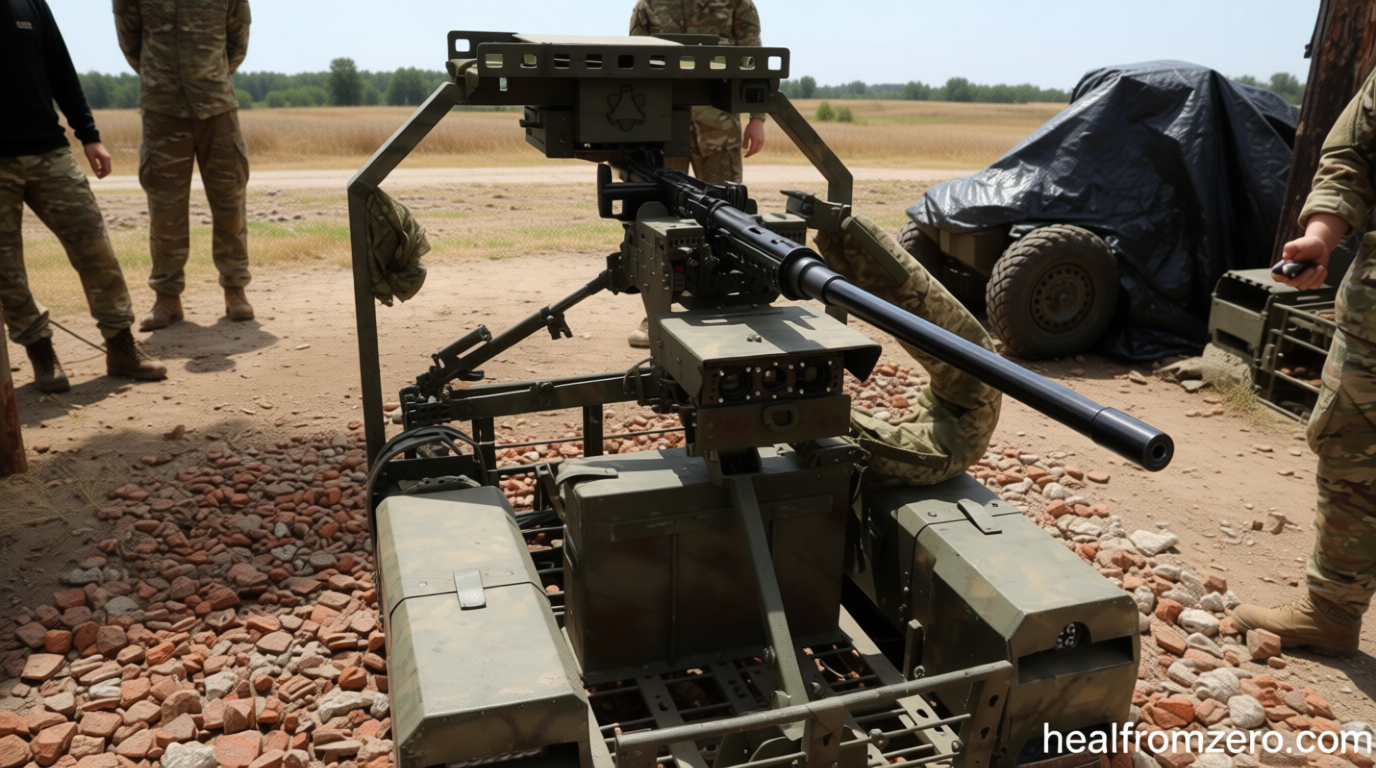
For the Third Assault Brigade’s “NC13” unit, the strategic advantage is clear. In 164 assaults, they calculated that a force of 2,300 soldiers would have been required to achieve the same effect as their robotic counterparts. Now, they rely on a fleet of machines to accomplish the mission, with operators monitoring progress through live streams. The first robot stumbles over debris, its wheels struggling for traction, before navigating a crater with calculated ease. From above, an observation drone captures the moment a mushroom cloud erupts—a visual reminder of the power unleashed by these machines.
The assault’s initial strikes are designed to draw attention, creating a window for four additional robots to flank the Russian positions. This coordinated approach highlights the adaptability of Ukraine’s forces, who have embraced technology to counter a weary and overstretched enemy. As Bar, the unit’s deputy commander, reflected on his past experiences in Donbas, he admitted,
“I couldn’t even imagine such a thing, back then. But I realize that if such equipment had been available at the time… more of my comrades would have survived.”
The shift from traditional combat to remote operations has redefined what it means to be a frontline soldier.
The Human Element Behind the Machines
While the robots carry out the attacks, the minds behind them remain central to the strategy. Gora, a 22-year-old embedded hardware and software engineer, exemplifies this new generation of warfighters. She quickly corrects her title when asked, insisting,
“I am an embedded hardware and software engineer,”
as she links the control hub to a body shop where the machines are repaired and assembled. Gora’s journey began in early 2022, when the war’s relentless drone strikes kept her awake in Kyiv. Her expertise in IT became her frontline, a role she embraced with determination.
“The key is not the vehicles, the key is minds and how they plan it,” she explains. “It’s about connecting communication between vehicles, between operators.” This emphasis on human ingenuity underscores the challenges of operating in an increasingly automated environment. Operators must balance technical precision with real-time decision-making, adapting to evolving threats as quickly as the machines themselves. When a drone named Salamander 6 is spoofed, the team scrambles to recalibrate its course, demonstrating the fluid nature of this new battlefield.
A Strategic Toll on Russia
Ukraine’s focus on unmanned systems has not only transformed its tactics but also its strategic goals. The country now aims to inflict 35,000 Russian casualties monthly, a target designed to pressure Moscow into recruiting from urban centers and the middle classes. This approach has already begun to take effect, as evidenced by the British spy agency GCHQ’s recent report placing the total Russian death toll at 500,000. The numbers are a stark reminder of the scale of the impact, with technology playing a decisive role in altering the course of the war.
For Mykola “Makar” Zinkevich, the commander of the NC13 unit, this new era feels less like progress and more like a loss of the war’s human essence. “Back then, war was somehow more, shall we say, masculine,” he says. “It was your skills that mattered there—how well you’d trained, how disciplined you were, and so on. Now, technology decides everything. There is no going back.” His words reflect a growing unease among veterans, who once relied on instinct and courage in the face of enemy fire, now watching from monitors as machines carry out the dangerous work.
Yet, for many Ukrainians, this evolution is a necessary trade-off. The cost of human lives has been immense, with four years of invasion claiming an estimated 500,000 Russian casualties. The robots, though silent and distant, have become lifelines, enabling missions that would have been impossible without them. As the war continues to reshape itself, the question remains: can Russia adapt to this new reality, or will it be left struggling to regain the initiative?
With the battlefield now a blend of human strategy and machine execution, Ukraine’s success hinges on its ability to innovate faster than its adversaries. The robots may lack the physical presence of soldiers, but their impact is undeniable. They have forced Russia into a defensive posture, with its forces stretched thin and its adaptability tested. In this new war, the margin between victory and defeat lies not just in weapons, but in the capacity to envision and execute a future where technology and human ingenuity collide.