Rescuers race to reach 7 villagers trapped for a week in flooded Laos cave

Rescuers Race to Reach Seven Villagers Trapped in Flooded Laos Cave
Rescuers race to reach 7 villagers – In a high-stakes operation, cave divers are maneuvering through submerged passages to locate seven villagers stranded underground in a Laos cave after nearly a week of being cut off from the surface. The group had ventured into the cave in the central Laotian province of Xaisomboun last Wednesday in search of gold, but heavy rainfall triggered sudden flooding, sealing off the exit and leaving them isolated, according to reports from Laos and Thai rescue teams.
International Divers Join the Effort
Two Thai divers and a Finnish expert, who had previously played a crucial role in the 2018 Thailand cave rescue of a soccer team, are now assisting in the current mission. The operation began on Monday, with the team navigating the treacherous terrain to reach the trapped villagers. State-run Lao News Agency confirmed that the men are believed to be on an elevated ledge within the cave, which maintains a steady flow of air, offering them some protection.
Cave Access Challenges
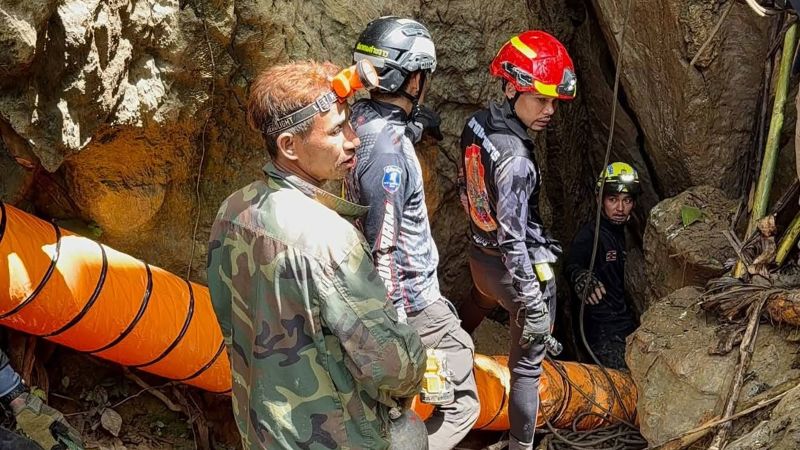
To access the stranded individuals, rescuers must traverse a 340-meter tunnel, as noted by the MTK Command and Control Center, which coordinates the operation. Some sections of the passage are only 60 centimeters wide, requiring divers to crawl on their stomachs to proceed. Images from the site show cables laid through a narrow gap between rocks, guiding the team to the lower parts of the cave.
Bongkawong, a seasoned Thai diver, described the natural entry point as a path that plunges downward at a 45-degree angle. “It is so narrow that you have to tilt sideways, duck low, and crawl flat on your stomach to get through,” he explained. The diver emphasized that entering and exiting the cave must be carefully coordinated, as there is no space for rescuers to cross one another.
Survival Conditions and Equipment
Rescuers are utilizing advanced gear, including breathing masks, gas monitors, and helmets, to assess oxygen levels and detect harmful gases within the narrow cave system. An ‘airline’ system is also being implemented to supply fresh air from the outside, ensuring the trapped group has a stable environment. Video footage shared on the Facebook page of a Thai rescuer showed divers moving through dark, waterlogged caverns, with efforts underway to pump water out of the tunnels to improve access.
Outside the cave, a rope team was dispatched on a rappelling mission to scan for possible routes to reach the villagers from four shafts identified on the mountain above the cave. The operation is unfolding in a mountainous region near Long Tieng, where the terrain is characterized by sweeping valleys and abundant mineral resources. Rescuers are relying on a detailed cave map, which Bongkawong said is highly accurate, to guide their efforts.
“That’s why I believe, given the geography and the living conditions of the victims, if they are in that specific area, their chances of survival are very high – very high,” he stated. The diver’s confidence stems from the cave’s unique features, such as the elevated ledge where the villagers are thought to be located. This area is said to benefit from continuous airflow, which may help sustain their survival.
Escape and Local Knowledge
Authorities were alerted to the situation by a member of the group who managed to escape before the exit was fully submerged. Bounkham Luanglath, head of Laos’ Rescue Volunteer for People, confirmed that the survivor exited by wading through the water, a technique only a local would know. “We call it ‘boo’ out,” Bongkawong said, revealing the local term for the action taken to escape.
The villagers frequently visit the site for gold deposits, despite repeated safety warnings from officials. Luanglath explained that the community’s reliance on the cave for mining highlights the tension between economic necessity and risk. The Southeast Asian country, a one-party communist state, closely monitors the release of information, which has led to a cautious approach in sharing details about the operation.
Historical Context and Operational Comparisons
The current mission echoes the 2018 rescue of 12 boys and their soccer coach in northern Thailand’s Chiang Rai province. At that time, a downpour flooded the tunnels, trapping the group for over two weeks. A massive international effort involving Australian, British, and U.S. divers saw the boys removed one by one through the cave network in a heroic operation that captured global attention.
Bongkawong, who participated in that effort, compared the two scenarios: “Tham Luang was difficult to search; this cave is difficult to access.” While the 2018 rescue focused on navigating the cave’s interior to locate the trapped individuals, the current challenge lies in reaching them through the tight, water-filled corridors. The unique geography of the Laos cave adds another layer of complexity, with its narrow passages and unpredictable water levels.
As the operation continues, rescuers are working tirelessly to locate the seven villagers. The success of the mission hinges on precise coordination, cutting-edge equipment, and the expertise of those involved. Despite the dangers, the team remains optimistic, citing the cave’s airflow and the survival conditions as key factors in the villagers’ chances of being found alive. The efforts underscore the critical role of international collaboration in high-risk rescue scenarios, especially in remote and challenging environments.