
From ‘ghost sharks’ to ‘death ball’ sponges: Scientists find more than 1,100 wild and unusual ocean species
From ‘ghost sharks’ to ‘death ball’ sponges: Scientists find more than 1,100 wild and unusual ocean species
From ghost sharks to death ball – Recent explorations of Earth’s oceans have unveiled a staggering array of previously unknown marine life, with over 1,100 species identified in the past year alone. This revelation, shared by the Ocean Census, a collaborative initiative led by Japan’s Nippon Foundation and the UK-based Nekton ocean research institute, highlights the ongoing efforts to chart the planet’s deep-sea biodiversity. The discovery of these new organisms includes some of the most enigmatic creatures ever documented, such as a worm that dwells within a glass sponge and a carnivorous sponge known for its deadly grip. These findings underscore the vast, unexplored depths of the ocean and the urgent need to protect its fragile ecosystems.
Uncovering the Deep Sea’s Secrets
The Ocean Census, a three-year-old global project, has expanded its catalog of marine life by 54% compared to previous annual reports. This growth reflects the intensifying focus on understanding the ocean’s hidden realms, where extreme conditions have long fostered unexpected biological diversity. For decades, scientists assumed that life in the deep sea was sparse, but recent decades have shown otherwise. The latest discoveries reveal a world teeming with organisms that challenge conventional notions of survival and adaptation, many of which possess traits so unique they defy classification.
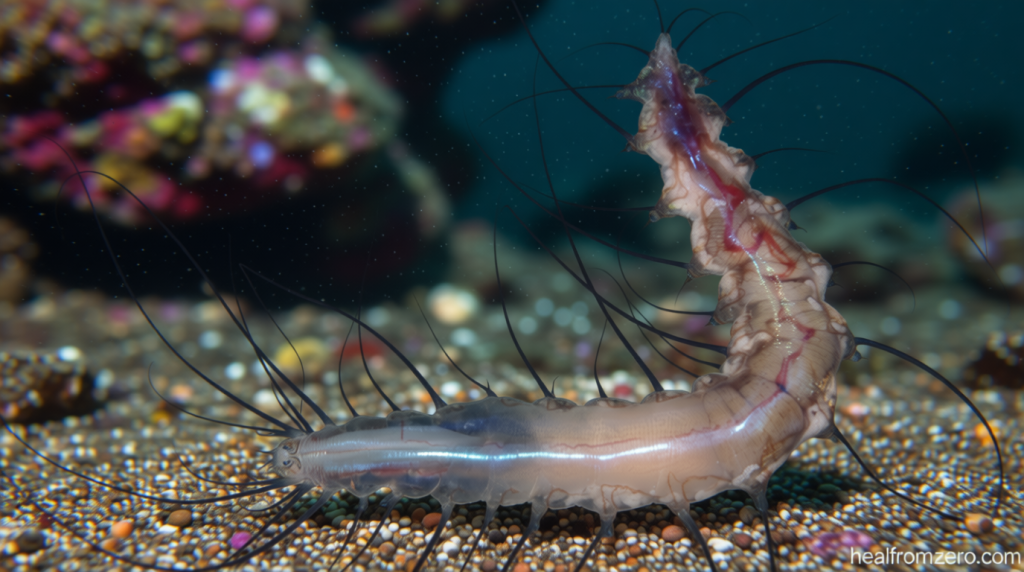
Among the newly documented species is a bristle polychaete worm, found nesting inside a glass sponge that resembles a delicate, lattice-like fortress. Known colloquially as a “glass castle,” this sponge is constructed from silica, the same material used in human-made glass. The symbiotic bond between the worm and its host is a marvel of evolutionary cooperation. The sponge provides shelter and a nutrient-rich environment, while the worm performs a critical role by removing harmful debris from the sponge’s surface. Such relationships illustrate the intricate web of life in the deep, where even the most isolated habitats can support complex ecosystems.
A World Beneath the Surface
Other remarkable finds include a ghost shark, or chimaera, discovered near the seafloor off Japan’s coast at a depth of 2,700 feet. These ancient fish, which split from their shark and ray relatives nearly 400 million years ago, possess translucent skin and a barb-like tail that aids in camouflage. Their discovery in the Pacific’s abyssal plains adds to the growing evidence that deep-sea environments are hotspots for biological innovation. In contrast, a tiny ribbon worm found in Timor-Leste is a striking example of both beauty and danger. Measuring just an inch in length, this creature sports vivid orange stripes that signal its potent chemical defenses, which have sparked interest in its potential medical applications.
The most fearsome addition to the list is the “death ball” sponge, identified in the South Sandwich Islands’ North Trench at depths approaching 12,000 feet. This carnivorous species uses microscopic velcro-like hooks to trap passing crustaceans, ensnaring them before consuming them whole. The sponge’s ability to thrive in such extreme conditions—where pressure is immense and light is absent—demonstrates the resilience of marine life. These examples, drawn from locations spanning the globe, paint a picture of an ocean that remains both a mystery and a treasure trove of undiscovered species.
Challenges and Opportunities
While these discoveries are thrilling, they come against a backdrop of mounting threats to marine ecosystems. Climate change has accelerated ocean warming, disrupting habitats and altering food chains. Meanwhile, human activities such as industrial and agricultural pollution continue to degrade water quality, while deep-sea mining initiatives threaten to extract resources from the same environments that harbor these newly identified species. The urgency of these challenges has intensified the race to document biodiversity before it is lost to irreversible change.
The Ocean Census aims to expedite the process of identifying and cataloging species by introducing a new classification status: “discovered.” This label allows researchers to record species immediately in an open-access database, streamlining the transition from initial observation to formal scientific recognition. According to a spokesperson for the initiative, this approach ensures that new species are quickly visible to both scientists and policymakers, fostering timely conservation strategies. However, the process of formally describing a species remains crucial, as it establishes the official scientific record needed for protection and policy implementation.
“The important thing is that scientists are continuing every year to make numerous interesting discoveries of species new to science throughout the global ocean at all depths,” said Tammy Horton, a research scientist at the UK’s National Oceanography Centre. Horton emphasized that while some species may initially appear novel, detailed analysis is often required to confirm their uniqueness. “Sometimes a species believed to be new to science turns out not to be after a thorough examination,” she noted. “But this is not a very common occurrence.” The formal description process involves rigorous validation, ensuring that each new species meets the criteria for classification and becomes a recognized part of marine biology.
Michelle Taylor, the Ocean Census’s head of science, echoed the urgency of these findings. “With many species at risk of disappearing before they are even documented, we are in a race against time to understand and protect ocean life,” she said. The organization’s 13 expeditions, conducted in some of the least explored regions, have yielded a wealth of data that highlights the ocean’s untapped potential. These expeditions have not only added to the species count but also provided insights into how marine life adapts to extreme environments, from the crushing pressures of the abyss to the icy depths of polar regions.
Preserving the Ocean’s Future
The Ocean Census is now calling for increased investment in marine research to sustain this momentum. The organization argues that the ocean holds immense ecological, scientific, and economic value, yet it remains one of the most under-studied ecosystems on the planet. By accelerating the identification process, scientists hope to create a more comprehensive understanding of marine biodiversity, which is essential for developing effective conservation policies. “We spend billions searching for,” Taylor added, “but the true cost of inaction is the loss of species we may never see again.”
These discoveries also have implications beyond the scientific community. For instance, the toxins produced by ribbon worms are being studied for their potential to treat neurological disorders such as Alzheimer’s and schizophrenia. Similarly, the unique adaptations of the ghost shark and the death ball sponge may inspire new technologies or medical breakthroughs. As the ocean continues to reveal its secrets, the interplay between scientific inquiry and conservation becomes more critical than ever. The 1,121 new species documented in the past year are not just fascinating in their own right—they represent a vital step in safeguarding the planet’s most mysterious and valuable habitat.
The rapid pace of discovery underscores the importance of international collaboration. The Ocean Census’s work, involving over 1,000 researchers from 85 countries, exemplifies how global partnerships can drive progress in marine science. Yet, the challenge of formalizing these findings remains significant. On average, it takes 13.5 years for a newly discovered species to be officially described, a delay that can leave many organisms vulnerable to habitat destruction. By recognizing the “discovered” status, the Ocean Census seeks to bridge this gap, allowing for quicker action to protect species that may have been overlooked in the rush of exploration.