
A free Iran is their shared dream. But the diaspora remains torn on the best path forward.
A Free Iran is Their Shared Dream. But the Diaspora Remains Torn on the Best Path Forward
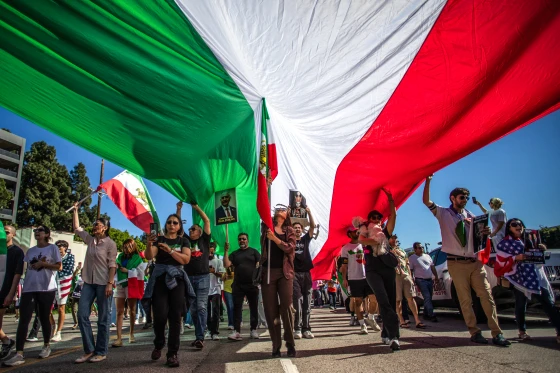
LOS ANGELES — In recent days, the Iranian diaspora in the U.S. has shown a stark divide. On one side, a group of Iranian Americans marched near City Hall, voicing opposition to a war that began without prior approval. They shouted slogans like “End the conflict in Iran” and “We the people reject war.” Just miles away, in Tehrangeles, another crowd of Iranians celebrated what they saw as a turning point for their homeland. They waved American, Israeli, and Iranian flags, danced to upbeat music, and cheered at the news of Ayatollah Ali Khamenei’s death during a U.S.-Israeli strike. This contrast highlights the growing tension within the Iranian diaspora as violence intensifies in the region.
For those who fled Iran after the 1979 Islamic Revolution, the theocratic regime has long been a source of resentment. Yet, even as families endure the fallout of escalating conflict, their views on the way forward remain sharply divided. “Some are so frustrated with the regime that they would support its downfall, even if it means collateral damage,” explained Abbas Milani, an Iranian studies expert at Stanford University. “Others want to replace it without sacrificing the country’s stability.” The split reflects a shift from earlier this year, when the diaspora was largely united in backing protests against the government’s harsh tactics.
“The images of destruction and the joyous support for war have created more friction than we’ve seen before,” Milani noted. “It will take time for this to settle.”
Debates online have grown fiercer since the attack. Supporters of military action are often called “Zionists,” a term that has gained new prominence following the Hamas strikes on Israel in October 2023. Meanwhile, those advocating for peace face accusations of favoring the current regime. Discussions about leadership have also intensified, with some favoring Reza Pahlavi, the son of Iran’s last monarch, and others skeptical of a return to monarchical ties.
As the death toll climbs and the government’s internet blackout isolates many from their loved ones, the mood in Tehrangeles is evolving. With Khamenei’s passing, speculation has emerged that his son, Mojtaba Khamenei, might succeed him. Analysts warn that the Islamic Revolutionary Guard Corps could consolidate its power if the conflict continues. Meanwhile, President Donald Trump has expressed interest in dismantling Iran’s leadership and replacing it with a “good leader.”
A recent NBC News poll revealed that 54% of potential voters disapprove of Trump’s military approach to Iran, echoing a similar divide among Iranian Americans. Last year, the National Iranian American Council (NIAC) and YouGov found 53% of Iranians in the U.S. opposed U.S. military strikes. A new poll is expected to provide updated insights. “We are not a single entity,” wrote the Iranian Diaspora Collective on Instagram, a platform with over 81,000 followers. “Diversity in thought is what makes a free society strong.”
Los Angeles-based pastor Ara Torosian, who left Iran in 2010, expressed sorrow over the destruction of historical sites and the loss of innocent lives, particularly children. Yet he argued that the suffering today surpasses generations of repression faced by dissidents. “When the Revolutionary Guard found Christian items in my Tehran home, I was imprisoned and beaten,” he recalled. “Now, seeing the chaos, I feel the pain is a necessary price for change.”