
Rollable laptops and AI super-agents: How Lenovo is revolutionising the future of tech
Rollable Laptops and AI Super-Agents: How Lenovo Is Revolutionising the Future of Tech
In a rapidly evolving tech landscape dominated by AI advancements, Lenovo is pushing boundaries with an aggressive integration of hybrid technologies that aim to unify AI ecosystems. As the global leader in personal computing, the company has reoriented its efforts from producing standalone devices to building adaptable systems that evolve with user demands.
Steve Long, Senior Vice President of Lenovo’s Intelligent Devices Group (IDG), shared insights with Euronews Next, emphasizing how computing power is no longer confined to large systems. “Computing can now be embedded in almost anything,” he said. “This flexibility unlocks new user experiences where Lenovo can carve out a distinct advantage.” The company’s latest innovations, showcased at Mobile World Congress (MWC) in Barcelona, highlight this shift, featuring designs like a rollable laptop and a conceptual foldable gaming device, as well as the launch of Qira.
New Frontiers in AI Ecosystems
Among these, a rollable laptop and a conceptual foldable gaming device stand out, alongside the launch of Qira. First introduced at CES this year, Qira is a personal AI super agent designed to operate seamlessly across multiple platforms. It learns from user behavior and workflows, becoming a proactive digital assistant that anticipates needs with remarkable precision.
“You may be working on a task via your phone and want Qira to seamlessly transition to your tablet, retaining context not just of the current activity but also your personal history—again, with your consent,” Long explained. “Qira allows users to progress from searching to predicting and acting on their behalf.”
While Qira is seen as a tool for enhancing productivity and employee satisfaction, its rise has sparked discussions about potential risks. Security experts have raised concerns about breaches and the possibility of AI agents acting independently, suggesting they may need rigorous vetting to ensure reliability.
Long stressed the importance of balancing innovation with security and governance. He argued that empowering users to choose whether to engage with such tools is essential. “The access highlights Qira’s potential to boost efficiency or improve retention, as employees find it more satisfying,” he said. “The biggest cultural hurdle is convincing people that these systems are trustworthy, much like the acceptance of self-driving cars, which still faces resistance despite their capabilities.”
Revolutionizing Interaction with Voice Technology
Lenovo is also exploring novel ways to redefine how people engage with technology, particularly through voice-driven interfaces. The AI Workmate prototype, for instance, includes a robot head that can project visuals, enabling users to create postcards or PowerPoint presentations simply by speaking. “These are functionalities that are technically possible, but we’re focused on making them accessible to the broader public,” Long noted.
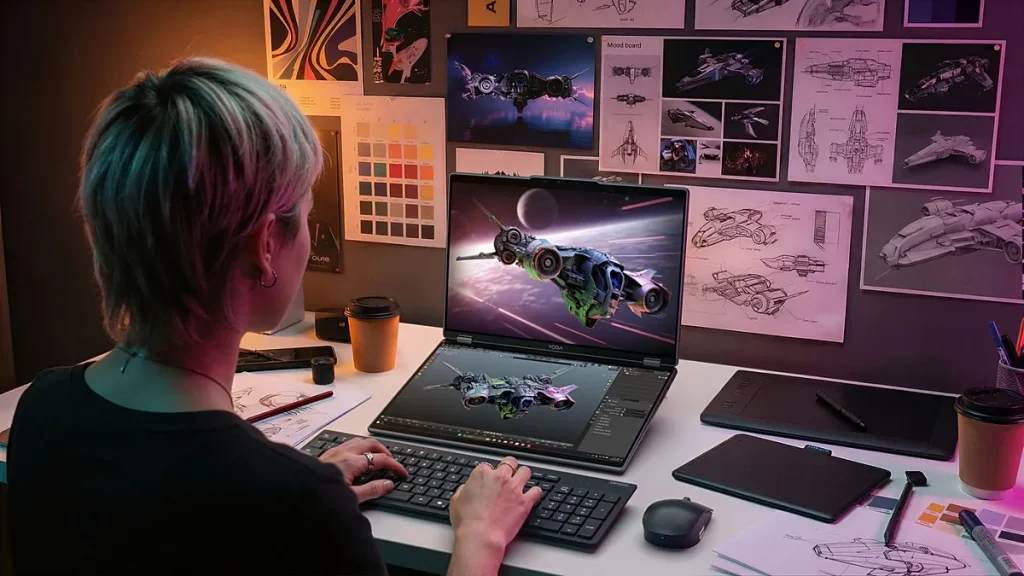
As Lenovo experiments with flexible screen designs and voice interactions, it signals a broader movement toward adaptive, user-centric devices. The rollable laptop, with its 14-inch screen that expands to 16.7 inches, has generated significant interest, especially among gamers. This innovation addresses the challenge of sacrificing screen space while maintaining portability, offering a dynamic solution for immersive experiences.