Saudi Arabia turns to Muslim military heavyweights in landmark defense pact as Iran war closes in

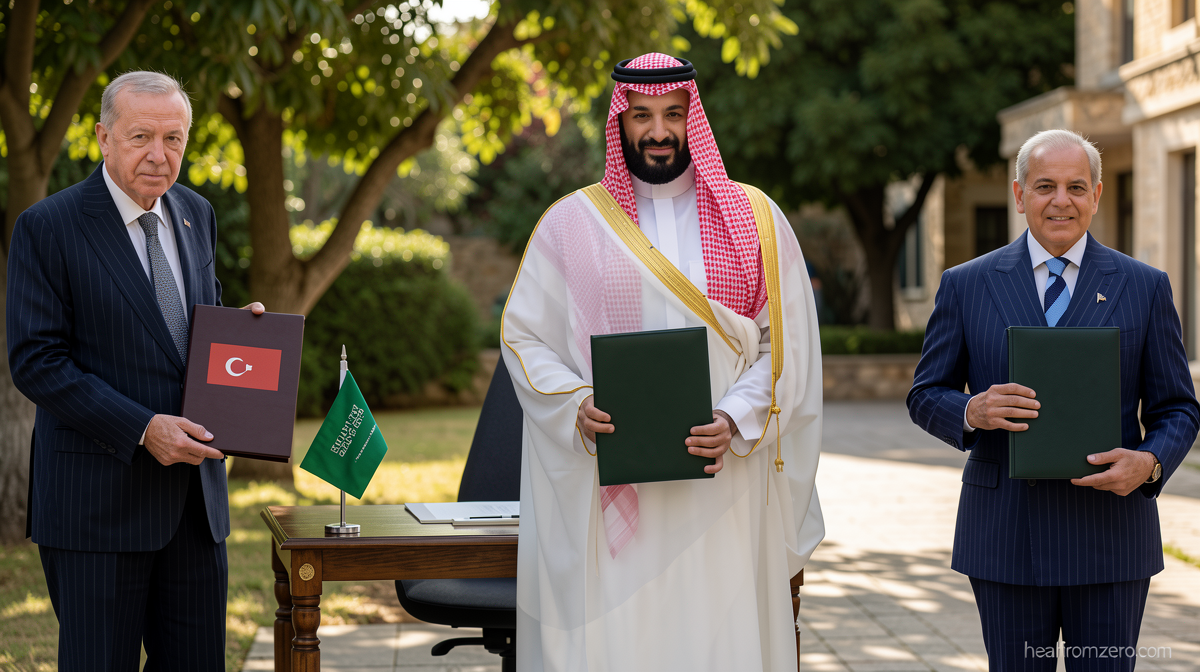
Saudi Arabia Turns to Muslim Military Powers in New Defense Pact
Healfromzero.com – Saudi Arabia turns to Muslim military allies in a landmark agreement that could reshape Middle Eastern security. The kingdom signed a comprehensive defense pact in Mecca on Friday with Turkey and Pakistan, creating a collective security framework similar to NATO’s Article 5. Under this arrangement, an attack on any one member automatically triggers a defensive response from all three nations.
This agreement comes as tensions with Iran escalate. Riyadh faces mounting pressure from multiple fronts and seeks additional security guarantees beyond its long-standing partnership with Washington. The new alliance unites Turkey, which maintains the second-largest armed forces in NATO, and Pakistan, the only Muslim nation with nuclear capabilities.
Building Regional Security Architecture
The pact’s stated purpose is strengthening collective deterrence against potential aggression. All three governments released a joint statement highlighting enhanced military cooperation across all dimensions. While specific commitments remain undefined, the framework could draw all signatories into conflict if one faces a major attack.
Regional analysts note this reflects growing uncertainty among Gulf states about American security guarantees. Saudi Arabia’s reliance on Washington has been a defense cornerstone, but recent years show increasing skepticism about whether the United States will prioritize Gulf interests during crises. The new alliance provides Riyadh with alternative security options.
Turkish officials characterize the agreement as non-targeted, emphasizing it does not create a sectarian bloc. The Saudi foreign ministry echoed this position, while a Turkish representative suggested additional regional countries could eventually join, potentially expanding the framework into a broader security architecture.
Strategic Geography and Timing
Both Pakistan and Turkey share direct borders with Iran, giving them substantial strategic interest in preventing regional conflict from escalating. Pakistan must balance its relationship with Tehran while managing its considerable Shiite population. Turkey and Iran, despite competing interests, share concerns regarding Kurdish separatist movements that could destabilize multiple countries.
The agreement’s timing coincides with several regional developments. Israel has expanded military operations across neighboring territories, while Saudi Arabia’s relationship with the United Arab Emirates has experienced notable strain. These factors contribute to a more complex security environment requiring multilateral cooperation.
During ongoing conflict, Iranian forces have repeatedly targeted Saudi infrastructure, including civilian facilities and energy installations. Although direct Iranian attacks diminished following an April 8 ceasefire, Iran-backed militias in Yemen and Iraq have continued campaigns against Saudi positions.
Clear Signals to Tehran
The Mecca agreement serves as a deterrent message to Iran. A Saudi official told CNN on Thursday that the kingdom anticipates a coordinated offensive by Iran-aligned militias in Iraq and Yemen, potentially backed by the Islamic Revolutionary Guard Corps. Simultaneously, Tehran has warned Gulf states that renewed American military action could provoke retaliatory strikes against regional energy and desalination infrastructure.
Should Iran launch another significant attack on Saudi territory, the new pact could automatically invoke Turkish and Pakistani military responses, potentially transforming a regional conflict into a much larger confrontation. This escalation risk represents a fundamental shift in Middle Eastern security calculations.
“The Saudis should understand that a paper agreement with Turkey and Pakistan will not bring them security, just as decades of one-sided dependence on the Americans failed to do so,” said Ebrahim Rezaei, a member of the Iranian parliament’s National Security and Foreign Policy Committee.
Frequently Asked Questions
What countries are part of the new defense pact?
The agreement includes Saudi Arabia, Turkey, and Pakistan, forming a collective defense framework in the Middle East.
How does this pact relate to NATO?
The agreement mirrors NATO’s Article 5 provisions, where an attack on one member triggers a response from all signatories.
What is the main purpose of this agreement?
The primary goal is strengthening collective deterrence against potential aggression, particularly from Iran and its allies.
Could other countries join this alliance?
Turkish officials have indicated that additional regional countries could eventually join the framework, potentially expanding it into a broader security architecture.
How does this affect Saudi Arabia’s relationship with the United States?
The pact provides Riyadh with alternative security options, though it does not replace its traditional partnership with Washington.